Wednesday Aug 05, 2026
Wednesday Aug 05, 2026
Wednesday, 4 February 2026 00:22 - - {{hitsCtrl.values.hits}}
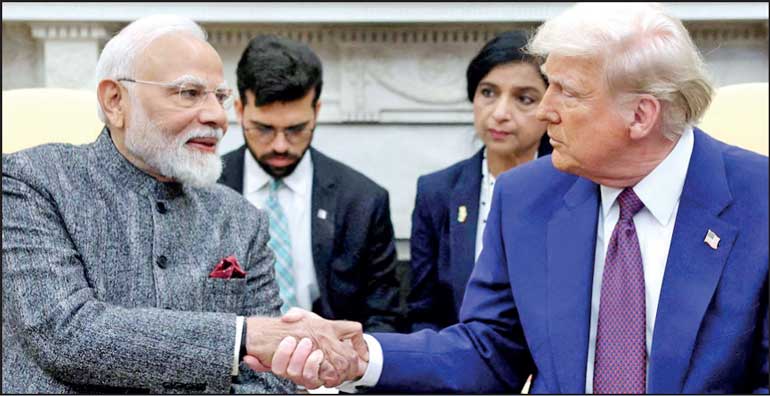
Indian Prime Minister Narendra Modi with US President Donald Trump
US President Donald Trump has said that Washington is lowering its tariffs on India to 18%, from the earlier 50%, following a trade deal struck between the two countries, bringing cheer for labour-intensive sectors–such as textiles, marine and leather–struggling with the levies so far.
“They will likewise move forward to reduce their tariffs and non-tariff barriers against the United States, to zero,” Trump posted on his social media platform Truth Social following a telephonic conversation with Modi.
But there is no clarity on India’s market opening commitments although the US farm lobby is already celebrating the access American farmers will get to “India’s massive market”.
“New US-India deal will export more American farm products to India’s massive market, lifting prices, and pumping cash into rural America,” said US agri secretary Brooke Rollins in a social media post.
Trump also said that India has agreed to stop Russian oil purchases and White House officials clarified that based on the promise, the 25% punitive tariffs on Indian goods for Russian oil purchases was being removed–bringing down tariffs on India to 18%.
“The Prime Minister (Modi) also committed to “BUY AMERICAN,” at a much higher level, in addition to over $ 500 billion of US energy, technology, agricultural, coal, and many other products,” Trump added.
The Indian Prime Minister responded to Trump’s announcement on social media platform `X’ thanking him for agreeing to reduce tariffs on Indian goods to 18%.
“Wonderful to speak with my dear friend President Trump today. Delighted that Made in India products will now have a reduced tariff of 18%. Big thanks to President Trump on behalf of the 1.4 billion people of India for this wonderful announcement,” Modi said.
The PM, however, did not mention a trade deal, or its contours, in his post. Nor did he confirm that India had agreed to stop Russian oil purchase and bring down tariffs and non-tariff barriers on American goods to zero.
Commerce and Industry Minister Piyush Goyal said in a social media post that India and US are natural allies and the partnership will co-create technologies, co-develop solutions, and work together for peace, growth, and a brighter future for India and US.
“This agreement unlocks unprecedented opportunities for farmers, MSMEs, entrepreneurs, and skilled workers to Make in India for the world, design in India for the world, and Innovate in India for the world. It will help India get technology from the US,” Goyal said.
External Affairs Minister S Jaishankar, who is currently on an official trip to the US, welcomed the announcements on bilateral trade. “This will create more jobs, spur growth and promote innovation in both economies. It will strengthen ‘Make in India’ endeavours and encourage trusted,” he said in a social media post.
Trump’s announcement that India would buy $ 500 billion worth of US goods is highly ambitious given the fact that India’s imports of goods from the US in FY25 was less than a tenth of that at about $ 45.69 billion.
“We spoke about many things, including trade, and ending the War with Russia and Ukraine. He agreed to stop buying Russian Oil, and to buy much more from the United States and, potentially, Venezuela. This will help end the war in Ukraine, which is taking place right now, with thousands of people dying each and every week!,” Trump stated in his post.
India had so far shied away from committing to reduce Russian oil purchases to zero although its procurement of crude from Moscow since December 2025 declined substantially. This followed imposition of US sanctions on Russian oil companies Rosneft and Lukoil.
Since Moscow is a long-term economic and strategic partner, it may be difficult for Delhi to officially stop its trade with the country, including purchase of oil.
A deal with the US is essential for India to stay competitive in the American market. India’s competitors, such as Vietnam, Bangladesh and Indonesia, have already negotiated pacts with the US and face tariffs of 19-20%.
India had so far shied away from committing to reducing Russian oil purchases to zero, although its crude purchases from Moscow since December 2025 have declined substantially. This followed the imposition of US sanctions on Russian oil companies Rosneft and Lukoil.




