Monday Nov 16, 2026
Monday Nov 16, 2026
Monday, 16 November 2026 05:05 - - {{hitsCtrl.values.hits}}
|
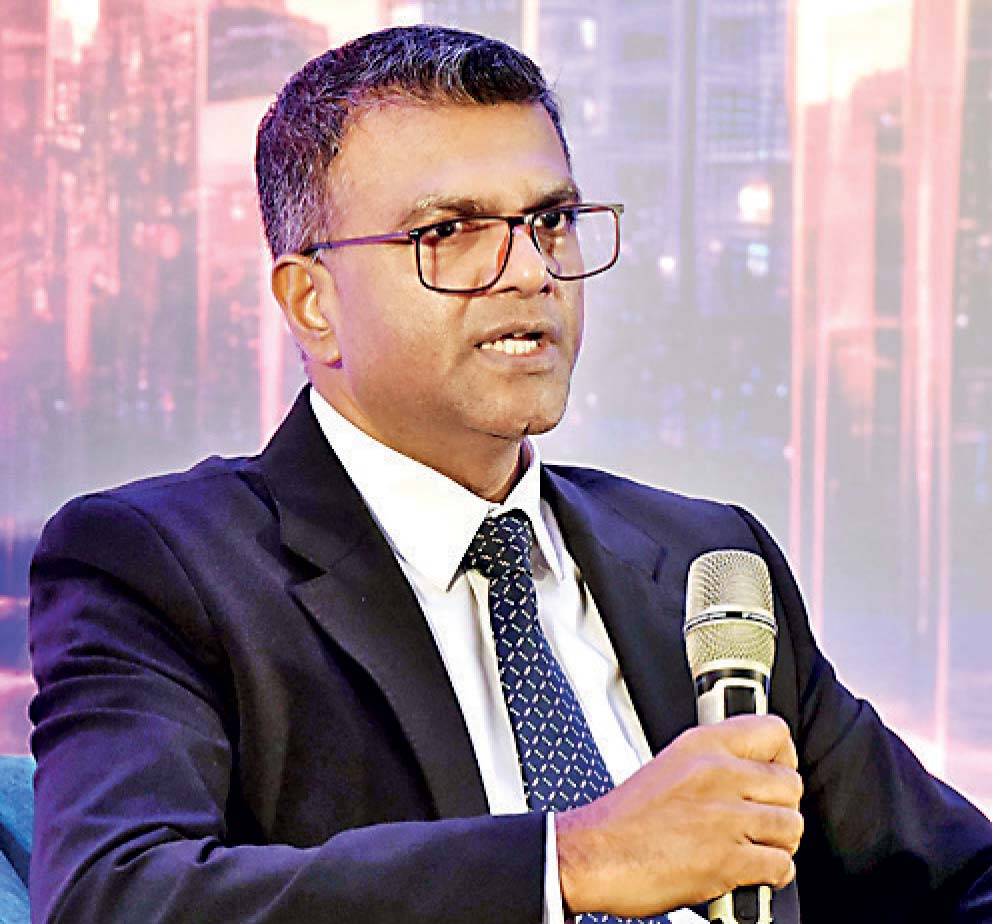
Treasury Secretary Dr. Harshana Suriyapperuma – Pic by Upul Abayasekara
|
The Government has changed the way State institutions buy goods, works, and services. They can now complete most of the procurement process for next year’s projects before Parliament passes the Budget, a change the Treasury says will save six months in project delivery. The Treasury cited the reform as evidence that the State’s ability to deliver is improving, which analysts see as the main test of Budget 2027’s investment plan.
Treasury Secretary Dr. Harshana Suriyapperuma, speaking at the EY Sri Lanka Budget 2027 forum on 12 November, said procurement delays had long eaten into the time available to implement projects.
“Historically, we had to wait until the Budget was approved for the spending agencies, Government ministries, line agencies, and departments to start the procurement process,” Dr. Suriyapperuma said. “Some of the complex procurements and larger projects require at least six to eight months just to go through the procurement process. So, by the time you start the actual implementation, you are left with six months or less to implement.”
“That is why, historically, the ability to deliver was less,” he said.
He said the Treasury had proposed a new method to the National Procurement Commission (NPC), which accepted it. Institutions preparing 2027 projects can now advertise, call for tenders, shortlist bidders, appoint Bid Evaluation Committees (BECs) and High-Level Procurement Committees (HLPCs), and complete the whole process up to the point of award in the preceding year. Once Parliament approves the Budget, they can issue awards to the selected bidders from the first days of January.
“We have saved six months in the process to make sure projects are implemented as much as possible within the same period,” Dr. Suriyapperuma said.
The award itself must still wait for the Budget. Under the NPC’s Procurement Guidelines 2024, published in Gazette Extraordinary No. 2412/01 of 25 November 2024, an institution must ensure that budgetary provision is available before issuing a Letter of Acceptance to a winning bidder. It must then issue the letter within three working days of the award being approved and within the period the bid remains valid. The guidelines already require institutions to keep three-year Master Procurement Plans tied to the medium-term budgetary framework, submit annual procurement plans at the budgeting stage, and complete preparatory work well before bidding to reduce delays. HLPCs, which handle the largest contracts, and the BECs that assist them, are appointed by the Treasury Secretary.
Dr. Suriyapperuma said the State’s delivery record was already improving. He said the 2025 Budget was ready to implement from April 2025, leaving nine months, and Cyclone Ditwah took away the last month. “So, in reality, we had only eight months to deliver. Out of nearly Rs. 1.5 trillion, we were able to deliver approximately 80% within eight months,” he said. “That shows the ability of the Government to deliver is improving.”
“Obviously, there is room for us to improve further, but the ability to deliver is improving,” he said. “It is not by accident. It is by a curated strategy that we follow, monitoring closely, engaging stakeholders at all levels, and identifying ways to improve ourselves.”
Analysts have been more cautious. CT Smith said about 75% of the 2025 capital budget was spent. It said less than 30% of the 2026 capital budget, or about Rs. 385 billion of Rs. 1.38 trillion, had been spent in the first nine months. “Capital spending has a record of falling short of plan,” CT Smith said. Budget 2027 raises capital expenditure to Rs. 2 trillion, or 5.12% of GDP.
Dr. Suriyapperuma said the Treasury had also found ways to keep projects running beyond the 12-month Budget cycle. He said such projects had been constrained because Government budgeting is not on an accrual basis. Framework agreements, introduced last year, let institutions set up procurement tailored to their needs. “Instead of going through the standard procurement approaches, you can have dedicated, customised procurement arrangements for your institutions,” he said.
He said digitisation was the other lever, cutting the time taken to obtain approvals such as the bonded warehouses that power sector projects often need. He gave two examples.
The first was a VAT system introduced in 2025, which he said had been met with a lot of scepticism. He said it was rolled out after monthly meetings with chamber representatives and the Inland Revenue Department. “Every month on average, we get an extra Rs. 20 billion in collections. Plus or minus Rs. 10 billion goes as refunds back to the industry. So, we have a net positive of Rs. 10 billion a month,” he said, adding that this amounts to Rs. 120 billion a year. He said the law requires refunds within 45 days, but the system had made one refund in a single day because it reconciles automatically, without human intervention.
The second was the National Single Window for Trade, which went live on 5 November in pilot mode and is running alongside the manual process. “For 20 years, Sri Lanka tried to implement a single window for trade,” he said. Tea and coconut were the first two sectors onboarded. He said their first shipments went through a fully online process involving six agencies, including quarantine, standards, and Customs. The containers have already left Sri Lanka. Despite a technical glitch, he said, the clearances took no more than an hour or two. “That shows the system is working,” Dr. Suriyapperuma said.
He said the system cuts person-to-person contact, improves accuracy, and removes the opportunity for irregularities, sparing businesses the need to go from agency to agency for approvals. “The single window system that we are using is 100% built by local enterprises,” he said.