Thursday Oct 15, 2026
Thursday Oct 15, 2026
Wednesday, 25 February 2026 00:22 - - {{hitsCtrl.values.hits}}
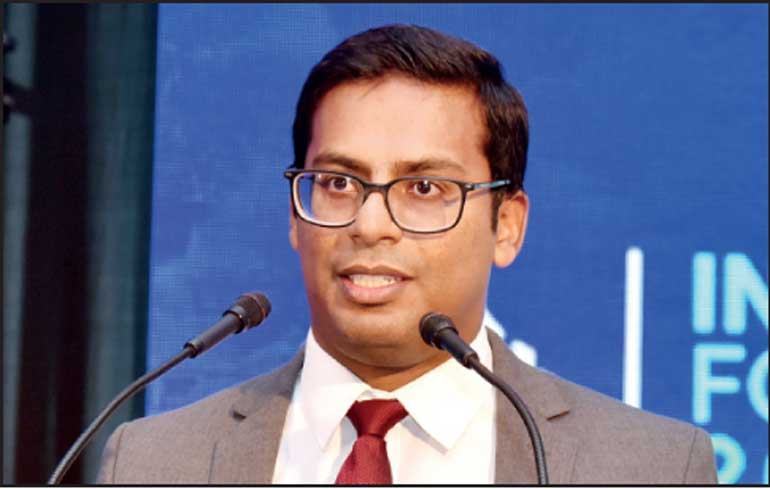
Talal Rafi
– Pic by Ruwan Walpola
Economist Talal Rafi said Sri Lanka has made measurable progress in stabilising the economy following the crisis, but cautioned that sustaining recovery and shifting to a growth trajectory will require continued fiscal discipline, external sector resilience and trade and productivity-driven reforms.
Speaking at the Softlogic Stockbrokers Investor Forum 2026, Rafi divided his remarks into four areas: the current macroeconomic position, sustainability of recovery, macroeconomic risks and opportunities ahead.
He noted that the period from 2022 to 2024 was defined by stabilisation, and that from 2025 onwards the country must transition into growth mode. However, he stressed that growth cannot come at the expense of stability. “There cannot be long-term growth without fiscal and monetary stability,” he said.
Rafi pointed to improvements in key indicators, including inflation returning towards target, exchange rate stability and a reduction in public debt-to-GDP from around 128% at its peak to near 100%.
Gross financing needs have declined from about 34% of GDP towards 20%, while interest payments to revenue have eased from around 80% to near 50%. IMF projections place growth at 2.9% this year and 3.1% next year, though the Central Bank is more optimistic.
Despite these gains, he cautioned that external pressures remain significant. Referring to recent crisis-related damage estimates and the impact on agriculture and trade, he noted that widening imports and reconstruction costs could weigh on the current account. He cited IMF estimates of a possible $ 700 million impact on the external balance.
On debt dynamics, Rafi said Sri Lanka is currently servicing multilateral obligations while preparing to resume bilateral repayments from 2028, which could add roughly $ 1 billion annually to existing payment obligations.
He underscored the importance of reserve accumulation, noting projections of reserves rising from about $ 6.8 billion currently to $ 8.8 billion by year-end, and further increases in 2027 and 2028. Achieving these targets, he said, will require sustained external inflows and prudent management.
He also referred to projections of potential sovereign bond issuances in the coming years, cautioning that credit ratings and global financing conditions will influence outcomes.
Assessing sustainability, Rafi identified three pillars: fiscal performance, external sector strength and productivity growth. Revenue mobilisation remains challenging, while domestic political cycles and global shocks pose ongoing risks. He stressed the need for export diversification and sustained tourism growth, arguing that future expansion must be driven by the tradable sector rather than consumption and non-tradable activity funded by foreign borrowing.
He warned that the current recovery appears consumption-led and said Sri Lanka must pivot towards productivity-enhancing investment, technology adoption and infrastructure development. “Stabilisation without productivity growth will not work in the long term,” he said.
On opportunities, Rafi highlighted renewable energy, logistics and shipping, tourism and IT-enabled services as potential growth areas.
He argued that rising global demand for data centres and energy-intensive industries could create opportunities for countries able to provide competitive power supply. He also pointed to Sri Lanka’s strategic location on major shipping routes and the growth potential of closer economic integration with India, particularly southern Indian states.
However, he warned that risks remain elevated. Among them are fiscal slippage, reform fatigue under prolonged adjustment programs, political pressures ahead of elections and uncertainty once the IMF program concludes.
Externally, he cited global interest rate movements, slowing global growth, trade tensions, China’s export dependence and volatile commodity markets as possible triggers. He drew parallels with past crises in emerging markets, where external shocks rapidly destabilised otherwise improving economies.
Concluding, Rafi said Sri Lanka’s long-term potential remains intact, given its location and human capital. However, he argued that trade and investment policy reform will be decisive in unlocking higher growth, alongside reforms in State-Owned Enterprises, regulation, land and labour markets.
He said investors should closely monitor the primary balance and reserve accumulation as leading indicators of whether the recovery remains durable and whether the transition from stabilisation to sustained growth is being successfully managed.




