Tuesday Oct 13, 2026
Tuesday Oct 13, 2026
Saturday, 22 August 2026 01:10 - - {{hitsCtrl.values.hits}}
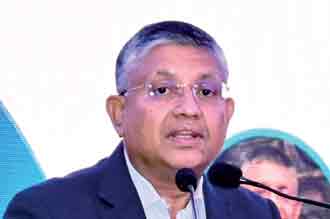
President Asoka Hettigoda
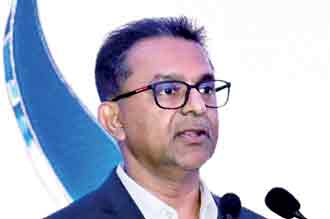
Vice President Eksath Wijerathne
 Visitor growth no longer translating into proportionate earnings; Sri Lanka earned $ 3.22 b from record 2.36 m tourists in 2025, compared to $ 4.38 b from 2.33 m visitors in 2018
2026 1H tourism revenue fell 11.8% YoY to $ 1.51 b, prompting Govt. to cut annual earnings target to $ 3.5 b
Industry reiterates need for a higher-value tourism model
First 16 days of August welcomes 113,307 visitors down 7.7% YoY; YTD arrivals down 2.3% YoY to 1.45 m
Sri Lanka’s tourism industry needs to shift its focus from visitor volumes to value, with industry leaders reiterating for greater emphasis on high-spending travellers, longer stays and wider economic benefits.
Addressing the media earlier this week, Hotel Association of Sri Lanka (THASL) President Asoka Hettigoda said tourism had re-emerged as a key driver of economic recovery but cautioned that arrivals alone were an inadequate measure of success.
“The gap between visitor numbers and tourism earnings remains a concern,” Hettigoda said, calling for a strategy centred on travellers who stay longer, spend more and engage more deeply with destinations and local communities.
The disparity is evident in recent performance. Sri Lanka welcomed a record 2.36 million tourists in 2025, up 15.1% from 2024, but tourism earnings rose only 1.6% to $ 3.22 billion from $ 3.17 billion.
The comparison with 2018 is starker. That year, Sri Lanka attracted over 2.33 million visitors, but generated around $ 4.38 billion in tourism earnings, underscoring the decline in value generated per visitor.
The weakness has continued into 2026. Tourism earnings fell 11.8% year-on-year (YoY) to $ 1.51 billion in the first half, with June earnings down 10.8% to $ 151.1 million.
Arrivals have also softened, with 1,456,735 tourists recorded from 1 January to 16 August, down 2.3% from 1,491,046 during the corresponding period of 2025, according to latest data released by the Sri Lanka Tourism Development Authority (SLTDA).
During the first 16 days of August, Sri Lanka welcomed 113,307 visitors, down 7.68% compared to 122,758 during the corresponding period of 2025.
July arrivals totalled 196,845, marginally below the 200,244 recorded a year earlier. India remained the largest source market, followed by the UK and the Netherlands.
As of 16 August 2026, a total of 363,585 Indian visitors had arrived, reinforcing the importance of the market to Sri Lanka’s recovery. India accounted for 531,511 arrivals, or around 27% of total visitors, in 2025.
The weaker performance has prompted the Government to cut its 2026 tourism targets from three million arrivals and $ 4 billion in earnings to 2.5 million visitors and $ 3.5 billion, amid disruptions to regional air connectivity linked to the Middle East conflict.
Meeting even the revised earnings target for 2026 will require a sharp second-half improvement, given that only $ 1.51 billion was generated in the first six months.
“Our ambition must therefore be not merely to attract more tourists, but to attract more high-value, high-spending travellers who stay longer, experience more of the country and contribute more meaningfully to our economy and communities,” Hettigoda said.
He identified stronger marketing, improved connectivity, infrastructure, destination management and a sustained focus on quality as essential to increasing tourism’s economic contribution.
THASL Vice President Eksath Wijerathne also stressed the need for continued investment and improvements in the tourism product as accommodation capacity expands. The sector now has more than 55,000 rooms, while SLTDA data earlier this year put registered capacity above 58,000 following the addition of around 4,600 rooms in 2025.
The expansion creates both opportunity and pressure. More rooms enable Sri Lanka to accommodate larger visitor volumes, but also require sufficient demand and spending to sustain hotels, restaurants, transport operators, attractions and other businesses across the tourism value chain.
The policy challenge is therefore shifting from filling rooms to increasing the value generated by each visitor.
Sri Lanka’s longer-term ambition is substantially higher. The Government’s National Tourism Vision 2030 targets five million tourists and $ 10 billion in tourism revenue. Reaching those goals will require stronger visitor spending, longer stays and wider distribution of tourism income; not simply more arrivals.
With tourism supporting hundreds of thousands of direct and indirect jobs, the immediate priority is to reverse the earnings decline. They said the sector’s performance will need to be judged not by how many tourists pass through the airport, but by how much economic value each visitor creates.
Pix by Sameera Wijesinghe




