Tuesday Sep 15, 2026
Tuesday Sep 15, 2026
Thursday, 29 January 2026 05:30 - - {{hitsCtrl.values.hits}}
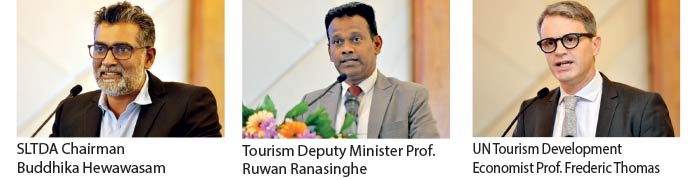
Sri Lanka’s tourism sector, struggling to attract high spenders, is estimated to lose $ 1.13 billion annually through economic leakages, despite generating $ 3.17 billion in earnings in 2024 and about $ 3.2 billion in 2025, according to the country’s first Rapid Assessment of Economic Leakages released yesterday.
The assessment, conducted by the Sri Lanka Tourism Development Authority (SLTDA) with technical support from UN Tourism, focuses on accommodation, inbound tour operators, and the wellness/Ayurveda segment. Addressing a stakeholder workshop held to release the findings, SLTDA Chairman Buddhika Hewawasam said the scale of leakage identified was “alarming” but not inevitable.
“The survey shows that at least $ 1.13 billion is lost annually through a combination of internal and external leakages. While some level of leakage is inherent in tourism, this is a factor we can mitigate through structural change and proper implementation,” he said.
Hewawasam said procurement-related imports alone exceed $ 800 million annually, driven by reliance on imported food, beverages, furniture, equipment, and energy. He added that informality across the surveyed sectors results in an estimated $ 84.8 million in annual fiscal losses due to non-payment of taxes.
He also noted that leakage rates in the wellness and Ayurveda segment exceed 50%, raising concerns about sourcing practices and value retention. “This raises serious questions around credibility and local value retention in a segment that should be more locally grounded,” he said.
Tourism Deputy Minister Prof. Ruwan Ranasinghe said the findings highlight the limitations of focusing on arrivals and headline earnings alone.
“Roughly one-third of every dollar earned through tourism is leaving the country. If we want tourism to strengthen the local economy, we must understand where these outflows occur and what can realistically be addressed through policy,” he said.
Prof. Ranasinghe noted that while imports are unavoidable in certain areas, the study shows clear opportunities to develop domestic supply chains and retain a larger share of tourism income within the economy.
UN Tourism Development Economist Prof. Frederic Thomas said the assessment was designed to move the discussion towards feasibility and implementation.
“Not all leakages are equal. Some are structural, but others are avoidable and policy-addressable,” he said, adding that imports of goods and services account for the largest share of losses.
He said the workshop marked a shift from analysis to action, with discussions centred on formalisation, licencing, digital payments, strengthening local value chains, and sustainability standards.
The outcomes of the dialogue are expected to inform a three-year implementation roadmap led by the SLTDA, with the focus shifting from increasing visitor numbers to retaining a higher share of value generated within Sri Lanka.
“This workshop is not about diagnosis alone. It represents a deliberate shift from analysis to action. Once we did the expenditure survey, it actually opened up a discussion not about whether we achieved higher revenue in a particular year, but about how we can increase the expenditure of tourists. The number itself does not create value. Value has to be created through a proper strategy on how we work with the sector, how we do marketing, and how we approach development,” Hewawasam said.
In 2025, despite recording the highest-ever arrivals of over 2.36 million, tourism income increased by only 1.6%, reflecting the impact of a downward revision in average per-day spending and intensifying concerns over the quality and value of tourism growth.
The SLTDA recently revised down per-day spending from a foreign visitor to $ 148 from the earlier $ 171 decided through a survey a decade ago.
– Pix by Lasantha Kumara




