Wednesday Jul 15, 2026
Wednesday Jul 15, 2026
Friday, 13 March 2026 00:22 - - {{hitsCtrl.values.hits}}
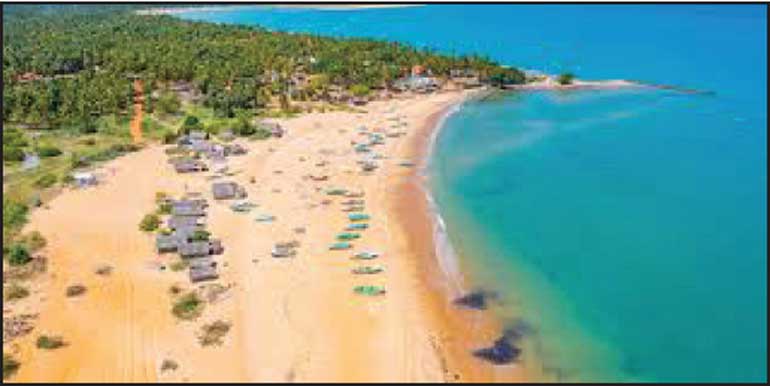
The Government’s drive to accelerate tourism investment through large-scale land leasing risks repeating the failures of earlier development efforts unless structural weaknesses in planning, infrastructure, and governance are addressed.
This is according to a ‘Policy Brief’ by the Centre for a Smart Future, authored by researchers Ashanee Kottage and Tehani Chandrasena Perera.
The brief says the current framework for tourism land leasing has already produced stalled projects, idle land, and growing investor uncertainty in key development zones such as Kalpitiya.
The warning comes as the Sri Lanka Tourism Development Authority (SLTDA) has identified 3,000 acres of coastal land for tourism investment, promoting them as ready for development in an attempt to attract private capital and expand accommodation capacity.
The brief says the administrative streamlining of land leasing will not by itself produce viable tourism projects if basic constraints such as environmental suitability, infrastructure capacity, and community acceptance remain unresolved.
The Kalpitiya Integrated Tourism Resort Program (KITRP), launched in 2010, is cited as a case in point.
The project involved leasing 10 islands in the Kalpitiya peninsula to seven investors. The development plan envisaged around 5,000 acres of resort development, 4,000 hotel rooms, and between 15,000 and 18,000 direct jobs.
More than a decade later, most of these projects have not progressed.
Several island leases signed in 2010 remain undeveloped. In some cases, investors have not submitted investment proposals, while in others construction approvals remain pending or projects have been delayed by regulatory hurdles and disputes with local communities.
The brief notes that the result has been capital tied up in projects that have not moved forward, idle land, and weakening investor confidence, alongside growing opposition from fishing communities dependent on lagoon resources.
Environmental constraints have also affected project feasibility.
Many of the islands earmarked for resort development are low-lying, exposed to storms, and lack reliable freshwater supplies. Ecological pressures in the lagoon have increased following earlier aquaculture activity.
Mangrove restoration efforts in the area have recorded only 18–22% survival of replanted saplings, pointing to the fragility of the ecosystem.
Infrastructure gaps remain a major constraint.
According to the Kalpitiya development plan cited in the brief, only 54% of the area’s daily water demand is currently met, leaving a deficit of about 3.5 million litres per day. The region generates roughly 132 metric tons of solid waste daily, yet its waste management facility was designed to handle only five tons from the urban core.
Healthcare provision is also limited.
The main hospital in Kalpitiya is a 40-bed district facility staffed by four doctors, none of them specialists.
Tourism projects also face lengthy regulatory procedures.
Approvals are required from multiple agencies, including the Coastal Conservation Department, Central Environmental Authority, and Urban Development Authority. Environmental clearances alone can take six to nine months.
The brief also highlights weaknesses in the Environmental Impact Assessment (EIA) process.
An analysis of 250 EIA reports found that 31% did not disclose data sources, 45% failed to report the methodology used to assess social impacts, and 79% did not explain the effectiveness of proposed mitigation measures.
The report says such gaps leave regulators, communities, and investors without reliable information on environmental and social risks.
Weak land governance and fragmented administration add to investor uncertainty. The study notes that poor inter-agency coordination and fragmented land administration have been identified by the World Bank as barriers to investment in Sri Lanka.
The analysis also finds a mismatch between the type of tourism development proposed and the profile of visitors currently coming to Kalpitiya.
Around half of visitors are sports-oriented travellers, particularly kite surfers. The wider visitor base consists largely of eco-tourists and long-stay budget travellers rather than high-spending luxury tourists.
Projects designed around high-end resort models therefore face weak demand signals in addition to regulatory and environmental constraints.
One proposed overwater bungalow development on the Vellai Islands has remained stalled for more than 15 years. Although some regulatory approvals were eventually obtained, construction has yet to begin.
The authors argue that tourism planning has tended to treat destinations as isolated investment sites rather than complex systems shaped by ecological limits, infrastructure capacity, and community livelihoods.
Without changes to the current approach, the report warns that Sri Lanka risks repeating a pattern of stalled projects, environmental pressure, and declining investor confidence in tourism investments.
The brief proposes introducing a pre-leasing diagnostic framework to assess environmental compatibility, infrastructure readiness, governance capacity, and community acceptance before tourism land leases are issued.
According to the authors, such assessments could reduce project risk, prevent stalled investments, and align tourism development with local ecological and economic conditions.




