Friday Oct 16, 2026
Friday Oct 16, 2026
Friday, 27 March 2026 04:48 - - {{hitsCtrl.values.hits}}

Tourism Minister Vijitha Herath
The Presidential Task Force on the Implementation of the Sri Lanka Tourism Development Program yesterday convened to discuss measures to sustain the industry as disruptions linked to the Middle East conflict begin to affect arrivals.
Meeting under the chairmanship of Tourism Minister Vijitha Herath, the Task Force reviewed measures to maintain tourism activity, including uninterrupted fuel supply, upkeep of hotels and attractions, and targeted efforts to draw visitors from countries less affected by the conflict, the President’s Office said in a statement.
The Task Force, comprising public and private sector heavyweights, also reviewed progress on the Beira Lake cleaning project and took up issues affecting film tourism, alongside broader efforts to sustain sector activity.
Those present included Tourism Deputy Minister Prof. Ruwan Ranasinghe, Presidential Secretary Dr. Nandika Sanath Kumanayake, Senior Economic Adviser to the President Duminda Hulangamuwa, Public Administration, Provincial Councils and Local Government Ministry Secretary S. Aloka Bandara, Foreign Affairs, Foreign Employment and Tourism Ministry Secretary Aruni Ranaraja, Senior Additional Secretary to the President Roshan Gamage, Sri Lanka Tourism Development Authority Chairman Buddhika Hewawasam and Director General Malkanthi Rajapaksa, John Keells Group Chairman/CEO and The Ceylon Chamber of Commerce Chairman Krishan Balendra, Jetwing Travels Chairman/Managing Director Shiromal Cooray, Sri Lanka Convention Bureau (SLCB) and Sri Lanka Institute of Tourism and Hotel Management (SLITHM) Chairman Dheera Hettiarachchi, along with senior Government and security officials and other tourism sector stakeholders.
The discussions come as early data point to emerging pressures on the sector. Tourist arrivals fell 5.15% year-on-year (YoY) in the first 15 days of March to 92,573, reflecting disruptions to air travel and transit routes. Nearly 30% of visitors to Sri Lanka travel via Middle Eastern hubs, exposing the sector to flight cancellations and rising aviation costs. By mid-March, 447 arrival and 451 departure flights had been cancelled.
Last week, The Hotels Association of Sri Lanka (THASL) President and Siddhalepa Group Chairman/Managing Director Asoka Hettigoda said the sector is losing between $ 80 million and $ 100 million a month due to cancellations.
“We are seeing, at least for the month of March, a 30 to 40% reduction in Europeans,” he said. “Even though in headcount, we are down only 40%, I think in terms of real revenue, we are down by at least 50%.”
He also warned that forward bookings for May to July remained weak, with no real numbers other than Asians, as higher travel costs and uncertainty weigh on long-haul demand.
The current disruption follows Cyclone Ditwah in November 2025, which had a more contained economic impact.
Ceylon Chamber Chairman Balendra in late January said tourism infrastructure damage was estimated at around Rs. 500 million, with arrivals recovering in January to levels about 10% higher than the same period last year.
Tourism arrivals cross 700,000 mark despite March slump
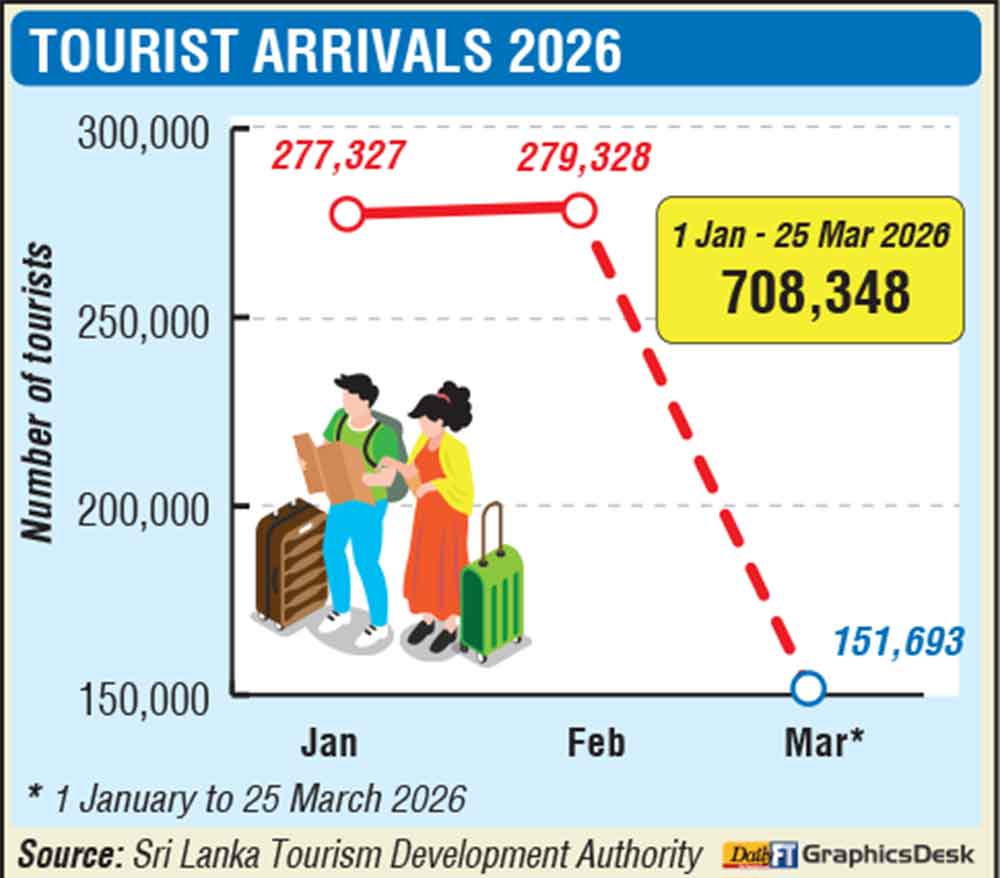
Sri Lanka’s tourism sector has surpassed the 700,000 visitor milestone for 2026, maintaining overall growth momentum despite a sharp slowdown in March triggered by the escalating Middle East conflict and its impact on global aviation.
Latest data show the country welcomed 151,693 visitors between 1-25 March, marking a steep 22% year-on-year (YoY) decline compared to the same period last year. The downturn follows the outbreak of hostilities on 28 February, which disrupted key air routes, led to flight cancellations, and increased travel costs, particularly affecting transit corridors between Europe and Asia.
Despite the March setback, cumulative arrivals for the year have reached 708,348, reflecting a 4.45% YoY increase, supported by strong inflows recorded in the first two months of 2026.
The slowdown is also reflected in daily arrival trends, with the average falling to 6,068 visitors from 7,407 a year earlier. The highest single-day arrivals during the first 25 days of March was registered on 14 March, with 7,318 visitors.
Even amid aviation disruptions, Sri Lanka continued to attract travellers from key long-haul Western markets. The UK, Germany, France, and the US remained among the top contributors in early March, helping cushion the overall decline.
India retained its position as the largest source market, accounting for 39,424 visitors or 26% of total arrivals during the first 25 days of March. The UK followed with 13,967 arrivals, while Russia registered 13,272. China contributed 12,166 visitors and Germany 10,523, alongside steady inflows from Australia, France, the US, Japan, and Bangladesh.
Year-to-date (YTD) figures further highlight the strength of core markets, with India contributing 139,164 visitors, followed by the UK with 74,295 and Russia with 63,505.
However, analysts say the March contraction underscores Sri Lanka’s heavy reliance on Middle Eastern transit hubs, through which an estimated 34% of tourists travel. Disruptions in these corridors have had an immediate impact on connectivity, particularly for European travellers.
Tourism Deputy Minister Prof. Ruwan Ranasinghe has cautioned that even a brief closure of Middle Eastern airspace could carry significant financial consequences, estimating potential losses of between $ 10 million and $ 15 million in tourism revenue for just one week of disruption.




