Sunday Oct 04, 2026
Sunday Oct 04, 2026
Thursday, 2 July 2026 04:44 - - {{hitsCtrl.values.hits}}
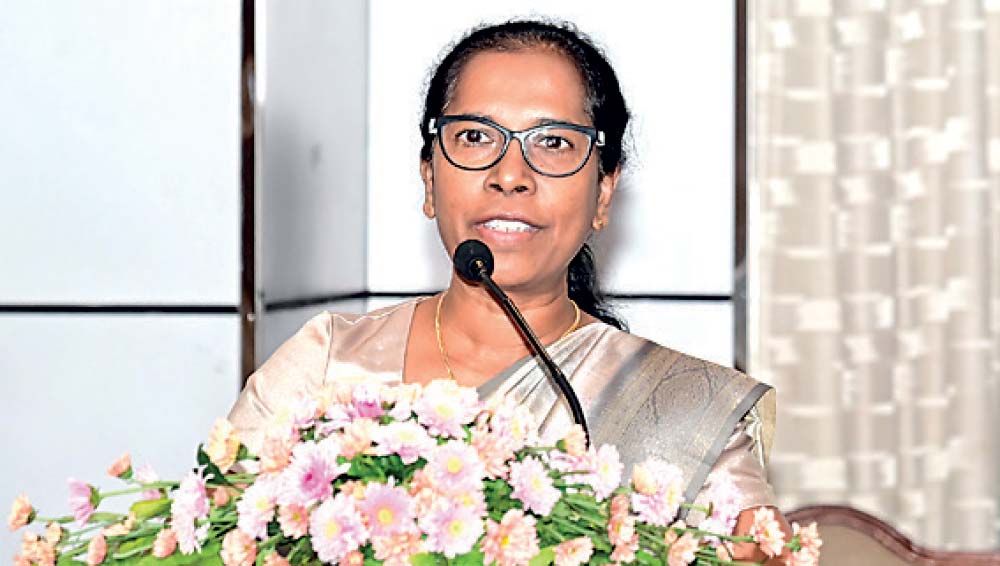
Finance Ministry Tax Policy Adviser Thanuja Perera – Pic by Sameera Wijesinghe
In a rare public explanation of Sri Lanka’s tax policy, Finance Ministry Tax Policy Adviser Thanuja Perera recently sought to reassure businesses that recent tax reforms are intended to modernise the tax system, improve fairness, and strengthen compliance rather than impose additional burdens on compliant taxpayers.
Addressing a seminar on recent tax changes organised by Corporate Management Consultants, Perera outlined the rationale behind Value Added Tax (VAT) on overseas digital services, recent legislative amendments, and tougher enforcement provisions under the Inland Revenue Act, while responding to concerns over compliance costs, VAT refunds, and the treatment of imported digital services.
Central to her presentation was the introduction of VAT on overseas digital services supplied to consumers in Sri Lanka, which took effect on 1 July.
Perera rejected suggestions that the measure constitutes a new tax, arguing that it merely changes how VAT is collected and where it becomes chargeable.
“The biggest misconception surrounding this reform is that digital VAT is a new tax,” she said, explaining that VAT has always been intended as a tax on domestic consumption, regardless of where the supplier is located.
She said Sri Lanka’s previous VAT framework taxed services supplied by local businesses but lacked an effective mechanism to capture digital services supplied from abroad, even when consumed domestically. The amendments therefore adopt the internationally recognised destination principle, under which consumption is taxed where the customer is located rather than where the supplier operates.
Perera noted that the principle is widely applied in jurisdictions including the European Union, the UK, Australia, Singapore, India, and South Africa.
She said the new framework primarily targets business-to-consumer (B2C) transactions, requiring overseas digital service providers to register and account for VAT when supplying to Sri Lankan consumers. Many business-to-business (B2B) transactions, however, fall outside the non-resident registration framework, reducing compliance burdens for VAT-registered businesses.
Perera also sought to reassure startups and businesses that rely heavily on imported software and cloud services, noting that voluntary VAT registration remains available regardless of turnover. Businesses that register voluntarily will appear on the Inland Revenue Department’s (IRD) VAT register, allowing overseas suppliers to recognise them as registered persons and avoid charging VAT upfront, subject to reporting requirements.
She said the Government had consulted major overseas digital service providers before implementation and had simplified registration and filing procedures in response to their feedback. While the tax took effect on 1 July, overseas suppliers have until 30 September to complete registration with the IRD.
Perera said the reforms would restore competitive neutrality by ensuring overseas suppliers face broadly the same VAT obligations as local businesses providing equivalent services.
“Businesses should compete on quality, innovation, and efficiency, not because one falls outside the tax net,” she said, adding that local suppliers had long been required to collect VAT while competing against overseas providers operating outside Sri Lanka’s VAT system.
She also clarified confusion surrounding the latest legislative amendments.
Although the Budget proposed reducing the VAT registration threshold to Rs. 36 million annually, Parliament ultimately retained the existing Rs. 60 million threshold before passing the legislation. However, she stressed that the Social Security Contribution Levy (SSCL) threshold had already been reduced to Rs. 36 million under separate legislation and took effect from 1 July.
Perera said reports suggesting the SSCL threshold had also been restored to Rs. 60 million were incorrect.
Defending the tougher enforcement provisions introduced under the Inland Revenue Act, Perera said they were a response to persistently weak compliance rather than an attempt to penalise compliant taxpayers.
She acknowledged that some businesses had described the new provisions as “draconian,” but argued that stronger penalties had become necessary because compliance levels remained exceptionally low. She said fewer than one in four employers currently file mandatory employment income declarations, adding that higher voluntary compliance would reduce the need for enforcement action.
“My appeal to you is to file the return on time. The more you comply, the lesser your problems,” she said.
Responding to concerns raised by exporters, Perera said discussions with the business community indicated that the majority of VAT refunds are now being processed within the statutory time frame, signalling improvements in tax administration alongside the legislative reforms.
On the impact of the reforms on consumers, she said any increase in prices would depend on competitive conditions, production costs, and business pricing strategies rather than the legislation alone, noting that businesses operating in competitive markets may absorb part of the additional tax burden instead of passing it on fully to customers.
Perera said the broader objective was to safeguard Sri Lanka’s VAT base as the economy becomes increasingly digital while supporting a more stable, equitable, and sustainable revenue system.
“If a service is consumed in Sri Lanka, it should be taxed in Sri Lanka, irrespective of whether the supplier is located in Sri Lanka or elsewhere,” she said.



