Monday Nov 02, 2026
Monday Nov 02, 2026
Monday, 2 November 2026 06:29 - - {{hitsCtrl.values.hits}}
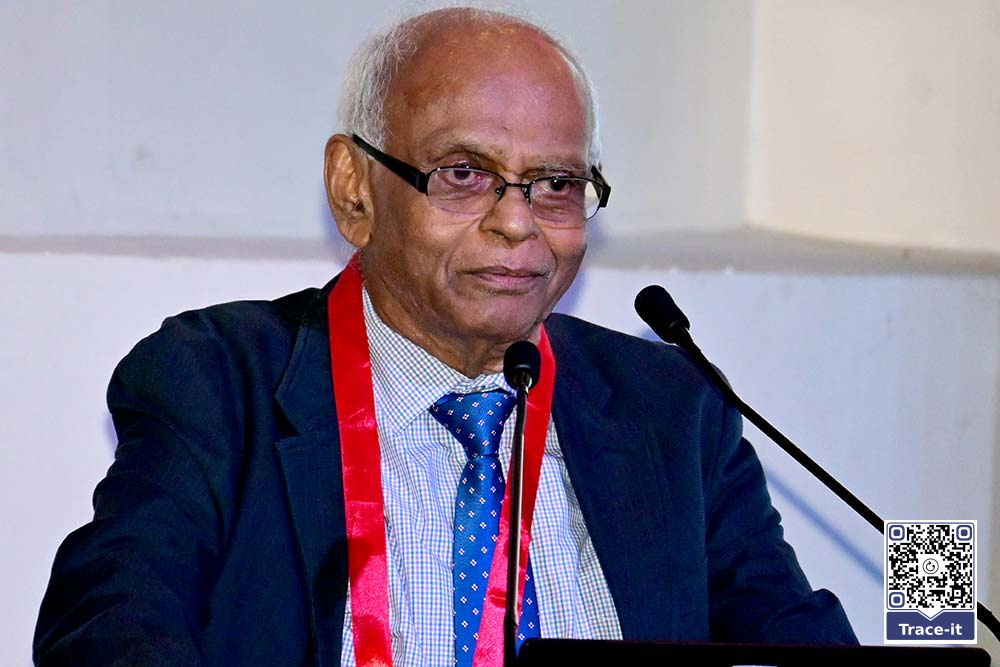
CBSL former Deputy Governor Dr. W.A. Wijewardena – Pic by Sameera Wijesingha
Former Central Bank Deputy Governor Dr. W.A. Wijewardena has called on the Government to slow its revenue drive in the 2027 Budget, warning that taxpayers are being squeezed by high income taxes, indirect taxes and inflation while receiving deteriorating public services in return.
Delivering CA Sri Lanka’s 28th Annual Tax Oration on Thursday, Dr. Wijewardena said Government revenue had risen from 12.3% of GDP in 2021 to the 15% target set under the International Monetary Fund’s (IMF) Extended Fund Facility (EFF), which was to be reached by 2024, and had been exceeded in 2025. He said the target was likely to be exceeded again in 2026, and in 2027 if taxes stayed at current levels.
“We outperformed the IMF, which is not a good thing, because many of you might think that when the Government raises more revenue it is good. In fact, that revenue is transferred from us. We have to sacrifice our own consumption and our own investment in order to provide that money to the Government,” he said.
Dr. Wijewardena said collections had improved through a lower personal income tax threshold, which was cut to Rs. 100,000 a month before being raised to Rs. 150,000, a marginal tax rate of 36%, and the requirement that every citizen over 18 obtain a Taxpayer Identification Number (TIN). VAT was raised from 8% in 2021 to 15% and then to the current 18%, while the removal of exemptions and the reduction of the VAT registration threshold to Rs. 36 million drew small firms into a more complex compliance system, he added.
He warned that indirect taxes on essential consumption made the tax system regressive, with low-income earners paying a higher share of their income in tax than high-income earners.
“It is just like a physician who gives medicine to a patient in pain. If the physician gives an overdose, the medicine will become toxic. The same thing is happening to Sri Lanka today,” he said.
Dr. Wijewardena said citizens were being hit by three types of taxes: direct taxes, which reduced disposable income; indirect taxes, which eroded the real value of purchases; and inflation, which acted as an implicit tax.
“We again experience a reduction in the real value of our financial assets when the Central Bank goes by its inflation target of 5%, or most probably 7%,” he said, referring to the upper limit of the Central Bank’s target band.
He argued that the IMF’s standard prescription relied on revenue-based fiscal consolidation, which narrows the budget gap mainly by raising revenue rather than also cutting spending, and on a primary surplus, the budget balance excluding interest payments. Critics say this protects the interest income of lenders to the Government while squeezing public servants and subsidy recipients, he noted.
The IMF had sought a primary surplus of 1.5% of GDP in 2025, but the Government achieved about 4% by curtailing capital expenditure, Dr. Wijewardena said. Of the Rs. 1.3 trillion allocated for capital expenditure in 2025, only Rs. 987 billion, or about 75%, was spent. The 2026 capital budget, also Rs. 1.3 trillion, was only 16% utilised in the first half and 28% by end-September, he said, adding that officials expected to spend the remaining 72% in the last quarter.
“If they can do so, in fact they should receive our compliments and respect for being so efficient in disposing of the capital expenditure program,” he said, warning that lower capital formation would weaken future growth and, with it, the revenue base.
Citing overcrowded wards at the National Hospital in Colombo, reliance on private tuition and delays at police stations, Dr. Wijewardena said the ‘moral contract’ between the state and taxpayers had been breached.
“This particular sacrifice that the taxpayers make is not matched by public value,” he said.
He also said the Inland Revenue Department’s Revenue Administration Management Information System (RAMIS) lacked the capacity to handle the expanded tax net, leaving taxpayers unable to file returns. He blamed this on the over-performance in tax collection and the failure to upgrade the technology available to collection agencies.



