Friday Jun 12, 2026
Friday Jun 12, 2026
Monday, 23 February 2026 01:47 - - {{hitsCtrl.values.hits}}

UNDP Sri Lanka Resident Representative Azusa Kubota

Global Steering Group for Impact Investment Sri Lanka Chair Chandula Abeywickrema
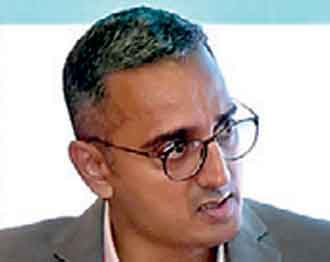
Gojo & Company, Inc. Deputy Chief Investment Officer Sohil Shah
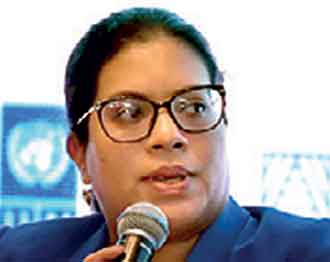
UNDP Policy and Program Specialist and Team Leader for Sustainable Growth Dulani Sirisena
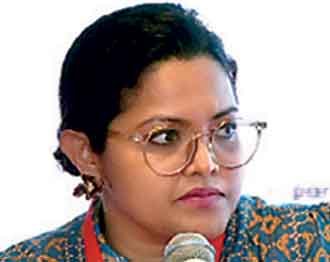
Selyn Sri Lanka Director of Business Development Selyna Peiris
 UNDP Sri Lanka Resident Representative Azusa Kubota says MSMEs structurally underprepared to attract institutional capital
Warns enterprises that take on debt without financial discipline risk collapse
Impact investors, industry experts say entrepreneurs mistrust investors, an obstacle for impact investing
Cite poor awareness of regulatory and legal obligations like paying taxes; 40% of Ditwah debris from unauthorised structures
United Nations Development Programme (UNDP) Sri Lanka Resident Representative Azusa Kubota has positioned enterprise readiness as a structural reform priority aimed at unlocking private capital for micro, small and medium enterprises (MSMEs), shifting the conversation at the recent Lanka Impact Investment Summit from recovery to investability.
Delivering the keynote on day two of the Summit, Kubota framed the issue as one of capital architecture rather than humanitarian support, arguing that Sri Lanka’s financing constraint lies in weak enterprise systems rather than a shortage of liquidity.
Referring to the combined effects of the 2022 economic crisis and Cyclone Ditwah, she noted that the cyclone affected over 1.8 million people and displaced more than 300,000. The UNDP’s Rapid Assessment for Information and Decision Analysis (RAPIDA) conducted with the Government showed that over half of those in flooded areas were already facing multiple vulnerabilities before the disaster.
Key informant interviews conducted last month found that 93% of affected communities reported livelihood losses, while 91% of 510 key informants said business activities and operations had been impacted. Around one-third reported that both formal and informal businesses were severely affected or completely shut down.
Kubota said MSMEs, which account for two-thirds of Sri Lanka’s employment and over half of GDP, remain central to economic recovery but structurally underprepared to attract institutional capital.
Challenging the assumption that purpose-driven enterprises are inherently investable, she said: “Purpose is powerful, but it does not replace clean financials. It does not replace governance discipline. It does not replace decision-grade data. And many enterprises simply don’t have the systems or the support to generate that information.”
“Some are still reorganising after the economic crisis. Some are drowning in multiple debt. Some lack basic cash-flow visibility. And many are operating in deeply informal environments where shocks, whether economic or climate-driven, keep setting them back,” she added.
Kubota argued that capital often fails before investors even engage, not because of weak business ideas, but because the surrounding ecosystem does not support readiness.
She outlined four pillars of capital readiness: governance, financial discipline, data and reporting, and standards and compliance. Without these, she cautioned, financing can deepen fragility rather than reduce it.
“An enterprise that takes on debt without financial discipline risks collapse. One that receives capital without governance discipline risks mismanaging it. One that receives grants without market linkages risks stagnation.”
Impact investment is no longer niche. According to the Global Impact Investing Network’s 2024 market sizing report, global impact investment assets reached an estimated $ 1.571 trillion in 2024, with a 21% compound annual growth rate among consistently tracked organisations since 2019.
More than 3,900 organisations are active in the market, including institutional investors such as pension funds and insurance companies.
Against that backdrop, Kubota said Sri Lanka must align enterprise systems with the expectations of institutional capital if it is to tap into this expanding pool.
She said UNDP, through its Sustainable Finance Hub, is exploring with stakeholders a package combining finance with risk guarantees, capacity building, financial and business literacy and gap financing, with the objective of crowding in private capital by absorbing early-stage risk and improving enterprise preparedness.
Global Steering Group for Impact Investment Sri Lanka Chair Chandula Abeywickrema said enterprise readiness begins with clarity on three fundamentals: commercial viability, scalability and sustainability across the short, medium and long term.
“Our SMEs lack significant engagement in this area and particularly they don’t understand what is commercial viability in the mid and the long term. They understand some idea about the short term, but the commercial viability in the short, mid and the long term, they have not much of understanding,” he said at panel discussion following Kubota’s keynote.
He said that many family-owned enterprises remain comfortable operating within limited geographies without clear expansion strategies, and invest little in research, development and innovation, weakening long-term competitiveness.
Abeywickrema also pointed to weak governance and limited regulatory awareness among SMEs, including gaps in financial disclosure, audited statements, tax compliance and employment contracts.
Regulatory awareness is a foundational element of governance and enterprise credibility. He said many entrepreneurs fail to appreciate that they operate within a regulated framework that covers business registration, financial disclosure, audited statements, tax compliance, employment contracts and environmental standards.
“Regulation comes in many forms. Income tax commitments, employment contracts, environmental arrangements. Entrepreneurs need to understand they are operating on a regulated canvas,” he said.
Abeywickrema noted that weak compliance has broader economic consequences, pointing to post-Ditwah damage patterns as an example. He said he observed that a significant share of debris following the cyclone originated from unauthorised or unapproved constructions. “About 40% of the debris was from unauthorised constructions,” he said, arguing that non-compliance with environmental and construction regulations ultimately increases vulnerability and economic loss.
He said improving awareness of regulatory obligations is a necessary first step in embedding governance standards within SMEs and strengthening long-term resilience.
He said mistrust of equity investors remains a constraint, with many entrepreneurs preferring debt over external partners due to fear of losing control. Exit horizons, he added, must be adapted to local realities rather than benchmarked mechanically against global markets.
Gojo and Company Inc. Deputy Chief Investment Officer Sohil Shah said the structural red flag in markets such as Sri Lanka is transparency rather than entrepreneurial energy.
“One of the bigger challenges we face is about transparency of financial reporting, documenting your processes,” he said, adding that underwriting decisions depend as much on data integrity and governance controls as on management vision.
Trust deficits, particularly after successive crises, must be addressed through stronger disclosure. “That barrier will be overcome by providing as much data as possible to the investors. So, the underwriting is not only on the management, but also on the data,” he said.
UNDP Policy and Program Specialist and Team Leader for Sustainable Growth Dulani Sirisena and Selyn Sri Lanka Director of Business Development Selyna Peiris noted that governance must be practical and embedded rather than viewed as a technical abstraction.
Basic board discipline, structured decision-making and clarity on what type of capital an enterprise needs were highlighted as immediate priorities. It was also noted that ecosystem actors, including government and intermediaries, have a role in supporting R&D, accelerator programs and capacity building, particularly for micro and small enterprises that lack internal compliance capacity.
The discussion suggested that Sri Lanka’s capital gap is structural, not monetary. The central constraint is not the absence of investors or liquidity, but the absence of institutional readiness within enterprises and across the supporting ecosystem.
Without reforms that strengthen governance, transparency, innovation capacity and risk-sharing mechanisms, private capital will remain cautious, regardless of global liquidity conditions.
– Pix by Ruwan Walpola




