Thursday Oct 22, 2026
Thursday Oct 22, 2026
Tuesday, 1 September 2026 03:07 - - {{hitsCtrl.values.hits}}
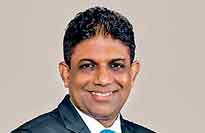 |
| Bingumal Thewarathanthri |
Standard Chartered Sri Lanka CEO Bingumal Thewarathanthri has made the case for Sri Lanka to consider an International Monetary Fund (IMF) Stand-By Arrangement (SBA) after completing its current Extended Fund Facility (EFF) in 2027, arguing that continued engagement could support investor confidence and external market access while allowing greater policy flexibility.
Speaking at a recent Global Research Briefing hosted by Standard Chartered, Thewarathanthri said the approaching end of the EFF raises a broader question over whether Sri Lanka is ready to maintain the fiscal discipline and reforms achieved under the program without an IMF framework.
“Are we ready to run on our own? What kind of fiscal discipline that we had? Can we continue? There are mixed views around it,” he said.
He noted that Sri Lanka has entered 17 IMF programs but has a poor record of completing them, particularly EFF arrangements. The current program, he said, offered the prospect of breaking that pattern.
“When we went into the program, of course, we’ve done 17 programs. We all know that. I don’t think we completed any. Definitely not EFF programs. This is the first time I think we are seeing a light at the end of the tunnel, and completing an EFF program,” he said.
Thewarathanthri pointed to fiscal consolidation as one of the gains under the EFF, noting that Sri Lanka had moved beyond its primary surplus target and recorded a Budget surplus during the first half.
He also cited cost-reflective energy pricing, the digitalisation of cash transfers, and Central Bank of Sri Lanka (CBSL) independence among measures implemented during the program.
However, he said the progress had left several economic questions unresolved, including poverty, support for small and medium enterprises (SMEs), and the pace of foreign direct investment (FDI).
“But there are some unanswered questions. Like, for example, the poverty line has gone up. Poverty is still hovering around 25%. There’s still not enough support for the SMEs,” Thewarathanthri said.
He also questioned whether Sri Lanka’s investment proposition was strong enough to attract large-scale foreign investors, noting that FDI had remained sluggish despite signs of a pickup.
“We are the most attractive country to bring some of the FDIs in. Are we giving enough as a package to a large investor coming into the country? So FDIs have been a bit of a sluggish one, but slowly picking up. So these are questions to be answered,” he said.
Thewarathanthri said remaining under an IMF arrangement would have advantages from the perspective of rating agencies, investors, and other stakeholders. IMF engagement could also matter when Sri Lanka eventually returns to international capital markets, particularly in determining the cost at which the country can borrow.
“I think from a rating agency perspective or a stakeholder or any investor point of view, being in a program will definitely help. And especially from a pricing perspective, when we access the market, will definitely help being in a program,” he said.
At the same time, he argued that Sri Lanka would require greater room to determine economic policy once the present EFF ends, making another arrangement with the same degree of policy prescription less attractive.
“But I think we will need greater flexibility in terms of how we run the country post the EFF program. So looking at all those scenarios, I would say being in a standby agreement, SBA would be the ideal scenario,” Thewarathanthri said.
He said an SBA represented, in his assessment, the most appropriate option for Sri Lanka, although the eventual course would depend on policymakers and negotiations with the IMF.
“I would think that that’s the most appropriate option for the country. How the policymakers will look at it, how they will negotiate, we’ll have to wait and see,” he said.




