Thursday Oct 22, 2026
Thursday Oct 22, 2026
Friday, 5 December 2025 06:48 - - {{hitsCtrl.values.hits}}
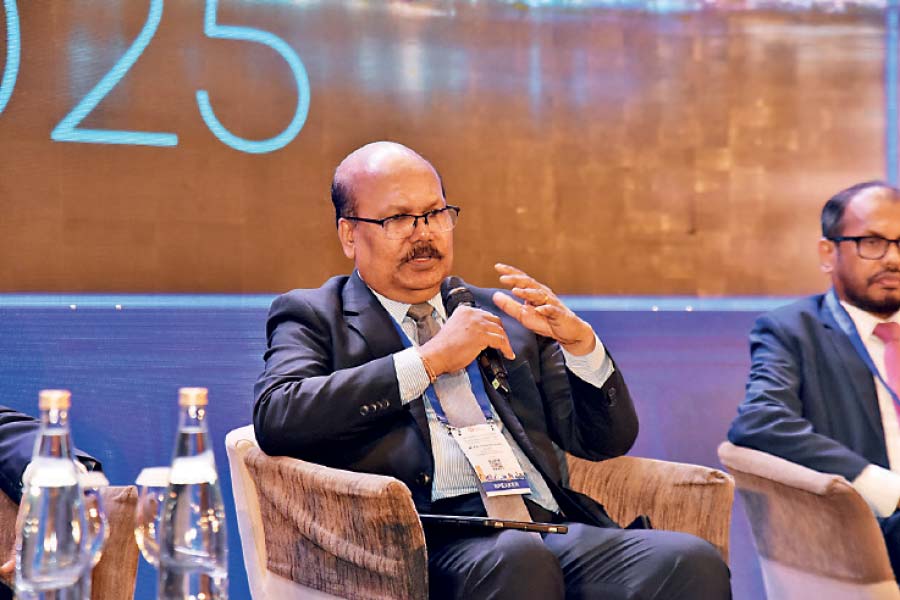
Trade, Commerce and Food Security Ministry Secretary K.A. Vimalenthirarajah – Pic by Upul Abayasekara
By Charumini de Silva
The Trade, Commerce and Food Security Ministry is preparing to introduce a comprehensive national tariff policy by mid-2026, replacing what officials described as decades of “patchwork, sector-specific, and discriminatory” protection that has suppressed competitiveness, discouraged entrepreneurship, and hindered integration into global value chains.
Ministry Secretary K.A. Vimalenthirarajah speaking during a panel discussion at the Sri Lanka Economic Summit organised by The Ceylon Chamber of Commerce on Wednesday said the overhaul will mark a decisive shift away from a revenue-driven, protectionist tariff structure towards a transparent, predictable, and facilitative regime aligned with global trade norms.
He stressed that the existing system, identified by the World Bank as one of the most complex in the world, has created unpredictability, high production costs, and limited the ability of local industries to compete regionally.
He said the Government has now identified 10 core objectives and principles for the new policy, with four central pillars guiding the reform.
The first is establishing predictability and consistency in the tariff regime, addressing longstanding complaints of ad-hoc changes and opaque decision-making. The second is simplification, with the new system designed to dramatically reduce complexity and remove the maze of para-tariffs and overlapping duties. The third is a shift from protection to “time-bound facilitation,” ensuring that any support extended to infant industries is targeted, transparent, and temporary. The fourth is enabling global and regional value chain participation by lowering input costs and ensuring timely access to raw materials, intermediate goods, and capital goods.
“Tariffs cannot be the panacea for every problem. For decades, they have distorted our entrepreneurship ecosystem,” Vimalenthirarajah said, adding that the current structure has discouraged new entrants while forcing existing firms to rely on protection instead of productivity and innovation.
He noted that the new regime will help transform Sri Lanka’s inward-looking Small and Medium Enterprises (SMEs) into export-oriented enterprises and strengthen diversification efforts outlined by the Export Development Board (EDB).
“The Cabinet has already approved the establishment of a National Tariff Committee and a Ministerial Tariff Committee, both of which are working towards finalising the new framework,” he said.
According to Vimalenthirarajah, the entire system is expected to be operational by the middle of next year, marking one of the most significant trade reforms in recent decades.
He also underscored that the tariff overhaul is inseparable from Sri Lanka’s broader trade agenda, particularly ongoing reviews of Free Trade Agreements (FTAs) and the country’s renewed push to expand market access.
“A Cabinet-appointed committee is currently reassessing existing FTAs to develop a technically sound national strategy, including diversification into Asian, African, and Middle Eastern markets,” he added.
He also confirmed that Sri Lanka has received an invitation to join the ASEAN Free Trade Area (AFTA) following earlier requests, a move the Government is evaluating against long-term strategic interests.
The Secretary emphasised that FTAs must be understood correctly: tariff reductions take place in staged phases, often over 15 to 20 years, and require extensive compliance with rules of origin, Sanitary and Phytosanitary (SPS) and Technical Barriers to Trade (TBT) protocols, and other regulatory standards.
Vimalenthirarajah warned that misconceptions have slowed national progress, even though Sri Lanka benefits from multiple concessionary market access schemes that remain underutilised due to limited export depth.
Responding to questions on using mineral resources in negotiations and addressing non-tariff barriers, he noted that Sri Lanka is stepping up engagement with the US and other partners to reduce such obstacles. He said global tariff averages are falling, making non-tariff barriers increasingly influential in determining competitiveness.
As part of its reforms, Sri Lanka will accelerate the implementation of World Trade Organisation (WTO)-aligned protocols, aiming to complete the remaining 14 intellectual property-related agreements within three years.
He added that the Single Window project and broader trade facilitation reforms will address bottlenecks in Customs approvals and compliance, ensuring Sri Lanka becomes a “compliant, predictable, and investment-friendly” economy.
Stating that Sri Lanka “cannot afford to stand alone,” Vimalenthirarajah said the Government is committed to regional integration and will pursue FTAs and economic partnerships that support investment flows, diversification, and export growth.




