Thursday Oct 22, 2026
Thursday Oct 22, 2026
Monday, 8 December 2025 04:43 - - {{hitsCtrl.values.hits}}
|
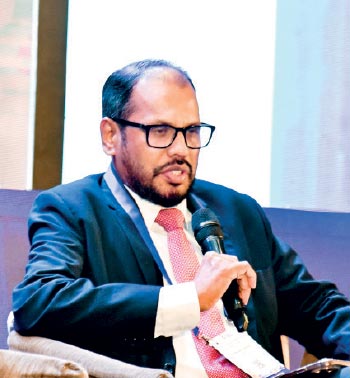
EDB Chairman Mangala Wijesinghe |
Sri Lanka is projected to fall short of its export target of achieving $ 18.2 billion in 2025 due to external and internal shocks, though preparing for a major structural shift in its strategy to boost earnings to $ 20 billion next year.
“We expect to close 2025 with $ 17–17.5 billion in export revenue, slightly below the original forecast of $ 18.2 billion, due to external and domestic factors, particularly the recent adverse weather,” Export Development Board (EDB) Chairman Mangala Wijesinghe said.
Speaking at a panel discussion at the ‘Investment Pulse – Why Sri Lanka: Investor View’ session of the Sri Lanka Economic Summit organised by The Ceylon Chamber of Commerce on Wednesday, he said they, however, remain on track for next year’s target of $ 20 billion.
Over the past 10 months, total exports in both merchandise and services exports amounted to $ 14.4 billion, reflecting a 6% growth rate, which the EDB Chief described as a significant uptick compared with the past decade and signalling a positive trend despite structural vulnerabilities.
He noted that the EDB has set out an ambitious agenda to reduce Sri Lanka’s longstanding dependence on traditional commodities and apparel, aiming to raise the export sector’s share of GDP from roughly 19% to 25% by 2030.
“To reach the $ 36 billion target, comprising $ 28 billion from merchandise and over $ 8 billion from services, Sri Lanka must sustain annual export growth of 10-12% from 2026 onwards,” he said.
Wijesinghe accepted the challenge of moving beyond Sri Lanka’s traditional sectors, stressing that product and value-chain diversification must be paired with market diversification and structural reform.
He said the Government’s strategy, embodied in a soon-to-be-published National Export Development Plan (NEDP) for 2026–2030, aims for total export receipts of about $ 36 billion by the end of the four years, driven by faster growth in both merchandise and services exports.
“The finalised NEDP will be presented in January 2026 and will provide the roadmap for translating targets into investment, skills development, and new-market penetration. If implemented, the combination of tariff reform, digital trade facilitation, renewed trade diplomacy, and focused sector development could substantially de-risk the economy and put exports on a higher-growth trajectory,” he explained.
According to him, the plan, which the EDB has prepared in partnership with the Asian Development Bank (ADB) and after months of stakeholder consultations, rests on three pillars; boosting trade competitiveness, expanding regional and global market linkages, and promoting sustainable, trade-led growth.
To change the composition of the export basket, he said the EDB has identified priority sectors beyond apparel, coconut, rubber, and tea, which together still comprise an estimated 60% of current export value.
He identified several “tier one” sectors earmarked for rapid expansion, including ICT/BPM, which is expected to surpass $ 1.7 billion this year and grow to over $ 5 billion by 2030, as well as logistics, electronics and electrical manufacturing, food and beverages, spices, and gems and jewellery.
“Logistics alone, currently generating around $ 1.7 billion, is projected to grow by 15-20% annually given Sri Lanka’s strategic geographic position. In addition, we have identified mineral-based exports as a high-potential tier-two sector that remains significantly underutilised,” he added.
He said market diversification will also be key to the strategy. “The US still remains the single largest market, accounting for nearly 25% of Sri Lanka’s export earnings, and Europe contributes about 22%. The EDB is pushing for deeper penetration into African, Asian, and Middle Eastern markets. Exports to these regions have grown by over 25% during the January-October period, underscoring their potential,” he pointed out.
The EDB Chief also noted that economic diplomacy has been strengthened, with foreign missions now assigned export performance targets.
“To capitalise on this momentum, the EDB plans to strengthen economic diplomacy and has set performance targets for Sri Lanka’s foreign missions. We are also pushing a formal review of existing free trade agreements (FTAs) and preferential trade arrangements (PTAs) and are proposing negotiations on new FTAs and PTAs to support the $ 36 billion objective,” he said.
He noted that a Ministerial Committee, chaired by Trade, Commerce and Food Security Ministry Secretary K.A. Vimalenthirarajah, has been constituted to evaluate current agreements and will report early next year.
Wijesinghe highlighted significant policy reforms included in the 2026 Budget, particularly efforts to modernise the country’s outdated tariff structure to create a transparent and investor-friendly environment. “The long-discussed National Single Window has finally secured Rs. 2.5 billion in funding to move forward, enabling full online integration of key agencies including the Board of Investment (BOI), EDB, Customs, and the Land Ministry to streamline trade processes and shift to e-invoicing,” he said.
The EDB Chief also stated the reactivation of the Export Development Council of Ministers (EDCM), chaired by the President and revived after nearly 20 years, as a significant governance step.
“The EDCM will play a key role in policy coordination, especially in light of the reconstruction needs following recent disasters. The Council, exporter forums, and sectoral task forces will be responsible for monitoring the implementation of the NEDP and ensuring that reforms remain aligned with national priorities,” he added.
He said the new strategy reflects a decisive shift in Sri Lanka’s export ambitions, balancing diversification, market expansion, and policy modernisation to reduce economic risk and accelerate growth. “The goal is not only to boost revenue, but to transform the export sector into a more resilient and technologically advanced engine of the economy,” Wijesinghe pointed out.