Tuesday Sep 29, 2026
Tuesday Sep 29, 2026
Tuesday, 29 September 2026 03:21 - - {{hitsCtrl.values.hits}}
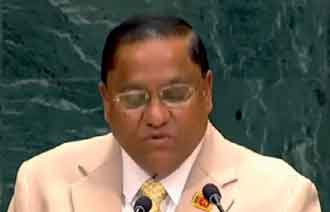
 Foreign Affairs Minister Vijitha Herath addresses UN General Assembly
Calls for reform of global financial system, fairer debt rules and action on $ 4 t SDG financing gap
Backs two-state solution, Gaza ceasefire, total nuclear disarmament and UN80 reform push
|
Foreign Affairs Minister Vijitha Herath |
Sri Lanka has told the UN General Assembly that institutions, national and global, regain public trust only by delivering results. It offered its own recovery from economic crisis as evidence, and called for a fairer international financial system that does not leave small, shock-exposed economies to absorb global disruption alone.
Addressing the General Debate of the 81st session yesterday, Foreign Affairs Minister Vijitha Herath said Sri Lanka had restored macroeconomic stability after the 2022 crisis despite conflict in West Asia and Cyclone Ditwah, and noted that the World Bank had reclassified the country as an upper-middle-income economy.
He cautioned, however, that such gains did not fully reflect the vulnerabilities of countries exposed to debt and external shocks.
“We are building trust through action, not rhetoric; through delivery, discipline, and the courage to confront wrongdoing,” Herath said.
Sri Lanka renewed its call for reform of the international financial system and for fairer rules governing debt and development finance. Herath said the Seville Commitment, which Sri Lanka welcomed last year and which calls for urgent action to close a $ 4 trillion financing gap for sustainable development in developing countries, must now be translated into concrete action.
He described Cyclone Ditwah as one of the worst natural disasters in Sri Lanka’s recent history, claiming hundreds of lives and affecting more than 2 million people. The harshest consequences of climate change, he said, continued to fall on countries that had contributed least to global emissions, making action on climate impact overdue rather than merely urgent. Sri Lanka is on track to achieve 70% renewable energy by 2030 and carbon neutrality by 2050, he added.
The speech’s most distinctive passage concerned an incident in March, when, Herath said, Sri Lanka found a ship belonging to a party to a conflict in distress close to its territorial waters. He said the country marshalled limited national resources to rescue and care for the wounded and sick and went on to rescue hundreds more, acting on international law while safeguarding its neutrality. He did not identify the vessel or the parties involved.
Herath quoted President Anura Kumara Dissanayake: “We will never hesitate to protect humanity. If there are actions that must be taken to protect human lives, we will not hesitate to take them under any circumstance.”
He presented the episode as the image Sri Lanka wished to project abroad: a small island nation convinced that space for humanity survives even amid profound division, and a world whose capacity to uphold humanity should outpace its capacity to destroy it.
On West Asia, Sri Lanka urged all parties to respect international law, including International Humanitarian Law, the rules governing conduct in armed conflict, and said dialogue was the only viable way forward. It reaffirmed support for an independent, sovereign Palestinian State alongside Israel within pre-1967 borders, welcomed the Security Council resolution on a Gaza ceasefire, and called for unobstructed humanitarian access and urgent reconstruction.
Herath said the only real guarantee against nuclear weapons was their total and verifiable elimination, and cited Sri Lanka’s deployment of more than 21,000 peacekeepers on UN missions since 1957. He also reaffirmed Sri Lanka’s commitment to the Law of the Sea and to the Marine Biological Diversity of Areas beyond National Jurisdiction (BBNJ) Agreement, the treaty on marine biodiversity in waters beyond national jurisdiction, of which it is a founding member.
On domestic governance, he said the Government was enforcing anti-corruption laws without fear or favour, that investigations and prosecutions were proceeding without political interference, and that the ‘United as a Nation’ Anti-Narcotics National Program had led to the arrest of key figures in the narcotics supply chain.
Seventeen years after the end of a three-decade conflict, he acknowledged that deep wounds remained, and said the Government was strengthening national institutions to address outstanding issues.
On technology, Sri Lanka called for meaningful technology transfer and equitable access for developing nations, and said it had developed national ethical guidelines for artificial intelligence (AI) in line with international frameworks.
Herath said Sri Lanka supported the UN80 Initiative, the Secretary-General’s program to reform and streamline the UN, arguing that faith in multilateralism required the courage to acknowledge where the system had fallen short. Managing global transformation, he said, could not mean managing change for some while asking others merely to adapt to its consequences.
“My country comes to this Assembly not with the expectation that the UN can solve every problem, but with the conviction that there are problems which no country can solve alone,” Herath said.