Sunday Oct 04, 2026
Sunday Oct 04, 2026
Friday, 29 May 2026 06:42 - - {{hitsCtrl.values.hits}}
|
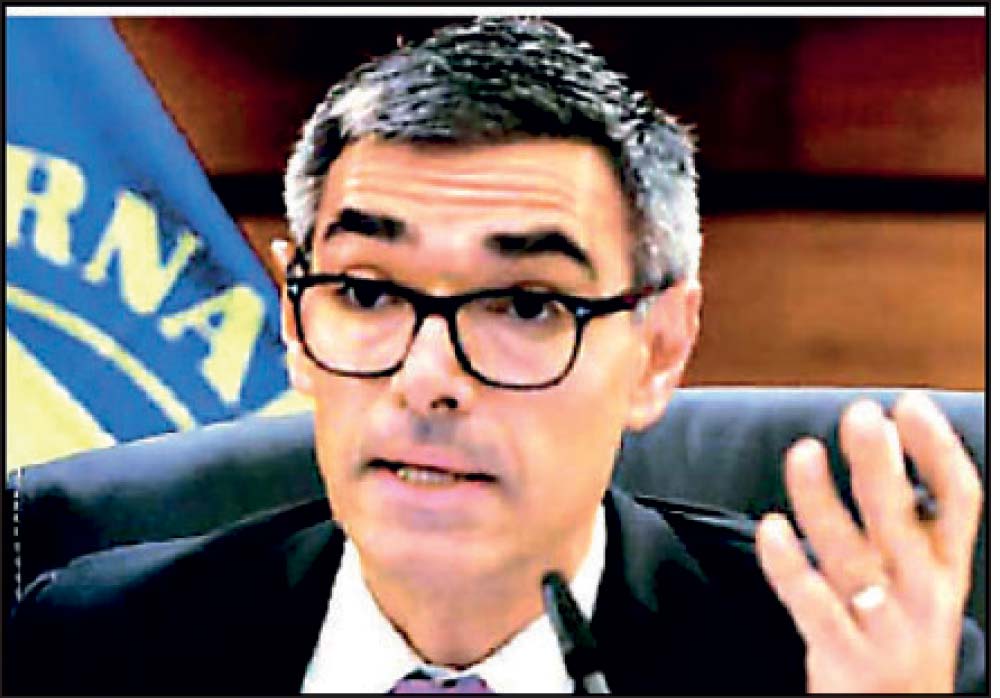
Mission Chief for Sri Lanka Evan Papageorgiou
|
International Monetary Fund (IMF) Mission Chief for Sri Lanka Evan Papageorgiou yesterday said Sri Lanka’s current monetary policy stance remains “broadly appropriate,” despite the Central Bank of Sri Lanka’s (CBSL) recent 100-basis point policy rate hike.
Addressing the media virtually from Washington, he said the country’s macroeconomic recovery remained on track, supported by stabilising prices, improving foreign reserves, and continued economic momentum.
He expressed confidence that Sri Lanka still has strong potential to achieve the IMF’s 3% growth projection.
“We think that there are good, very strong factors in the economy that continue to push economic growth forward,” Papageorgiou said.
His remarks came a day after the IMF approved the combined Fifth and Sixth Reviews under Sri Lanka’s four-year Extended Fund Facility (EFF) program, unlocking around $ 700 million in financing and marking another key milestone in the country’s post-crisis recovery program.
Despite the policy tightening move, Papageorgiou said the IMF still expected inflation to remain broadly aligned with the CBSL’s 5% target, both this year and over the medium term.
“Now, with prices stabilised and foreign reserves continuing to grow as we have in the projection, we do not see any evidence of destabilising monetary expansion,” he added.
Papageorgiou highlighted the significant progress achieved under Sri Lanka’s IMF-supported reform program, noting that inflation, which surged to nearly 60%-70% during the peak of the 2022 economic crisis, had now fallen to low single-digit levels, despite a temporary increase last month linked to external shocks stemming from the Middle East conflict.
He stressed that one of the key reforms under the IMF program had been ending monetary financing of the fiscal deficit by the CBSL.
According to Papageorgiou, the CBSL is no longer printing money to finance Government expenditure, while policy interest rates are being maintained in line with the inflation-targeting framework designed to preserve price stability.
He also defended Sri Lanka’s more flexible exchange rate regime, describing the rupee as an important “shock absorber” against external disruptions.
“In practical terms, allowing the exchange rate to adjust to global developments helps absorb part of the economic pressure from events such as rising global oil prices and geopolitical instability, rather than forcing the burden entirely onto foreign reserves or abrupt policy interventions,” he explained.
Papageorgiou insisted on the importance of maintaining a prudent and rules-based approach to both monetary policy and exchange rate management.
He noted that Sri Lanka’s foreign reserve position continued to improve, although the pace of reserve accumulation had moderated recently as the CBSL intervened selectively to smooth excessive currency volatility linked to the Middle East crisis.
Even so, he said the broader policy direction remained fully consistent with the reform path agreed between Sri Lanka and the IMF. “We do not see any evidence of destabilising monetary expansion,” Papageorgiou reiterated.
He also pointed out that the rupee should serve as the first line of defence against external shocks, particularly when the economy is hit by real sector disruptions such as higher global energy prices.
“In such cases, some adjustment has to happen through the real sector and the currency, rather than trying to hold the exchange rate fixed and risking bigger problems later,” he said.