Thursday Sep 17, 2026
Thursday Sep 17, 2026
Tuesday, 6 January 2026 02:56 - - {{hitsCtrl.values.hits}}
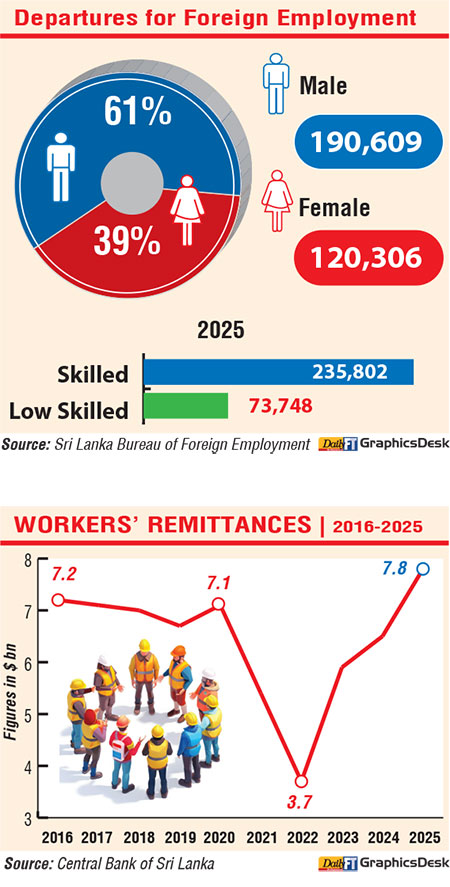 Sri Lanka’s workers’ remittances surged to a historic high of an estimated $ 7.8 billion in 2025, marking the largest annual inflow ever recorded and underscoring a strong post-crisis recovery in external foreign exchange earnings.
Foreign Affairs, Foreign Employment, and Tourism Minister Vijitha Herath announced the milestone yesterday, noting that the figure surpasses the previous decade-high of $ 7.24 billion achieved in 2016.
The 2025 performance reflects an 8% increase over that earlier record and a robust 19% year-on-year (YoY) growth, despite the Central Bank yet to formally confirm December inflows.
“December remittances are estimated at between $ 650 million and $ 700 million, which would lift total inflows for the year to around $ 7.8 billion,” Herath said.
He described the achievement as a significant turnaround for a country that endured a severe foreign exchange crisis just a few years ago, adding that the rebound reflects renewed confidence among Sri Lankans in rebuilding the economy.
The rebound in remittances has been particularly pronounced since the economic crisis. In 2022, inflows slumped to a 12-year low of $ 3.78 billion. This was followed by a sharp recovery in 2023, when remittances jumped by 57% to $ 5.96 billion. The momentum continued in 2024, with a further 10.1% YoY increase to $ 6.57 billion, supported by a surge in outbound labour migration as many Sri Lankans sought overseas employment after the economic collapse.
Historically, between 2014 and 2018, Sri Lanka averaged around $ 7 billion a year in workers’ remittances about $ 600 million per month, highlighting the sector’s long-standing role as a stabilising pillar of the economy.
“The bulk of remittances in 2025 originated from Middle Eastern destinations, including Kuwait, the UAE, Qatar, Saudi Arabia and Israel, alongside inflows from Romania, Japan, the Maldives, Oman, South Korea, Australia and the US,” Herath said.
Foreign Affairs and Foreign Employment Deputy Minister Arun Hemachandra said that in 2025, a total of 310,915 skilled and semi-skilled workers left the country for foreign employment, comprising 190,609 men and 120,036 women.
He also noted that total departures declined by 1.2% YoY, indicating that even with fewer workers going abroad, remittance inflows increased as migrants sent more money back home.
It also noted that workers’ remittances remain a critical non-debt source of foreign exchange, helping to offset balance of payments (BoP) deficits, improve liquidity in the domestic foreign exchange market, strengthen international reserves and enhance Sri Lanka’s overall creditworthiness.
In addition, remittances help the broader socio-economic benefits, including poverty reduction and the promotion of savings and investment.
Despite the strong performance, high remittance costs remain a key concern for migrant workers globally. The United Nations’ 2030 Sustainable Development Goals (SDGs) call for reducing remittance costs to 3% by 2030 as part of efforts to reduce inequality within and among countries.




