Thursday Oct 22, 2026
Thursday Oct 22, 2026
Wednesday, 22 April 2026 00:22 - - {{hitsCtrl.values.hits}}
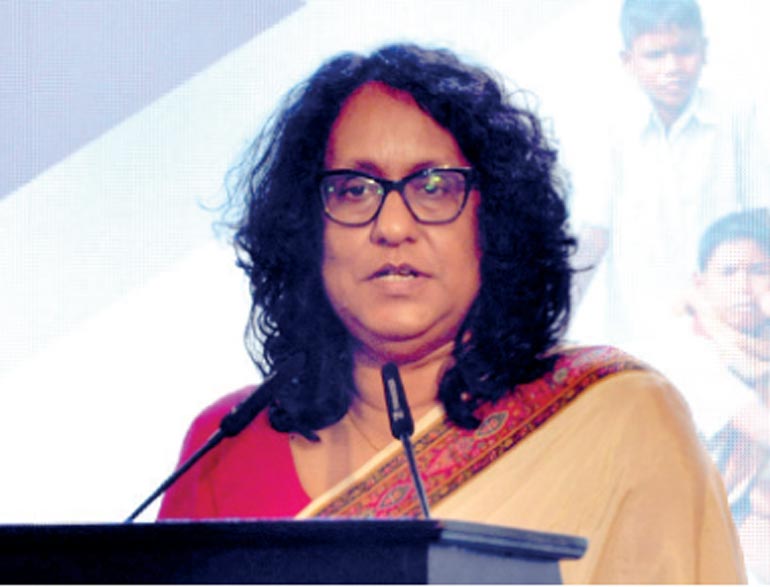
Prime Minister
Dr. Harini Amarasuriya
– Pic by Lasantha Kumara
By Charumini de Silva
At a time when South Asia is rethinking labour markets and social protection, Prime Minister Dr. Harini Amarasuriya yesterday called for a “fundamental rethinking” of how economies define productivity, urging policymakers to recognise unpaid care work as a core pillar of economic systems.
Delivering the keynote at the inaugural session of the three-day ‘South-4-Care Learning Hub’ in Colombo, organised with support from the International Labour Organisation (ILO), World Bank Group and the International Training Centre of the ILO, she stressed that the care economy is “no longer a peripheral issue, but central to how societies function.
“Care work is the foundation upon which both formal and informal economies are built,” Dr. Amarasuriya said, noting that domestic work, childcare, elder care and community support underpin economic activity, but remain largely invisible in policy frameworks.
A key thrust of the Prime Minister’s address was the need to redefine economic categories that exclude unpaid labour.
She argued that conventional measures of labour force participation fail to capture the real extent of women’s economic contribution.
“When we talk about the low participation of women in the labour force, we imagine simply that this is unproductive, and therefore we need to bring men into the labour force. No, it is important that women have the choice whether to work in a labour force or not. However, we also have to recognise that the unpaid work that they do to our families, communities, eventually sustains our economy. That is one of the most important factors in the economy, which does not get recognised, and distorts economic discourse and undervalues women’s contribution to the economy,” she explained.
Dr. Amarasuriya described this invisibility as a structural issue, warning that failure to account for unpaid care distorts economic discourse and undervalues women’s contribution. “We need to move beyond binaries, where productive work is defined only in terms of paid work,” she said, acknowledging that such a shift challenges traditional economic thinking.
Highlighting Sri Lanka’s unique context, the Prime Minister pointed to disconnect between educational achievement and labour market outcomes.
She cited the recent Advanced Level (A/L) examination data, asserting that girls outperformed boys by around 10% across all streams, including technology-related subjects, an outcome she said had “surprised” many.
Despite this progress, she pointed out that the country continues to face, high levels of women dropping out of the workforce due to care responsibilities, persistent domestic violence and social challenges, and gendered concentration in low-paid, informal, or unpaid work.
“This is an anomaly in our society. Our girls are performing so well in education, yet women are leaving the labour force because of care responsibilities,” she stressed.
At a regional level, Dr. Amarasuriya highlighted the intersection between unpaid care work and informal employment across South Asia.
“Millions of women engage in informal sectors including; street vending, domestic work and subsistence agriculture contributing significantly to national economies and global supply chains. It is not because women are not working, it is a question of what kind of work they do,” she said.
The Prime Minister noted that mainstream economic policies fail to recognise these contributions, leading to systemic undervaluation of women’s labour.
Calling for a transformation in policy frameworks, Dr. Amarasuriya urged Governments and institutions to move beyond narrow metrics focused solely on output and efficiency.
“Labour force participation is not simply about productivity, it is about access to opportunity, dignity, and inclusion,” she said.
She highlighted the globally recognised ‘5Rs framework’ as a pathway forward. “Recognise unpaid care work, reduce its burden through services and infrastructure, redistribute responsibilities more equitably, represent care workers in decision-making and reward care work with fair compensation and protection,” she added.
The Prime Minister said Sri Lanka is already moving toward institutionalising this approach. “The Government is developing a national policy on unpaid care work, led by the Women and Child Affairs Ministry in consultation with stakeholders,” she added.
The policy aims to recognise unpaid care as a contribution to national development, reduce the disproportionate burden on women through public services and social protection, promote equitable sharing of care responsibilities across households, communities, the State and the private sector and address entrenched gender norms that assign care work primarily to women.
She also called for integrating care considerations into budgeting, fiscal policy and economic planning, including better measurement of unpaid care work with international technical support.
Dr. Amarasuriya said the South-4-Care Learning Hub, which brought together policymakers, development partners and experts was a critical platform to advance collaboration in South Asia.
She expressed confidence that the discussions would generate meaningful insights and actionable recommendations, to strengthen care systems across the region.
“Care work is not only an economic issue, it is an intergenerational one. It shapes human capital through its impact on education, health and well-being,” Dr. Amarasuriya said, underscoring the need to embed care within future workforce and development strategies.




