Friday Sep 04, 2026
Friday Sep 04, 2026
Friday, 4 September 2026 06:28 - - {{hitsCtrl.values.hits}}
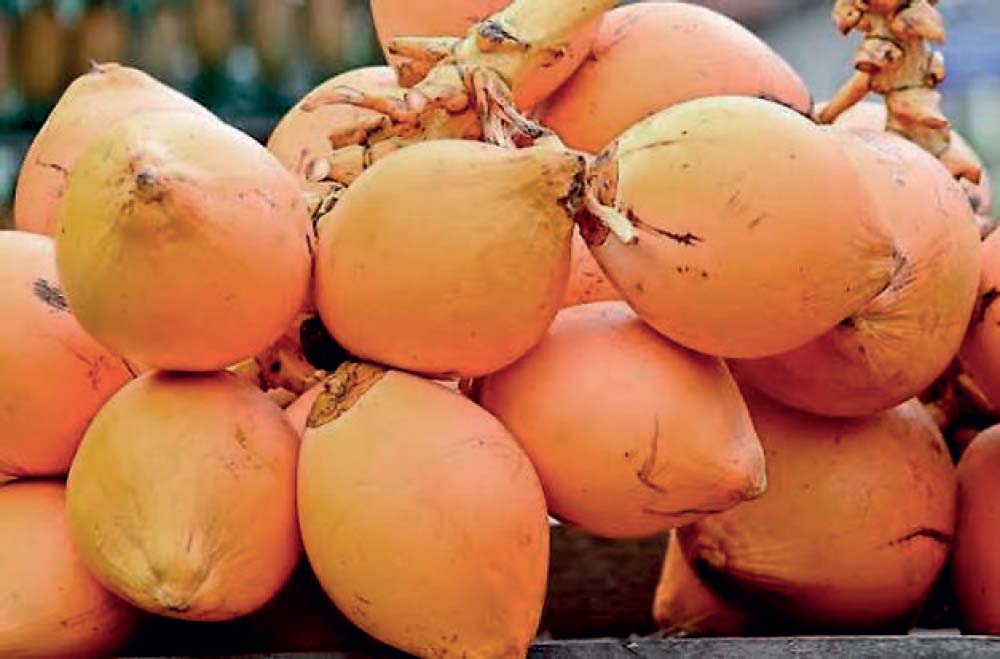 Sri Lanka is positioning its iconic king coconut industry for a major export expansion, with the Government launching a national program to establish 250 dedicated king coconut villages within three years as it seeks to capture a larger share of a rapidly expanding global market.
The “Ceylon King Coconut Village” initiative, launched on Wednesday at the Coconut Cultivation Board’s Mahayaya Estate in Kurunegala to mark International Coconut Day, aims to increase cultivation, productivity, and value addition, while building Sri Lanka’s presence in international markets for king coconut and related products.
The initiative aims to establish 250 king coconut villages islandwide by 2028, with 75 villages planned for this year, followed by 80 in 2027 and 95 in 2028. The initiative reflects an effort to move beyond traditional coconut cultivation towards a more organised production and export ecosystem around king coconut, leveraging Sri Lanka’s established reputation for the product.
Rural Development, Social Security and Community Empowerment Minister Dr. Upali Pannila said the global market for king coconut water-related products is currently estimated at $ 4-5 billion and could nearly double to around $ 10 billion over the next decade.
He said the move would provide Sri Lanka with an opportunity to secure a significant share of that growth, while raising incomes in rural communities.
“This project will help capture a large share of that market,” Dr. Pannila said.
The Government expects the creation of king coconut villages to raise household incomes among rural growers, increase village-level economic activity and generate new employment across cultivation, collection, processing, packaging, logistics, and other segments of the value chain.
Dr. Pannila said the initiative could therefore become an important intervention in addressing rural poverty by creating a broader income-generating ecosystem around the crop.
The program is being implemented by the Plantation and Community Infrastructure Ministry and is intended to take coconut cultivation towards higher productivity and greater commercialisation.
The creation of dedicated production clusters could help address some of the structural challenges facing smallholder agriculture by bringing growers into a more coordinated system, while creating the scale required for processing and export-oriented production.
The emphasis on related products is particularly significant given the global growth in demand for coconut water and other coconut-based beverages and ingredients.
Dr. Pannila also linked the initiative to the country’s wider external-sector challenge. He noted that Sri Lanka earned nearly $ 14 billion from merchandise exports last year, while services, IT, and tourism generated a further $ 7 billion. Against this, imports amounted to nearly $ 22 billion, highlighting the continuing need to expand foreign-exchange generating sectors.
The launch brought together senior officials from the plantation and agriculture sectors, including Plantation and Community Infrastructure Minister Samantha Vidyaratne, Agriculture and Livestock Deputy Minister Namal Karunaratne, Plantation and Community Infrastructure Deputy Minister Sundaralingam Pradeep, North Western Province Governor Tissa Kumarasiri, Plantation and Community Infrastructure Ministry Secretary Gunadasa Samarasinghe, International Coconut Community Director General Dr. Ir. Jelfina C. Alouw, and Indian Assistant High Commissioner Saranya V.S. Chairmen of the Coconut Cultivation Board, Coconut Development Authority, and Coconut Research Institute were also present.



