Sunday Oct 11, 2026
Sunday Oct 11, 2026
Monday, 20 April 2026 05:06 - - {{hitsCtrl.values.hits}}
|
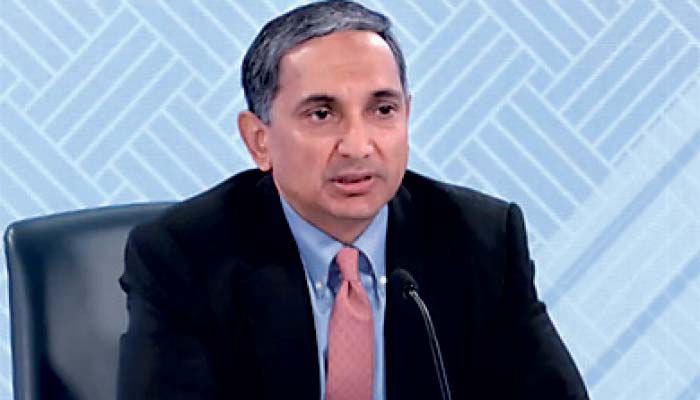
Asia Pacific Department Director Krishna Srinivasan
|
Sri Lanka is in a stronger position to cushion the impact of rising energy costs following improvements in revenue mobilisation, though vulnerabilities remain due to its reliance on fuel imports, the International Monetary Fund (IMF) said last week.
IMF Asia Pacific Department Director Krishna Srinivasan, speaking at a press conference at the launch of the Regional Economic Outlook for Asia and the Pacific last Thursday, said the country has rebuilt fiscal space since the crisis, providing room for limited intervention.
“In the case of Sri Lanka, over the last three years, they have made significant improvement in boosting their tax revenues, revenues as a share of GDP. So they have gradually built up fiscal buffers,” he said.
“So in some sense, I would say they’re better placed to provide support to people who are hurting from this energy shock,” Srinivasan added, while cautioning that any measures must be “very targeted and temporary” and implemented efficiently.
The IMF noted that Sri Lanka, like much of Asia, remains exposed to global energy market volatility due to its dependence on imported oil and gas. Across the region, energy use accounts for a significant share of output, translating into sustained pressure on external balances when prices rise.
The Fund’s latest Regional Economic Outlook indicates that while Asia’s growth remains resilient, the outlook is becoming less favourable. Growth is projected to moderate from 5% in 2025 to 4.4% in 2026, with inflation expected to rise in the near term. External balances are weakening and risks are tilted to the downside, particularly if energy prices remain elevated for longer.
The IMF also highlighted that economies with high import dependence and limited buffers face greater exposure to prolonged shocks. In Sri Lanka’s case, recent gains in revenue and reserves provide some resilience, but the economy remains sensitive to external developments, including disruptions linked to the Middle East conflict.
Sri Lanka recently reached a staff-level agreement with the IMF following the Fifth and Sixth Reviews under the Extended Fund Facility (EFF), which could unlock about $ 700 million subject to Executive Board approval. Progress on cost-reflective energy pricing and completion of external debt restructuring remain key conditions.
The IMF stressed that sustaining the recovery will depend on maintaining reform momentum, including strengthening governance frameworks, advancing trade liberalisation, accelerating digitalisation, and improving the regulatory environment.