Thursday Mar 26, 2026
Thursday Mar 26, 2026
Wednesday, 3 December 2025 02:33 - - {{hitsCtrl.values.hits}}
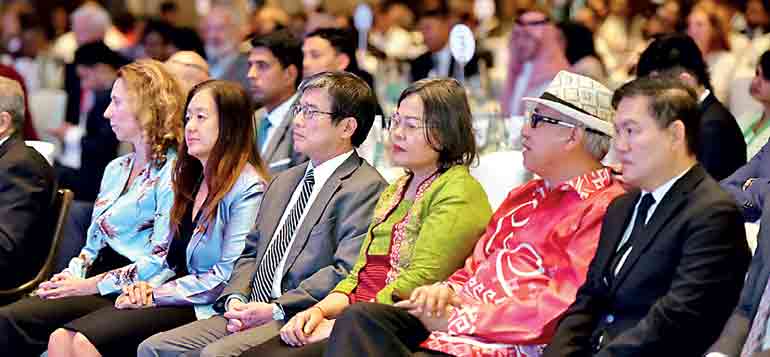
The Sri Lanka Economic and Investment Summit 2025, the flagship annual forum of the Ceylon Chamber of Commerce, opened yesterday with over 800 participants, including 100 foreign delegates.
Originally planned around the theme “Gateway to Growth: Asia’s Emerging Opportunity”, the summit’s agenda in the aftermath of the devastating effects of Cyclone Ditwah instead became a conversation on national resilience, near-term recovery and the task of rebuilding stability after the debt crisis.
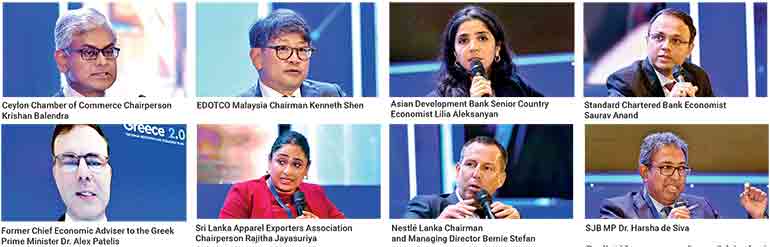
Opening the event, Ceylon Chamber of Commerce Chairperson Krishan Balendra said the disaster had altered the national mood and the purpose of the summit. He noted that the Chamber had paused its original program to reflect on the loss of life and widespread destruction, and said the business community was working with Government agencies to support relief operations.
Balendra said the summit, now in its twenty-fifth year, would proceed with a revised focus to examine how the country can recover quickly, safeguard macroeconomic stability and preserve the gains made since the economic collapse in 2022. All funds originally earmarked for social activities will be redirected to relief work.
Despite the immediate crisis, he said Sri Lanka remained on a credible path of economic recovery, with inflation stabilising, confidence improving, growth nearing 5%, domestic debt restructuring completed and stronger inflows from exports, tourism and remittances. International institutions, including the IMF and the World Bank, had also signalled confidence in the reform trajectory.
Balendra said the strong turnout of over 800 delegates, including more than 100 foreign participants, reflected renewed investor interest in the country’s medium-term prospects and its position in the Indian Ocean.
The two-day program will examine the macroeconomic outlook, lessons from other post-crisis recoveries and opportunities across tourism, logistics, ports, exports, manufacturing, technology and capital markets. Speakers include resource persons from Malaysia, Greece, the Netherlands, Australia, India and several multilaterals.
He called on public and private sector leaders to use the summit to reinforce reforms, strengthen resilience and convert investor interest into realised investment. “The country’s recovery”, he said, “depends on policy continuity and the ability to sustain credible long-term growth”. The stage was set for the discussion to move to the broader meaning of the moment, the keynote focused on how countries emerging from turmoil can use disruption to reset their economic direction.
Crises as turning points
Delivering the keynote address, EDOTCO Malaysia Chairman Kenneth Shen said Sri Lanka stood at a point where the turbulence of recent years could be converted into long-term institutional and economic gains.
Drawing on experience at Khazanah Nasional, Qatar Investment Authority and major investment banks, he argued that countries emerging from crisis often gain a window to reposition their economies if they strengthen governance and create credible investment institutions.
Shen said progress under the IMF program, including stabilised inflation, normalised policy rates and stronger investor sentiment, showed that Sri Lanka was emerging stronger than it went into the crisis. He placed Sri Lanka’s situation within broader global shifts: Geopolitical fragmentation, climate impacts, demographic pressures, energy transitions, supply-chain reconfigurations and rapid advances in artificial intelligence. These, he said, opened opportunities for smaller economies that can adapt quickly.
He said Sri Lanka’s natural advantages, including its maritime location, tourism assets, natural resources and strong human capital, provided a foundation to build on. But investment, he said, would depend on greater transparency. A lack of transparency, he noted, deters both local and foreign investors.

Drawing on the Malaysian experience, Shen said small economies benefit from having a central, well-governed sovereign investment institution that can restructure state assets, crowd in private capital and direct limited national resources towards priority sectors. Malaysia’s reforms, he said, showed how such a model can raise standards, catalyse new industries and reduce pressure on public finances.
He said Sri Lanka could apply similar principles to unlock value in State-owned enterprises, strengthen governance and attract long-term investment. With resilience already evident and reforms in motion, he said the country could position itself to draw sustained foreign capital if it remains focused on transparency, sustainability and inclusive growth.
The conversation then shifted to the quality of the recovery, with attention on whether recent stabilisation is translating into durable, investment-driven expansion.
Consumption to investment-led growth
Asian Development Bank Senior Country Economist Lilia Aleksanyan said the institution was assessing an emergency assistance loan following Cyclone Ditwah, similar to the $ 200 million facility consolidated from undisbursed project funds during the 2022 crisis. The size and scope of the new loan would depend on the Government’s post-disaster needs assessment, with room to adjust parts of the 2026 pipeline for reconstruction and climate-resilient infrastructure.
Aleksanyan said Sri Lanka’s recovery path for 2024 and 2025 remained broadly intact before the disaster, supported by lower interest rates, rising private credit and improved macroeconomic fundamentals. She cautioned, however, that growth remained driven mainly by consumption rather than long-term investment. “The durability of the recovery depends on shifting towards an investment-led model backed by reforms, predictable policies and non-debt-creating foreign inflows,” she said.
She said the disaster underscored the need to prioritise climate-resilient infrastructure and build greater shock-absorption capacity. Beyond the immediate horizon, she highlighted uncertainties in global trade patterns, shifting supply chains and the evolving tariff environment. Businesses, she said, would have to reassess export markets, supply-chain risks and intermediate input dependencies as Asia adjusts to what she described as a new trade landscape shaped by persistent uncertainty.
Against that backdrop, the summit turned to how markets are reading Sri Lanka’s trajectory, and why investors remain engaged despite the immediate shock of the disaster.
Investor confidence holding
Standard Chartered Bank Economist Saurav Anand said three categories of investors are currently engaging with Sri Lanka: Holders of dollar bonds, buyers of local-currency Government securities and corporate investors evaluating foreign direct investment opportunities. He said all three groups remained broadly positive, with confidence anchored in Sri Lanka’s performance against IMF benchmarks and expectations that nominal GDP could reach $ 100 billion dollars within the program period.
Anand said foreign holders of Government securities were focused on policy continuity and exchange-rate stability, while corporate investors were monitoring structural reforms and geopolitical positioning. Several multinational firms had already undertaken exploratory visits to assess project opportunities and possible entry points.
He said Cyclone Ditwah had prompted early investor questions, particularly on fiscal space, but concerns so far remained limited due to the buffers built through stronger-than-expected fiscal performance. The greater risk, he said, was the potential impact on the external account if reconstruction pressures outpace inflows.
He added that the broader global environment remained uncertain. Persistently high US inflation, limited monetary policy space in emerging markets, the potential effect of US tariff rulings and liquidity-driven volatility across asset classes were all factors influencing investor decisions. These dynamics, he said, will shape capital flows into emerging markets, including Sri Lanka, over the coming year.
Among the many questions, what will Sri Lanka do after the IMF program ends lingers. The summit offered an opportunity to compare Sri Lanka’s current phase within the experience of other crisis economies, emphasising the discipline required once formal IMF support tapers off.
After the IMF
Drawing parallels between Sri Lanka’s current reform phase and Greece’s experience with debt restructuring, multiple IMF programs and political volatility, former Chief Economic Adviser to the Greek Prime Minister Dr. Alex Patelis said countries emerging from crisis must adopt simple, disciplined and clearly communicated reform strategies. Success after an IMF program, he said, depends less on sophisticated policy design and more on focus, consistency and the ability to assign the strongest people to key tasks. Dr. Patelis said Greece’s recovery underscored the importance of institutional safeguards that prevent repeated policy mistakes. He urged Sri Lanka to entrench core reforms in laws, rules and constitutional structures that future governments cannot easily reverse. If institutional changes are sufficiently strong, he said, they build visibility and credibility.
He said governments must also convey a coherent national strategy to foreign investors, who have limited time and attention. Investor perception often hinges on whether a country offers a clear long-term direction rather than temporary incentives. Engagement, clarity and targeted outreach were central to Greece’s attempt to rebuild confidence. Dr. Patelis said countries must maintain ownership of their reform agenda rather than rely entirely on the IMF. Political transitions, he said, should not disrupt the economic trajectory, since investors always anticipate changes in government.
Despite the difficulties Greece faced during its decade of crisis, Dr. Patelis delivered an optimistic message. With stable institutions, clarity of purpose and consistent implementation, countries can emerge stronger.
“Greece is now growing faster than before its EU bailout and has regained investor confidence. Sri Lanka could follow a similar path through disciplined execution and credible long-term signalling,” he said.
The summit also heard industry voices, outlining how the apparel industry is coping with the disaster while reassessing competitiveness in a shifting global trade environment.
Creating differentiation
Sri Lanka Apparel Exporters Association Chairperson Rajitha Jayasuriya said the industry was still gathering information on the impact of Cyclone Ditwah, with early assessments suggesting that between 2,000 and 3,000 employees had been displaced and several factories in the central region remained inaccessible or flooded. She said figures were still shifting as access improved. “People cannot get to work. Roads have collapsed. We have no transportation,” she said.
Jayasuriya said export processing zones had stabilised to some extent, but factories outside the zones, particularly in the central districts, had suffered significant damage. She said it could take three to four months for operations to return to normal.
While manufacturing capacity remained intact, holiday-season exports risked delays due to broken transport links, limited access and fuel shortages. The industry was not seeking food or relief items, she said, but needed logistical support from the Government to move workers, inputs and finished goods.
She also addressed the recent US tariff outcome, saying the 20% tariff rate negotiated for Sri Lanka provided a reset in the country’s competitive position. It offered relief and a degree of parity in the region, she said, at a time when destinations such as Malta had become particularly expensive. But she stressed that competitiveness was not determined by tariffs alone.
Referring to Vietnam, she said Sri Lanka could not compete directly with a country that had spent more than a decade consolidating its manufacturing strength through large-scale foreign investment, supply chain relocation from China and deep integration across production segments. Vietnam’s export volume is eight times that of Sri Lanka’s, she said, and its supply-chain verticality gives manufacturers a structural advantage.
She said Sri Lanka remained poorly placed in terms of trade access. Vietnam has more than twelve major free trade agreements, including the CPTPP, RCEP and an EU–Vietnam FTA. These give Vietnam lower entry costs and greater certainty in key markets.
“This is not a moment to lose Sri Lanka, but a moment to position ourselves differently,” she said.
Jayasuriya said Sri Lanka should build on its strengths in producing highly technical apparel, particularly in intimates and active wear, supported by strong design capability and a reputation for manufacturing reliability and ethical compliance. She said the country needed to anticipate emerging regulatory requirements in supply-chain transparency and sustainability reporting and develop a national-level framework that signalled leadership in these areas.
“We cannot compete on volume or scale,” she said. “We must differentiate and position Sri Lanka as a high-compliance, high-capability manufacturing destination, while restoring the connectivity we need to operate today.”
The perspective from multinationals highlighted the practical constraints facing operations on the ground and what foreign firms look for when deciding whether to deepen their presence.
Stable base for FDI
Nestlé Lanka Chairman and Managing Director Bernie Stefan said the consumer goods sector remained confident of maintaining supply but faced serious short-term challenges in distribution, water access and retail network disruption. While some firms had avoided major damage due to elevated warehouse locations, others could not restart production immediately because access to clean water had been interrupted. Restoring operations, he said, would take several days.
Stefan said road connectivity remained the largest obstacle. Even after production resumed, companies struggled to move goods out of factories or secure fuel in affected districts. Nestlé’s distribution network had reported shortages in parts of the country, and thousands of retail outlets were inaccessible. He estimated that between 20 and 30% of the country’s 160,000 small retail stores may have been affected, with many ground-floor shops flooded.
On the broader operating environment, Stefan said Sri Lanka continued to offer multinationals a stable base, supported by strong corporate governance and a skilled labour force. Nestlé, which operates in 180 countries, has maintained a presence in Sri Lanka for 120 years and invested heavily in manufacturing, sustainability and export capability.
Its Pannala facility supplies over 90 percent of domestic output and exports coconut milk powder to 60 countries. He noted that Sri Lanka’s coconut exports would reach one billion dollars this year for the first time, but said the country could potentially double or triple that figure with higher yields and greater efficiency.
Stefan said foreign investors did not make decisions based solely on tax incentives. Predictable processes and ease of doing business mattered more. Productivity improvements, particularly in agriculture and labour markets, were essential if Sri Lanka was to position itself as a competitive manufacturing and export hub.
We return to the final intervention in domestic policy and the structural changes needed for sustained growth.
Fiscal complacency
SJB MP Dr. Harsha de Silva warned that Sri Lanka’s current fiscal buffers, generated by higher-than-expected tax revenue and stronger collections from debtors, should not lead policymakers to ease discipline or drift from the IMF program. He said the primary surplus had exceeded its target and the two state banks were collectively holding more than Rs. 1 trillion in cash. These buffers, he said, were not a licence for arbitrary spending. “We must not step away from the IMF program,” he said.
Dr. de Silva said the Government’s limited capacity to execute capital spending must be taken into account. Although the 2025 Budget allocated Rs. 1.3 trillion for capital expenditure, under Rs. 500 billion had been spent by end-September and under Rs. 600 billion by end-October. “There are constraints. The Government cannot spend,” he said. Sustained recovery required both public and private investment and long-delayed structural reforms. He said reforms in energy, agriculture, labour markets, capital markets and land administration were essential to raise productivity. Productivity growth had been negative for much of the past decade, he noted, and labour force participation had fallen from 52% to 48%. He also criticised the reversal of the Sri Lanka Electricity Board Act, saying it weakened prospects for private investment in power generation and transmission.
On investment policy, Dr. de Silva said inconsistent treatment of investors under different regimes, including Port City and the Strategic Development Project framework, had created distortions. While recent amendments had improved the frameworks, incentives still differed significantly between zones. This risked drawing investment into specific areas while leaving the wider economy behind.
Dr. de Silva said both the Port City Special Economic Zone for services and the newer manufacturing SEZ needed to function effectively. Investors should be supported based on clear criteria such as export performance, employment creation and sectoral impact, he said, rather than receiving location-based concessions. He said historical misuse of the SDP regime for discretionary tax holidays, sometimes as low as $ 15 to 25 million per project, had eroded revenue and contributed to fiscal pressures. On reconstruction financing, Dr. de Silva said about Rs. 1 trillion rupees was already available for immediate deployment without new legislation. Disaster spending would not fall under the 13% of GDP cap on other expenditure, and exemptions under the Central Bank Act allowed monetary support in the event of a natural disaster. Additional allocations would be needed in next year’s budget as rebuilding advances.
Dr. de Silva said fiscal rules and improved public finance management had strengthened discipline, but warned against using buffers to accumulate surpluses “larger than necessary” at the expense of investment. Sri Lanka, he said, could not rely on incremental inflows. Sustainable growth depended on opening the economy, accelerating reforms and attracting substantial foreign and domestic private capital.
“There is only one way to grow,” he said. “Open up this country and reach out to the world.”
Here’s a closing that fits the tone of the piece—measured, grounded, and written the way a business desk would wrap up a long summit report:
Although the summit opened under the shadow of a national disaster, the interventions across the sessions pointed to the same conclusion: the window for a durable recovery is open, but it will not stay open on sentiment alone. Sri Lanka’s ability to turn stabilisation into sustained growth now rests on how quickly it can execute reforms, restore connectivity, rebuild capacity and give investors a reason to stay engaged long after the crisis headlines fade.
- Pix by Ruwan Walpola



