Thursday Jun 11, 2026
Thursday Jun 11, 2026
Saturday, 20 December 2025 00:33 - - {{hitsCtrl.values.hits}}
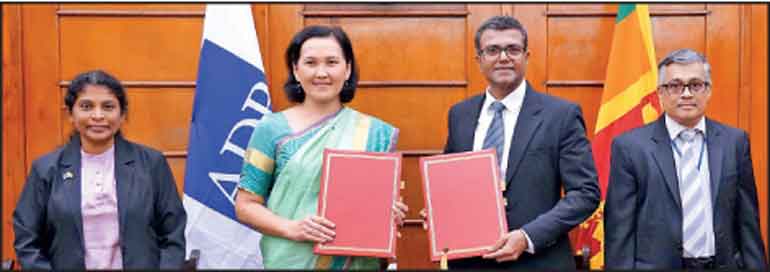
Treasury Secretary Dr. Harshana Suriyapperuma (right) with ADB Sri Lanka Resident Mission Country Operations Head Cholpon Mambetova
Sri Lanka yesterday formalised a new partnership with the Asian Development Bank (ADB) to introduce innovative, climate-resilient irrigation solutions aimed at strengthening food security and water management in the country’s drought-prone Dry Zone.
The grant agreement for the Transforming Irrigation Systems for Improved Food Security Project was signed at the Finance Ministry in Colombo, with Treasury Secretary Dr. Harshana Suriyapperuma, signing on behalf of the Government of Sri Lanka, and ADB Sri Lanka Resident Mission Country Operations Head Cholpon Mambetova representing the regional lender.
The project will be financed through a $ 3 million grant from the Japan Fund for Prosperous and Resilient Asia and the Pacific, complemented by $ 1.63 million in counterpart funding from the Government of Sri Lanka, reflecting a shared commitment to modernising irrigation infrastructure and enhancing agricultural resilience.
The initiative is designed to address persistent challenges in Sri Lanka’s irrigation sector, where nearly 99% of the national network consists of open, gravity-fed earthen canals. These systems suffer from low conveyance efficiency, leading to significant water losses, reduced irrigation reliability and declining crop productivity, particularly in areas increasingly affected by prolonged droughts and erratic rainfall patterns linked to climate change.
Under the project, four pilot Pipe Distribution Network schemes will be implemented in the North Western and Uva Provinces, covering approximately 877 hectares across existing irrigated command areas and adjoining rain-fed uplands. The selected sites include the Kirindigalla Grama Niladhari Division under the Ridi Bendi Ela feeder canal, feeder canal areas under the Magalla and Inginimitiya reservoirs in the North Western Province, and the Meegas Ara small tank cascade system in the Uva Province.
By replacing or supplementing traditional open canals with closed pipe systems, the project seeks to significantly reduce water losses, improve delivery efficiency and enable more reliable irrigation scheduling. The improvements are expected to translate into higher yields, better water security for farmers and greater resilience of agricultural systems in climate-stressed regions.
The Agriculture, Livestock, Lands and Irrigation Ministry will function as the Executing Agency, while the Irrigation Department will serve as the Implementing Agency responsible for technical delivery and on-ground execution. Project implementation is scheduled for the 2026–2029 period.




