Wednesday Jul 15, 2026
Wednesday Jul 15, 2026
Tuesday, 14 July 2026 07:05 - - {{hitsCtrl.values.hits}}
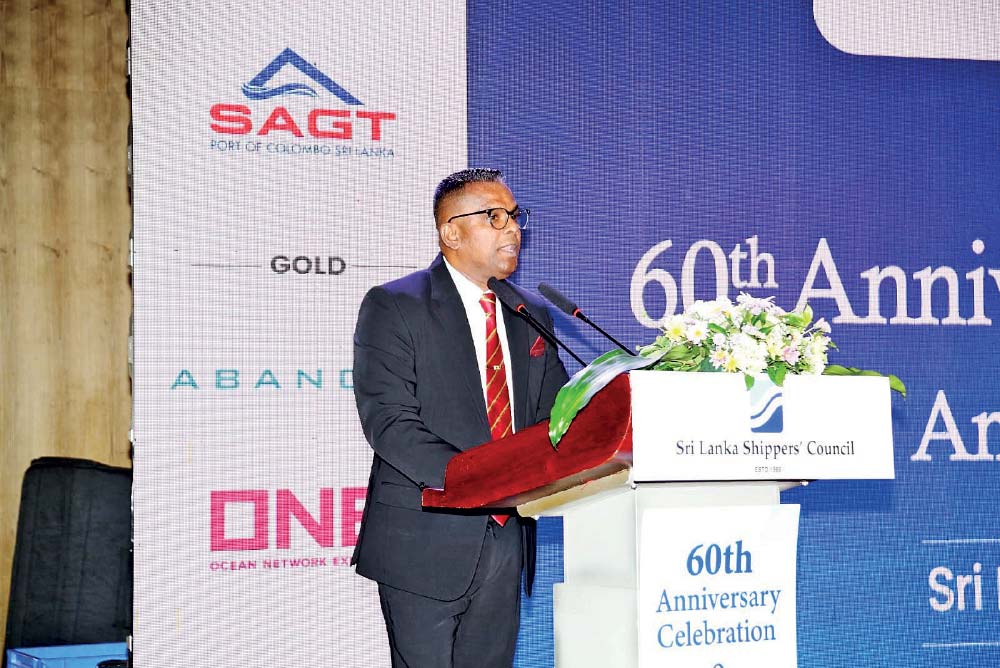
Chairman Trisherman Frink
By Charumini de Silva
The Sri Lanka Shippers’ Council (SLSC) has renewed its call for sweeping trade facilitation reforms, warning that hidden logistics costs, border delays, and outdated regulations continue to erode the competitiveness of Sri Lankan exporters and importers.
Addressing the Council’s 60th anniversary celebrations and 56th Annual General Meeting (AGM) last Friday, Chairman Trisherman Frink said eliminating unnecessary logistics costs remains the organisation’s core mission as it seeks to position Sri Lanka as a more efficient and competitive trading nation.
“Our vision is simple yet powerful—to enhance the competitiveness of our members by abolishing hidden logistics costs,” he said.
Frink stressed that every unnecessary border delay, inefficient procedure, avoidable surcharge, and outdated regulation ultimately increases the cost of doing business and weakens the international competitiveness of Sri Lankan companies.
“As the apex body representing Sri Lankan shippers, we have both a responsibility and an obligation to work with Government, regulators, and industry stakeholders to remove these barriers and create a logistics environment that enables businesses to compete successfully on the global stage,” he said.
He noted that the global trading landscape is evolving rapidly, driven by changing supply chains, digital transformation, intensifying competition among ports, and shifting international trade policies.
“In this environment, standing still is not an option. We must continuously adapt. We must innovate. And above all, we must work together,” Frink said, urging greater collaboration among Government agencies, regulators, ports, shipping lines, logistics providers, exporters, and importers.
Reflecting on the Council’s activities over the past year, Frink said the organisation had continued to represent the interests of Sri Lankan shippers through constructive engagement, evidence-based advocacy, and collaboration with policymakers.
“We firmly believe that sustainable progress is achieved not through confrontation but through dialogue, mutual respect, and partnership,” he said.
The Council strengthened its engagement with key public institutions during the year, including Sri Lanka Customs, the Sri Lanka Ports Authority, the Board of Investment, the Merchant Shipping Secretariat, the Export Development Board, Airport and Aviation Services (Sri Lanka), and the Asian Development Bank.
He thanked the heads of these institutions for maintaining open dialogue with the private sector, noting that while differences of opinion may arise, the shared objective remains improving Sri Lanka’s business environment.
Trade facilitation, he said, continues to be one of the Council’s highest priorities.
“International trade is no longer measured only by the quality of a product. It is measured by the speed, efficiency, predictability, and the cost of moving that product across borders,” he said.
Frink noted that repeated documentation requirements, unnecessary paperwork, delays in cargo clearance, and prolonged container dwell times add significantly to business costs, with exporters, importers, and ultimately the national economy bearing the burden.
“Our objective has never been to assign blame. Our objective is to build solutions that create value for everyone,” he added.
He also said the Council had actively participated in meetings of the Asian Shippers’ Alliance and the Global Shippers’ Alliance, strengthening links with counterpart organisations across Asia, Europe, Australia, and North America.
He opined that these partnerships provide valuable opportunities to exchange knowledge, monitor emerging global trade trends, and ensure that the interests of Sri Lankan shippers are represented internationally.
Frink outlined the Council’s priorities for the coming year, including advocating policies to enhance Sri Lanka’s trade competitiveness, accelerating digital trade facilitation initiatives, working with State agencies to remove unnecessary logistics barriers, and strengthening engagement with international organisations to introduce global best practices.
He stressed that the Council’s achievements have been built on collective effort rather than individual contributions.
“No organisation succeeds because of the efforts of one individual. Success is achieved through teamwork, commitment, and a shared vision. Let us continue to build bridges rather than barriers,” he said.




