Thursday Sep 10, 2026
Thursday Sep 10, 2026
Friday, 5 June 2026 04:12 - - {{hitsCtrl.values.hits}}
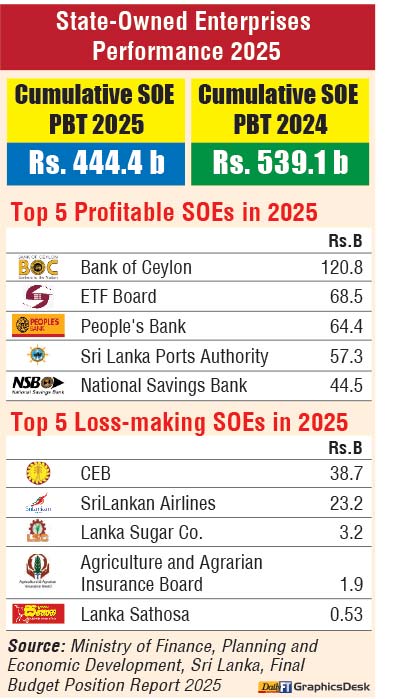 Sri Lanka’s major State-owned enterprises (SOEs) reported lower overall profitability in 2025, as a sharp reversal in the financial performance of the Ceylon Electricity Board (CEB) outweighed strong earnings growth across the rest of the State enterprise sector, according to the Finance Ministry’s Final Budget Position Report 2025.
The country’s main 51 SOEs recorded a combined profit of Rs. 444.4 billion in 2025, down 17.6% from the previous year. However, excluding the CEB, the remaining 50 SOEs generated profits of Rs. 483.2 billion, up 21.5% from Rs. 397.5 billion in 2024, indicating that the decline in aggregate profitability was driven entirely by the deterioration in the electricity utility’s financial performance.
The stronger performance of the broader SOE sector also boosted Government revenue. Collections through levies and dividends increased by 37.5% to Rs. 56.5 billion in 2025 from Rs. 41.1 billion a year earlier.
The report highlighted a series of reforms undertaken during the year as part of the Government’s SOE restructuring agenda. These included Cabinet approval to close, restructure, or merge several non-commercial SOEs, approval for the liquidation of 33 non-functional entities, and the drafting of the Public Commercial Enterprises Management Bill aimed at strengthening governance, accountability, transparency, and commercial discipline across public enterprises.
The Government also implemented reforms at State-owned banks under the Cabinet-approved State-Owned Banks Reform Policy. Independent directors were appointed with the assistance of a professional selection committee, resulting in independent directors constituting the majority on the Boards of State-owned banks.
The strongest profit contributors in 2025 remained the State-owned banking sector and major commercial enterprises.
Bank of Ceylon (BOC) emerged as the most profitable SOE with earnings of Rs. 120.8 billion, followed by the Employees’ Trust Fund Board at Rs. 68.5 billion and People’s Bank at Rs. 64.4 billion. Sri Lanka Ports Authority (SLPA) reported profits of Rs. 57.3 billion, reflecting the continued strength of port and logistics activities, while National Savings Bank (NSB) recorded profits of Rs. 44.5 billion. The Ceylon Petroleum Corporation (CPC) also remained among the leading contributors, reporting Profit Before Tax (PBT) of Rs. 36.5 billion amid lower global oil prices and the continued operation of the fuel pricing formula.
On the loss-making side, the CEB accounted for the largest deficit, recording a loss of Rs. 38.7 billion following a series of tariff reductions that sharply reduced revenue despite higher electricity consumption. SriLankan Airlines reported the second-largest loss at Rs. 23.2 billion, as foreign exchange losses and debt servicing obligations continued to weigh on financial performance despite stronger operating results. Other loss-making entities included Lanka Sugar Company, which recorded a loss of Rs. 3.2 billion, the Agriculture and Agrarian Insurance Board with a loss of Rs. 1.9 billion, and Lanka Sathosa, which reported a loss of Rs. 530 million.
Together, the figures illustrate the continued divergence between commercially-oriented SOEs, particularly banks and infrastructure entities, and enterprises facing structural operational and financial challenges.
CEB returns to loss
The largest setback within the SOE sector came from the CEB, which reported a net loss of Rs. 38.7 billion in 2025 compared to a net profit of Rs. 141.6 billion in 2024. The reversal occurred despite the existence of a cost-recovery pricing mechanism and followed a series of tariff reductions approved by the Public Utilities Commission of Sri Lanka (PUCSL), including reductions of 21.9% in March 2024, 22.5% in July 2024, and a further 20% reduction in average end-user tariffs in January 2025. A subsequent 15% tariff increase in June 2025 was insufficient to offset the cumulative impact of those reductions.
Electricity sales revenue fell 22.8% to Rs. 422.2 billion despite electricity consumption increasing 5.9% to 16,088 GWh. Direct generation costs increased marginally by 1.4% to Rs. 309.6 billion, while transmission and distribution costs rose 22% to Rs. 256 billion and corporate expenses increased 50% to Rs. 21.5 billion. The utility consequently recorded an operating loss of Rs. 26.1 billion, compared with an operating profit of Rs. 159.8 billion in 2024. Outstanding obligations to the CPC and independent power producers increased to Rs. 28.5 billion from Rs. 14.5 billion.
The report noted that higher rainfall and the addition of approximately 900 MW of non-conventional renewable energy capacity, largely from solar power, reduced reliance on coal and fuel-based generation. This contributed to a decline in the average unit cost of electricity supplied to Rs. 30.23 per kWh from Rs. 31.16 per kWh in 2024.
The Government also accelerated power sector reforms during the year. Six fully Government-owned successor companies were established as part of the unbundling of CEB functions, while the utility reduced its outstanding legacy debt from Rs. 181.7 billion to Rs. 77.2 billion by April 2026 through restructuring and debt repayments undertaken in line with International Monetary Fund (IMF)-supported reform commitments.
CPC profits improve
In contrast, the CPC recorded stronger financial performance in 2025, benefitting from lower international oil prices and the continued operation of the fuel pricing formula.
PBT increased 6.6% to Rs. 36.5 billion, despite revenue declining 8.7% to Rs. 848.4 billion. The improvement was driven by a 9.6% reduction in cost of sales and lower distribution, administrative, and finance costs.
Total fuel sales volumes increased 6.3% to 4.14 billion litres, supported by stronger demand from the transport and power generation sectors. The contribution from fuel supplied for power generation increased sharply, with profit from that segment rising to Rs. 10.1 billion from Rs. 1 billion in 2024. Aviation sector profits increased to Rs. 5.5 billion from Rs. 3.1 billion, while industrial sector profits rose to Rs. 4.4 billion from Rs. 1.3 billion.
The corporation’s petroleum import bill declined 9.3% to $ 1.94 billion from $ 2.13 billion in 2024, despite higher import volumes. The CPC also remitted Rs. 6 billion to the Consolidated Fund during the year.
SriLankan Airlines losses widen
SriLankan Airlines reported improved operating performance during the 2025/26 financial year, with passenger revenue increasing to Rs. 265.9 billion from Rs. 234.5 billion and total net traffic revenue rising to Rs. 333.5 billion from Rs. 298.9 billion. Earnings before interest and tax (EBIT) increased 13.8% to Rs. 26.4 billion.
However, the airline continued to face significant financial pressures from debt servicing obligations and exchange rate movements. Although interest costs declined to Rs. 24.7 billion from Rs. 36.2 billion following debt restructuring initiatives, foreign exchange losses significantly affected financial performance. Net loss before tax widened to Rs. 23.2 billion in 2025/26 from Rs. 7.6 billion a year earlier.
The Government continued to support the airline’s restructuring efforts, including the restructuring of its $ 175 million international Bond and an equity infusion of Rs. 25.28 billion during 2025. Total liabilities declined to Rs. 544.4 billion from Rs. 585.1 billion, while negative equity improved to Rs. 339.7 billion from Rs. 403.2 billion.
The Finance Ministry said the reforms underway across the SOE sector are intended to improve governance, operational efficiency, and commercial viability while reducing long-term fiscal risks and strengthening the contribution of public enterprises to the economy.




