Tuesday Sep 15, 2026
Tuesday Sep 15, 2026
Wednesday, 7 January 2026 06:25 - - {{hitsCtrl.values.hits}}
|
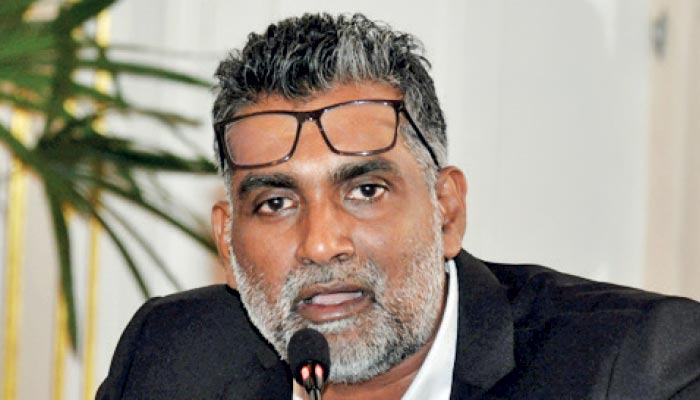
SLTDA Chairman Buddhika Hewawasam
|
The Sri Lanka Tourism Development Authority (SLTDA) Chairman Buddhika Hewawasam on Monday announced that it will launch a comprehensive tourism leakage survey towards the end of this month to accurately assess how much of tourist spending remains within the domestic economy.
Speaking at a media briefing at the Tourism Ministry, Hewawasam said the survey will examine how much of the revised average daily tourist spending of $ 148 actually stays in Sri Lanka.
The announcement builds on Sri Lanka’s largest-ever tourism research initiative unveiled on 27 November 2025, titled “From Data to Decisions: Strengthening Tourism Through Evidence and Collaboration.”
The year-long national airport exit survey, conducted from July 2024 to June 2025 by SLTDA with support from Australia’s Market Development Facility (MDF), provided detailed insights into traveller motivations, demographics and spending behaviour.
The SLTDA had been depending on spending estimates drawn from a 2018 survey, but its updated assessment from August 2025 has prompted a sharp reduction in its per-day spending figure from $ 171 to $ 148.
“This will be a leakage survey to determine how many dollars out of the $ 148 remain in Sri Lanka,” Hewawasam said, stressing the importance of understanding the real economic benefits generated by tourism.
In tourism economics, leakage refers to the portion of visitor spending that flows out of the host country rather than circulating locally. This typically occurs through imports of food and beverages, repatriation of profits by foreign-owned hotels and airlines, payments to overseas marketing agents, and remittances by foreign workers. While some level of leakage is unavoidable in an open economy, excessive leakage significantly reduces tourism’s contribution to local incomes, employment and development.
He said the upcoming survey will systematically measure these outflows by analysing supply chains, ownership structures, import dependence and spending patterns.
For tourism-dependent countries such as Sri Lanka, such assessments are seen as critical to accurately evaluating net economic gains, shaping policies to reduce leakage, strengthening competitiveness and promoting more sustainable and inclusive tourism growth.
As per the latest survey, using stratified random sampling, the study surveyed 11,731 inbound tourists across all major source markets and 5,000 outbound Sri Lankan travellers, ensuring equal participation opportunities.
SLTDA and MDF said the methodology significantly enhanced the reliability and credibility of the findings, making it one of the most robust tourism datasets produced in recent years.
As per the existing 2025 survey, the pending patterns varied significantly by travel style. Independent travellers spent an average of $ 148.26 per day, spreading expenditure across local eateries, transport providers and community-based experiences, with Russian tourists leading spending among non-packaged visitors. Package tourists generated higher value, spending $ 214.90 per day, dominated by the UK market and older travellers above 60 who favoured structured and secure travel arrangements.
“The forthcoming leakage survey is expected to further refine Sri Lanka’s understanding of tourism’s real economic contribution and guide strategies to maximise local value retention,” Hewawasam added.