Wednesday Oct 14, 2026
Wednesday Oct 14, 2026
Tuesday, 31 March 2026 05:21 - - {{hitsCtrl.values.hits}}
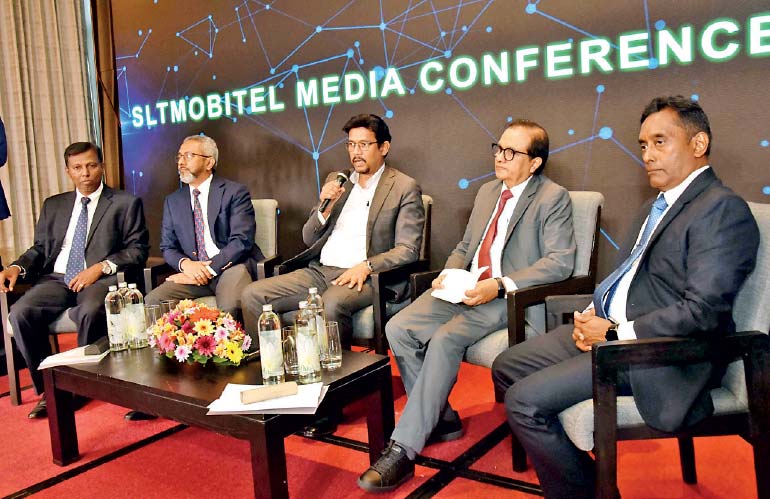
Digital Economy Deputy Minister Eranga Weeraratne (centre) at the media briefing. Others from left: SLT Group CEO Imantha Wijekoon, SLT-Mobitel CEO Riyaaz Rasheed, SLT Group Chairman Dr. Mothilal de Silva and Group Chief Finance Officer Sanjeewa Samaranayake – Pic by Upul Abayasekara
By Divya Thotawatte
Following a sharp 221% turnaround in 2025, officials used SLT-Mobitel’s performance to signal a stronger state role in Sri Lanka’s digital future and justify continued public ownership of telecom infrastructure.
This discussion took place at a recent event highlighting SLT-Mobitel’s achievements and strategic direction, where officials described the group profit surge to Rs. 10 billion as one of the most significant recoveries in the company’s recent history. They noted that this recovery came amid evolving conditions in Sri Lanka’s digital economy, including shifting consumer behaviour, rising data demand, and ongoing cost pressures in the telecom sector.
Digital Economy Deputy Minister Eng. Eranga Weeraratne said that this performance of the state-backed operator helped challenge the perception that enterprises run by the Government could not operate efficiently.
“Two years ago… there was a public cry to sell off these organisations because people were made to get the idea that shared enterprises are not something that the government is capable of doing. But today we clearly show that is not the case. If the organisation is run properly… we can change this 180 degrees.”
The Deputy Minister added that the Government role in telecommunications was also important since private firms already provided around 75% of telecommunication services. Yet, telecom infrastructure was essential to national digitalisation efforts, including secure data management and connectivity across public systems.
“We believe the country can be developed at a much rapid pace, only if we adopt digitalisation,” he said, noting that a State-linked operator enabled the Government to support data centres and manage sensitive information within the country.
Highlighting gains in profitability, cost management, and debt reduction, SLT Group Chairman Dr. Mothilal de Silva said, “2025 was our designated turnaround year, and I am proud to say that we delivered on that promise. These are much more than incremental gains. They are a fundamental shift in how the organisation is managed.”
Mobitel, the Group’s mobile arm had also recorded a significant reversal, returning to profitability after a period of subscriber decline. This recovery was due to pricing adjustments, strengthened distribution networks, and increased data consumption, he said.
“Mobitel recorded a strong positive growth in the subscriber base, a momentum we have sustained for nearly nine months now. While we saw a decline in traditional voice revenue due to change in consumer habits, with platforms like WhatsApp becoming the norm, our broadband business more than compensated for this by recording an exceptional 22.5% growth.”
SLT-Mobitel CEO Riyaaz Rasheed explained that tighter financial controls and a focus on operational efficiency had played a key role, alongside continuous investment in infrastructure.
“We managed to pay some of our debts, given the circumstances we were operating in… and exercised robust financial control.”
The company also outlined shifts in both strategy and operations aligned with the Government’s digital agenda. The officials indicated that the country was moving towards a more locally driven operation model, reducing its reliance on foreign suppliers and limiting its exposure to dollar-denominated costs in a capital-intensive industry.
At the same time, SLT-Mobitel is expanding into a 24/7 service model across regions, after recent disruptions during Cyclone Ditwah that highlighted the importance of uninterrupted connectivity.
“Without connectivity, you cannot actually survive in an economy, especially in a crisis like that,” Rasheed said, noting that round-the-clock service was being scaled up.
The model establishes what the company describes as the country’s most extensive after-hours service. The network includes 14 Outside Plant Maintenance Centres (OPMCs), located in metro and key regional areas such as Kandy and Jaffna, operating on a full 24/7 basis.
The Deputy Minister and the company officials all also spoke of future investments in artificial intelligence, cloud services, and next generation infrastructure which was part of a push to accelerate digital adoption.
Weeraratne also referenced initiatives like the National AI Expo and plans for a centre of excellence, with plans to expand access to digital tools among students.
Complementing these efforts, SLTMOBITEL has also expanded its digital portfolio with SmartChat Mega, providing SMEs with customised AIdriven business solutions, boosting the national economy through enterprise growth.
Furthermore, the Ceylon Remit solution, introduced at the event, is to enable Sri Lankans abroad to send money home seamlessly.
Officials said these initiatives were introduced with the objective of expanding Sri Lanka’s digital capabilities, while highlighting SLT-Mobitel’s recovery as a model for how state-linked enterprises could support the country’s long-term digital growth.




