Friday Oct 02, 2026
Friday Oct 02, 2026
Friday, 29 May 2026 06:37 - - {{hitsCtrl.values.hits}}
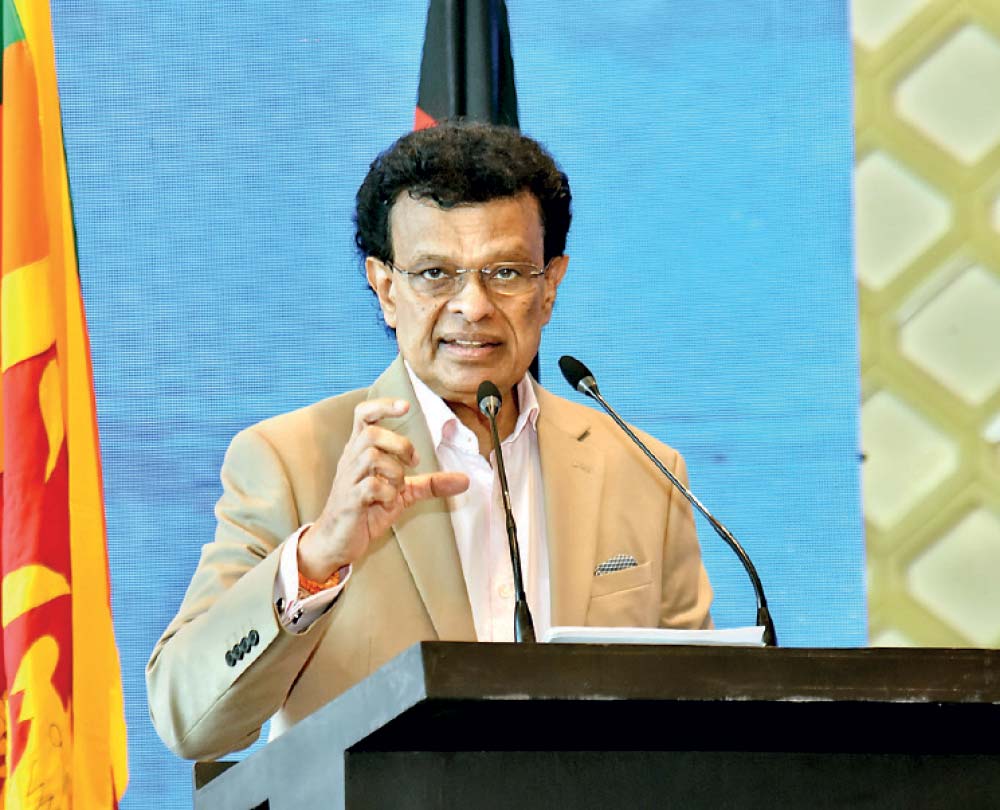
Chairman Dr. Parakrama Dissanayake
Sri Lanka Ports Authority (SLPA) Chairman Dr. Parakrama Dissanayake yesterday said the port sector could attract investments of up to $ 2 billion over the next one to three years, driven by expansion projects, logistics infrastructure, and public-private partnerships (PPPs).
Speaking at the Sri Lankan-German Business Forum 2026 in Colombo, Dr. Dissanayake said the Port of Colombo was currently facing a capacity crunch due to surging demand, but major expansion projects scheduled for next year would significantly ease congestion and strengthen Sri Lanka’s position as a regional maritime hub.
“The challenge is whether you can attract shipping lines. They choose the ports where they are going to call,” he said.
Dr. Dissanayake noted that global trade disruptions, supply chain instability, and geopolitical tensions had highlighted the critical role played by shipping lines and maritime connectivity in sustaining international trade.
He pointed out that disruptions to global shipping routes had already imposed heavy costs on world trade. “Trade disruptions are estimated to cost around $ 400 billion,” he said.
Highlighting Sri Lanka’s dependence on maritime logistics, Dr. Dissanayake noted that nearly 50% of Sri Lanka’s tea exports were shipped to the Middle East, making reliable shipping connectivity essential for export competitiveness.
He also dismissed criticism that shipping lines were excessively profiting from crises, noting that average freight rates among the world’s top five shipping lines had declined by around 25% in the first quarter of 2026 compared with the same period last year.
Providing an overview of Sri Lanka’s port sector, Dr. Dissanayake said the SLPA operated under a unique model in which it functioned simultaneously as landlord, regulator, and operator across all major ports, including Colombo, Galle, Trincomalee, Kankesanthurai, and Hambantota.
He said the Port of Colombo handled 8.3 million twenty-foot equivalent units (TEUs) in 2025, placing it among the world’s top 25 container ports despite Sri Lanka’s relatively small size. “In terms of connectivity, the Port of Colombo is among the top ports in the world,” he added.
However, he acknowledged that the Port was now operating close to capacity, creating congestion and vessel delays.
Sri Lanka’s current container handling capacity stands at around 10 million TEUs, while projected demand for 2026 is expected to reach 9.3 million TEUs. “When capacity utilisation exceeds 70%, congestion begins to emerge. That is exactly the problem the Port of Colombo is facing now,” he said.
Dr. Dissanayake noted that container volumes at Colombo Port grew by a “phenomenal” 22% in April alone, further straining existing infrastructure.
He said the commissioning of the East Container Terminal (ECT) next year would increase the Colombo Port’s total capacity to 14 million TEUs, while Hambantota Port would add a further 2 million TEUs of capacity.
The SLPA Chairman said Sri Lanka now aims to transform Colombo from purely a transshipment hub into a fully-fledged logistics hub. “We became a transshipment hub about three decades ago, but we have not been able to graduate into a logistics hub,” he said.
As part of this strategy, the SLPA plans to invite expressions of interest (EOIs) within the next few months to establish a logistics hub on a 14-acre land parcel inside the Colombo Port.
Dr. Dissanayake said the proposed elevated highway connection between the Colombo Port and the outer circular highway would further strengthen the Port’s competitiveness by significantly improving cargo connectivity.
He also revealed plans for a new West Container Terminal (WCT) Phase II project involving a 3.4-kilometre breakwater and investments estimated at around $ 600 million, which would create an additional capacity of around 3.3 million TEUs per annum alongside new logistics facilities.
The project is expected to proceed under a PPP model, with support from multilateral lenders including the World Bank and the Asian Development Bank.
In addition, he said feasibility studies are already underway for the proposed Colombo North Port project, which is expected to add a further 11 million TEUs of capacity.
The SLPA is also preparing requests for proposals (RFPs) for marina development and port-related tourism operations in Galle and Trincomalee.



