Friday Oct 16, 2026
Friday Oct 16, 2026
Wednesday, 11 February 2026 00:23 - - {{hitsCtrl.values.hits}}
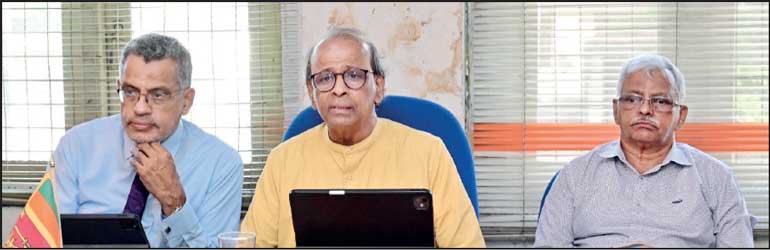
From left: Sri Lanka Chamber of Small and Medium Industries Immediate Past President Mohideen Cader, President Prof. Rohan De Silva and Vice President Colin Fernando — Pic by Sameera Wijesinghe
The Sri Lanka Chamber of Small and Medium Industries (SLCSMI) yesterday unveiled an eight-point ‘Future SME Sector Development Roadmap’, outlining a comprehensive strategy aimed at transforming small and medium enterprises into a resilient and growth-oriented pillar of the national economy.
Presenting the roadmap at a press briefing, Chamber President Prof. Rohan De Silva stressed that SMEs remain the backbone of the country’s economy, contributing nearly 60% of national revenue, yet continue to face systemic challenges that limit their growth potential.
The eight-point roadmap includes; access to finance, digital transformation, market access and export promotion, capacity building and training, infrastructure development, regulatory support and ease of doing business, sustainable practices, and public-private partnerships (PPPs).
The briefing was attended by senior office-bearers of the Chamber, including Immediate Past President Mohideen Cader and Senior Vice President Colin Fernando.
At the core of the proposed roadmap is improving access to finance, which the Chamber identified as the single biggest constraint faced by SMEs. The plan calls for the introduction of low-interest SME credit lines, State-backed loan guarantee schemes and simplified banking procedures.
Fernando said supporting startups, women-led enterprises, rural businesses and export-oriented SMEs, with financial inclusion and cash-flow stability as national priorities.
The roadmap also places strong emphasis on digital transformation, recognising that SMEs must adapt to remain competitive in an increasingly technology-driven economy. The Chamber proposed measures to promote digital literacy, e-commerce adoption, online payment systems and automation, supported by targeted incentives and training programmes.
They also called for the digitisation of Government services related to SMEs in order to reduce delays, improve transparency and curb corruption, with the aim of ensuring that both urban and rural enterprises can participate fully in the digital economy.
Expanding market access and boosting exports form another key pillar of the strategy. Prof. De Silva highlighted the need to strengthen local value chains, improve branding and product development, and create pathways for SMEs to access regional and international markets.
“Simplifying export procedures, improving access to trade information and encouraging SME participation in trade fairs and global platforms were identified as critical steps to help businesses move beyond survival and towards scalable growth,” he added.
Capacity building and skills development were also prioritised, with proposals for continuous training programmes covering entrepreneurship, financial management, digital skills, quality standards and innovation.
Prof. De Silva noted that partnerships with universities, vocational training institutes, chambers and industry experts would be central to ensuring that training initiatives are practical, relevant and accessible across the country.
The roadmap further underscores the importance of infrastructure development to support SME productivity. They proposed measures include the development of dedicated industrial zones for SMEs, improved transport and logistics networks, reliable power and water supply, and access to shared facilities such as testing laboratories and warehousing. Regional development is identified as a key focus to enable SME growth beyond major urban centres.
Addressing long-standing concerns over regulatory complexity, the Chamber called for reforms to improve the ease of doing business. This includes simplifying registration, licensing, taxation and compliance procedures, introducing transparent and time-bound processes, and establishing one-stop digital platforms to reduce bureaucracy. They said regulations should be reviewed to ensure they support enterprise growth rather than act as barriers.
Sustainability also features prominently in the roadmap, with the Chamber arguing that environmentally responsible practices are essential for long-term competitiveness. The plan proposes supporting SMEs in adopting energy-efficient technologies, waste reduction methods and sustainable manufacturing practices, alongside incentives for green enterprises.
Finally, the Chamber emphasised the role of public-private partnerships (PPPs) in driving SME development. Fernando called for stronger collaboration between Government, chambers, financial institutions, academia and the private sector, supported by structured platforms for dialogue to ensure policies remain inclusive, practical and responsive to real-world SME needs.
Prof. De Silva said the organisation was committed to working with any government to promote the interests of the SME sector. “A strong SME sector means a strong Sri Lanka,” he said, describing the roadmap not as a set of promises, but as a clear pathway towards inclusive growth, resilience and national economic recovery.




