Thursday Oct 15, 2026
Thursday Oct 15, 2026
Wednesday, 22 July 2026 06:46 - - {{hitsCtrl.values.hits}}
|
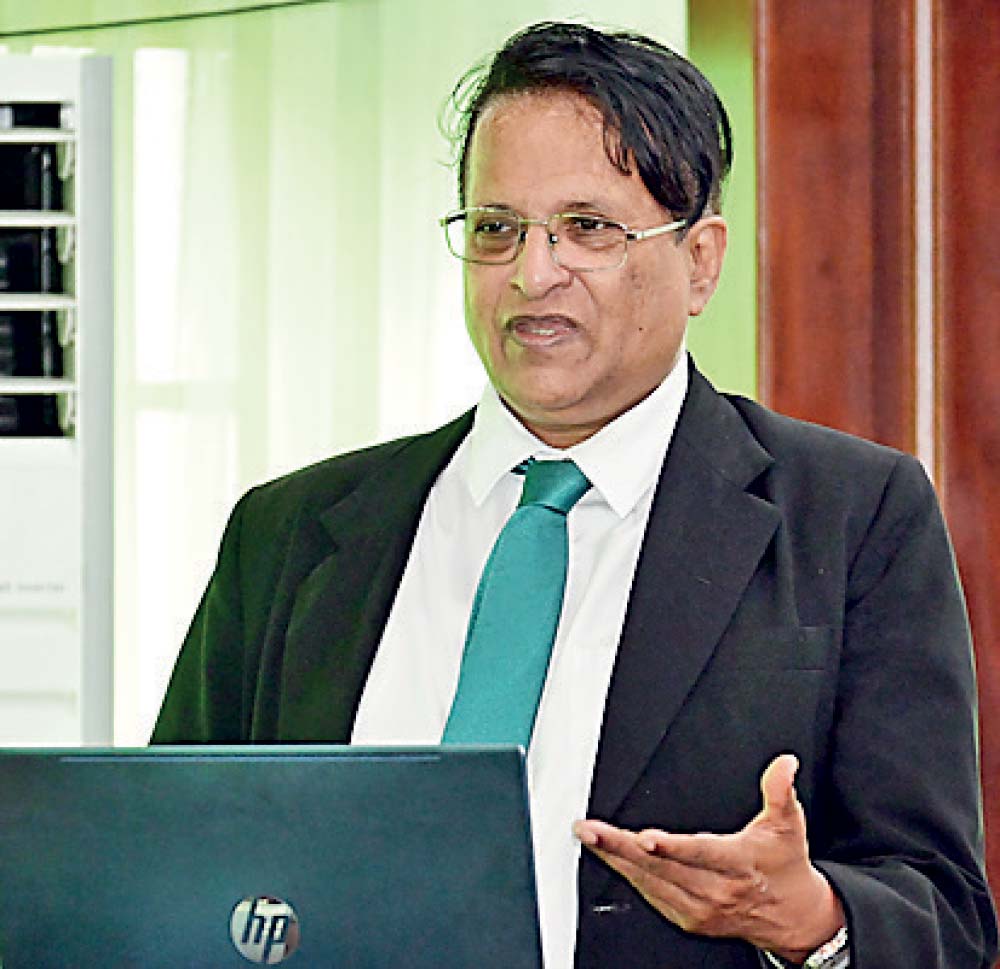
World Bank Lead Economist Dr. Harsha Aturupane – Pic by Sameera Wijesinghe
|
Sri Lanka risks falling further behind regional competitors unless it reverses years of anti-export policies, removes structural barriers to investment and reconnects with global trade, World Bank Lead Economist Dr. Harsha Aturupane warned yesterday, arguing that the country’s innovation ambitions will remain constrained without a more competitive economic model.
Delivering presentation at the Alumni Association of the University of Colombo’s inaugural global hybrid knowledge-sharing seminar on “Navigating Global Transformation in the Digital Age,” Dr. Aturupane said innovation alone cannot generate sustained economic growth and must be supported by trade, competition and access to international markets.
“Trade and innovation happen in multiple ways,” he said, explaining that larger export markets make innovation commercially viable, while international competition compels firms to improve quality and productivity rather than compete solely on price.
Drawing on the experience of East Asian economies, Dr. Aturupane said countries such as South Korea, Singapore and Japan used access to major global markets to build internationally competitive industries, while firms exposed to global competition continuously innovated to preserve comparative advantage.
He said Sri Lanka had followed a different path.
According to Dr. Aturupane, the country benefited from trade liberalisation following the 1977 reforms and through the 1990s, but those gains gradually dissipated as economic policy became increasingly inward-looking from the early 2000s.
He said periods between 2005 and 2014, and again between 2020 and 2022, were characterised by anti-export bias that reduced the scope for innovation-led growth.
“The export basket has been static,” he observed, noting that Sri Lanka continues to depend largely on apparel, tea, coconut and rubber exports.
Merchandise exports increased from $ 8.6 billion in 2010 to $ 12.8 billion in 2024, equivalent to average annual growth of only 3.4%, while the country’s integration into global value chains remains well below that of regional competitors.
Dr. Aturupane said Sri Lanka’s participation in global value chains stands at 8.1%, compared with 26% for India and 34% for Vietnam.
He warned that the country’s second-largest export industry—ICT/BPM services—could also face mounting disruption from artificial intelligence unless businesses shift rapidly towards higher-value activities.
“ICT/BPM is threatened by AI because much of what we do on the ICT/BPM are actually tasks that AI can do and might disappear.”
Dr. Aturupane argued that Sri Lanka’s competitiveness continues to be undermined by high domestic production costs arising from tariffs, non-tariff barriers and taxation that exceed those of many competing economies.
He also criticised the continued presence of loss-making State-owned enterprises, saying they impose substantial costs on the economy while reducing its international competitiveness.
He cited SriLankan Airlines and the Ceylon Petroleum Corporation as prominent examples, while noting that although the electricity sector had been restructured into six public companies, electricity costs remained high.
Beyond cost pressures, Dr. Aturupane identified the investment climate as another major impediment to growth.
He said cumbersome administrative procedures, weak regulatory enforcement and lengthy legal processes continue to discourage both foreign and domestic investment.
“Very often the potential foreign investors point out that our administrative costs, our business environment is very unprofitable.”
He added that commercial disputes frequently take so long to resolve that they undermine investor confidence.
“We have these lengthy legal processes which make disputes so long that basically it takes a generation to resolve a legal dispute.”
Dr. Aturupane also said Sri Lanka’s innovation ecosystem remains underdeveloped, pointing to weaknesses in intellectual property protection, limited access to global research databases and inadequate institutional support for researchers seeking to commercialise new ideas.
He further identified rent-seeking behaviour among sections of the public sector as a recurring concern raised by prospective investors.
Concluding his address, Dr. Aturupane said Sri Lanka’s ability to benefit from technological change and the digital economy will ultimately depend on broader economic reforms rather than innovation policy alone.