Wednesday Sep 23, 2026
Wednesday Sep 23, 2026
Wednesday, 23 September 2026 05:28 - - {{hitsCtrl.values.hits}}
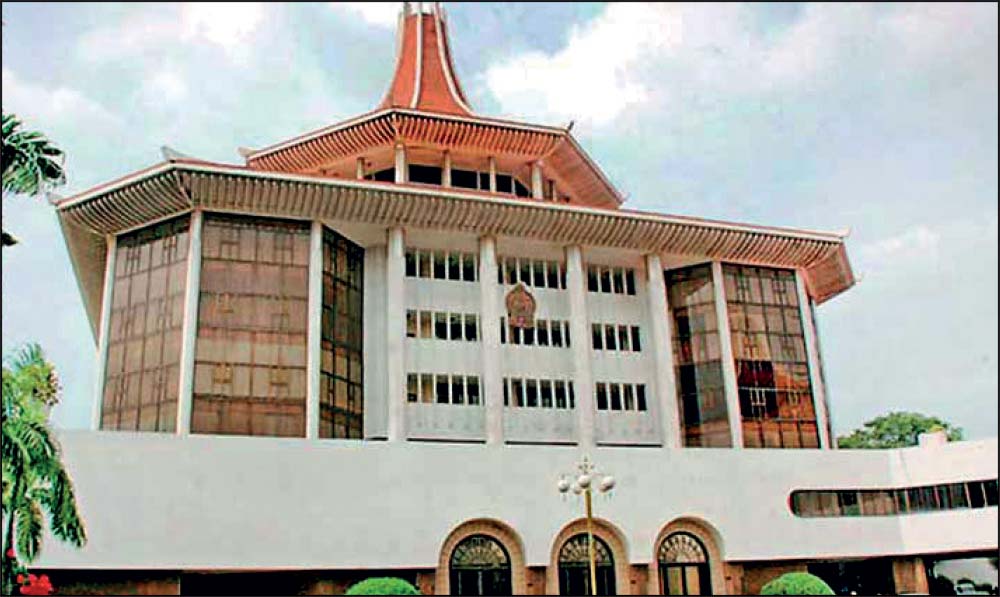 Speaker Dr. Jagath Wickramaratne yesterday informed Parliament that the Supreme Court has determined the Twenty Second Amendment to the Constitution Bill does not require approval by the People at a Referendum
This clears the way for the Government to enact the contested judicial reforms with a two-thirds parliamentary majority alone.
Announcing the Special Determination in the House, the Speaker said the Bill, together with the companion Judicature (Amendment) Bill, had been examined under Article 121(1) of the Constitution by a five-judge Bench.
The Bench was headed by Chief Justice P. Padman Surasena, sitting with Justices Achala Wengappuli, Arjuna Obeyesekere, Sampath B. Abayakoon and K.M. Gihan H. Kulatunga.
The Determination, filed within the constitutionally-prescribed period, held that the provisions of the 22nd Amendment Bill, which raises the retirement age of Supreme Court judges to 67 years and of Court of Appeal judges to 65 years, do not require Referendum approval under Article 83 of the Constitution.
The Judicature (Amendment) Bill, which raises the retirement age of High Court, District Court and Magistrates’ Court judges to 62 years and expands the High Court Bench from 110 to 120 judges, was found not inconsistent with the Constitution and may proceed by simple majority.
The Bench heard the petitions over two days, on 1 and 2 September, after the Bills were Gazetted on 7 August and placed on the Order Paper of Parliament on 18 August.
A record 72 Special Determination petitions were filed, 64 against the 22nd Amendment Bill and eight against the Judicature (Amendment) Bill, with 11 parties permitted to intervene.
At the outset of the hearing, counsel for several petitioners, including the Bar Association of Sri Lanka, applied for the case to be heard by a “Full Court” of all 17 sitting judges, and separately sought Chief Justice Surasena’s recusal on the basis that he would be the first Supreme Court judge to benefit from the extended retirement age.
The Bench rejected both applications, holding that only the Chief Justice has the constitutional discretion under Article 132(3) to constitute a larger Bench, and that acceding to the request would have amounted to an abdication by the Chief Justice of his constitutional role.
The Court stated that had it acceded to the application, ‘that would have amounted to an abdication by the Chief Justice of the Constitutional role vested in him and a usurpation of the discretion of the Chief Justice by the other Judges of this Court.’
The Bench also rejected the argument that judges hearing the case faced a disqualifying conflict of interest, finding the Petitioners’ position, that only the Chief Justice stood to benefit while other judges should hear the case, to be without basis.
The Determination stated: “If the Chief Justice is disqualified on that basis, such disqualification should apply to all other Judges since the “benefit” is one and the same. This in our view is a subtle attempt to fix benches according to one’s whims and fancies.”
The central submission advanced by the Petitioners was that extending the retirement age of sitting judges amounted to a “legislative bribe” or inducement that would compromise judicial independence protected under Article 3 of the Constitution.
The Court rejected this, distinguishing between a reduction in judicial tenure, which it said would threaten independence, and a non-discriminatory, non-discretionary increase applying uniformly to all sitting judges across the country.
“We conclude that any increase in the age of retirement of Judges cannot amount to conferring an inducement and/or favour to the incumbent Judges,” the Determination held.
The Court also dismissed submissions that the Bills amounted to “Court Capture” or “Court Packing,” noting that the judges who stood to benefit had served under successive prior governments of differing political composition.
“We strongly reject that the Government seeks to fill the Court with Judges who may be ideologically aligned with the Government,” the Bench ruled.
On comparative practice, the Bench noted that Sri Lanka’s judicial retirement ages remain low by international standards, observing that the retirement age for apex court judges is 75 in the United Kingdom, Canada and Brazil, 70 in Australia, New Zealand, South Africa, Japan and the Philippines, and that there is no mandatory retirement age for United States Supreme Court judges.
“We observe that the age of retirement of Judges in other jurisdictions are comparatively higher than in Sri Lanka,” the Determination noted.
The Court ordered two changes to the proviso in Clause 2 of the 22nd Amendment Bill, which caps any Chief Justice’s tenure at six years in office. It directed that the Sinhala text be amended to replace the phrase denoting “the date on which the Chief Justice turns 67” with a phrase denoting “the date on which the Chief Justice completes 67 years,” for clarity.
It further ordered that a second proviso be added at the Committee stage, stating that the six-year term limit will not apply to any person holding the office of Chief Justice as at the date of coming into operation of this Act, a safeguard intended to place the clause “on a solid constitutional foundation” and confirm that it will not reduce the tenure of the sitting Chief Justice.
The Court also observed that petitions in five cases, SC/SD/72/2026, SC/SD/74/2026, SC/SD/82/2026, SC/SD/99/2026 and SC/SD/101/2026, had not been delivered to the Speaker at the same time they were filed in Court, as required under Article 121(1), and noted that such non-compliance should ordinarily result in a petition being rejected.
The two Bills are scheduled for their second reading debate in Parliament on 24 and 25 September, 2026.




