Friday Oct 02, 2026
Friday Oct 02, 2026
Monday, 30 March 2026 05:44 - - {{hitsCtrl.values.hits}}
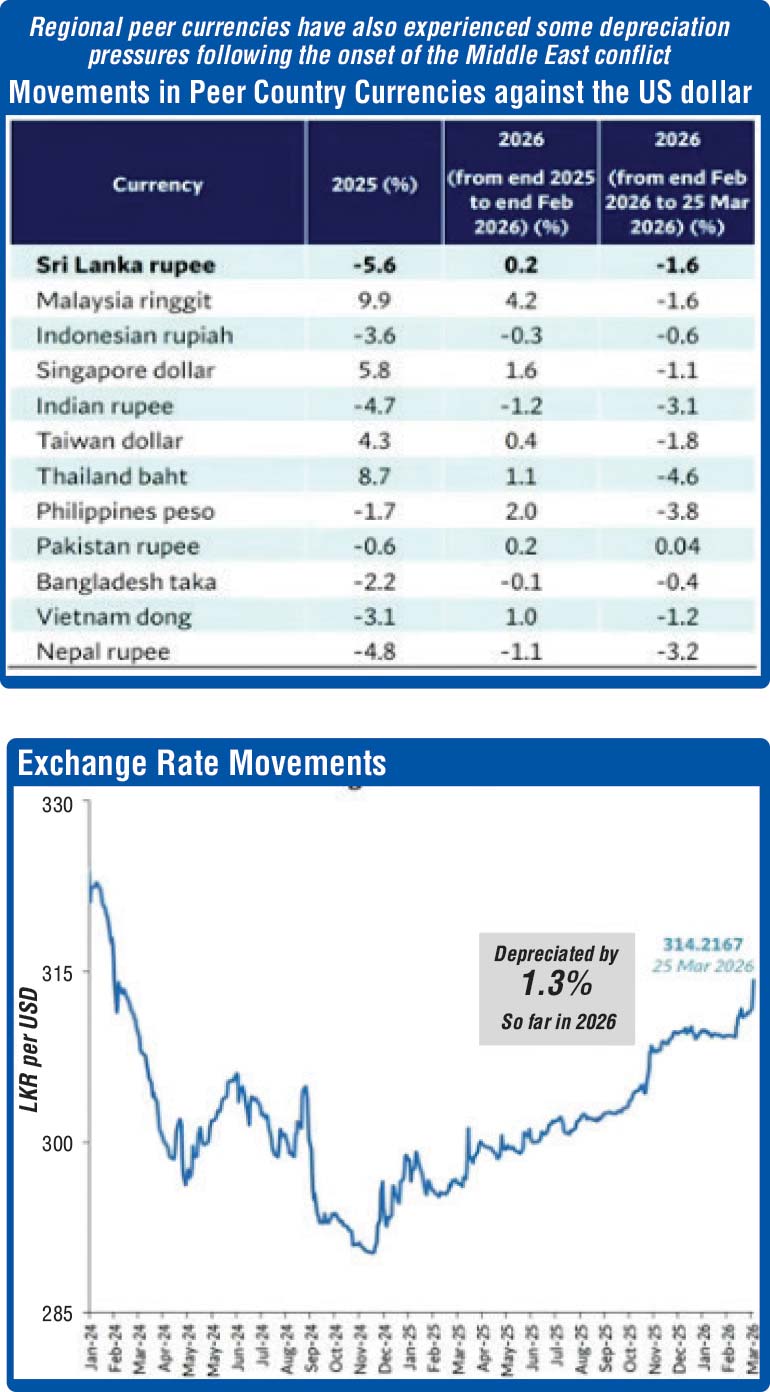
 Sri Lanka’s rupee has remained relatively stable in early 2026, with depreciation contained despite pressure from the Middle East conflict, while the Central Bank of Sri Lanka (CBSL) continued to build reserves through net foreign exchange purchases.
CBSL Economic Research Director Dr. Lasitha Pathberiya said the rupee depreciated by 1.3% so far in 2026, with pressure emerging in recent weeks following the onset of the conflict.
“The Sri Lankan rupee remained relatively stable in early 2026, but we observed some depreciation pressures during the last few weeks at the onset of the Middle East conflict. So, so far in 2026, the Sri Lankan rupee depreciated by 1.3%,” he said.
Prior to the outbreak of the war, the rupee had appreciated by a marginal 0.2% against the greenback. The currency had depreciated 5.6% in 2025.
He noted that the rupee’s movement since the crisis has been moderate relative to regional peers.
“But also, we have seen that regional peer countries have also experienced some depreciation in their currencies due to the Middle East conflict. The Sri Lankan rupee depreciated by 1.6% since the beginning of the crisis. But in other countries we have seen, we observed an even larger depreciation since the crisis,” Dr. Pathberiya said.
Data presented by him showed that the Sri Lankan rupee depreciated by 1.6% from end-February to 25 March, in line with the Malaysian ringgit (-1.6%), and less than the declines seen in the Indian rupee (-3.1%), Thai baht (-4.6%), Philippine peso (-3.8%), and Nepalese rupee (-3.2%). More resilient currencies included the Indonesian rupiah (-0.6%), Singapore dollar (-1.1%), and Vietnamese dong (-1.2%), while the Pakistan rupee marginally appreciated by 0.04% over the same period.
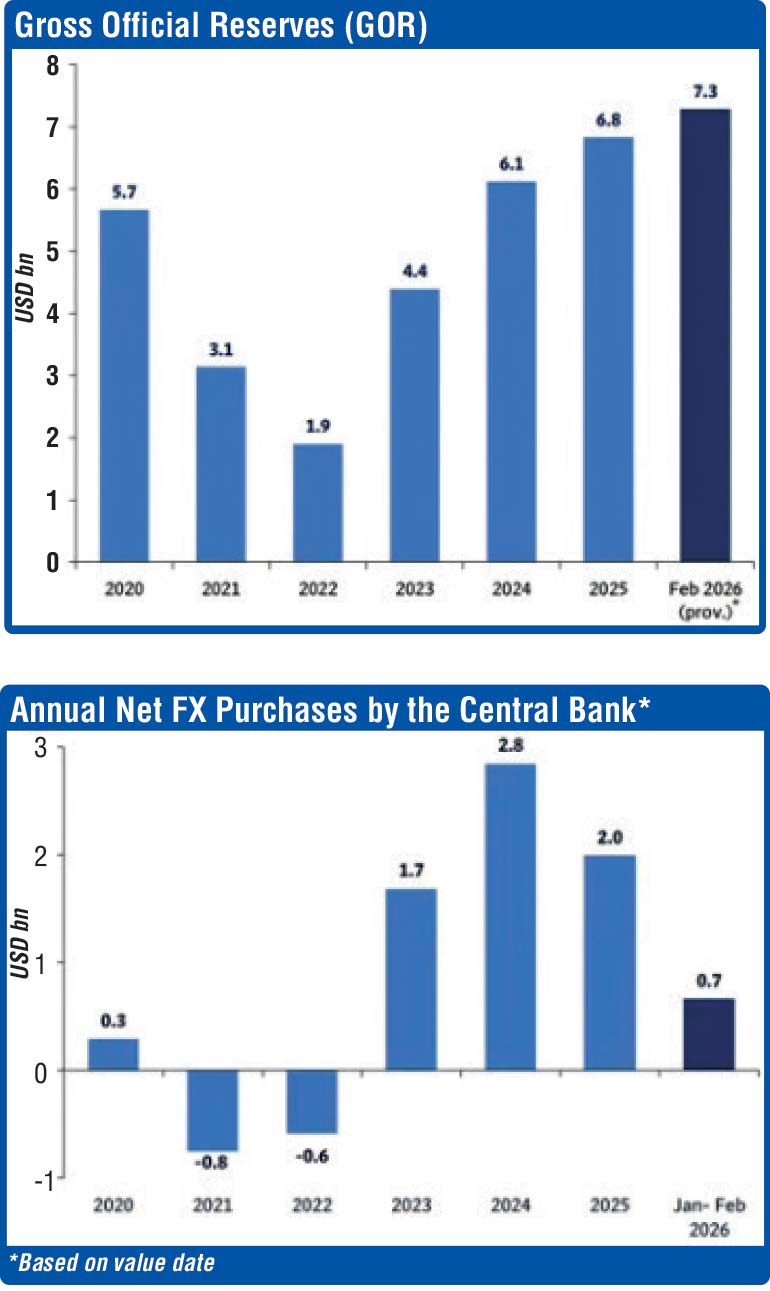
The CBSL has continued to be a net buyer of foreign exchange, purchasing a net $ 700 million in the first two months of 2026.
Net foreign currency purchases amounted to $ 2 billion in 2025, $ 2.8 billion in 2024, and $ 1.7 billion in 2023, following net sales of $ 800 million and $ 600 million in 2021 and 2022, respectively, after net purchases of $ 300 million in 2020.
Despite net purchases in January and February, gross official reserves increased by $ 500 million to $ 7.3 billion as at end-February.
CBSL Governor Dr. Nandalal Weerasinghe declined to comment on whether the Bank continues to be a net buyer of foreign exchange, stating that updated data will be released in April.
Responding to questions on intervention amid the global energy supply shock, Dr. Weerasinghe said the CBSL is operating a flexible exchange rate policy, where the rate is determined by market demand and supply.
“Coupled with our inflation targeting framework, this is the best policy anyone can have,” he said. On intervention thresholds, he added: “We can only intervene to manage the excess volatility on a day-to-day basis.”
“We have our scenario-based planning but no one has a model to predict what will happen in this [Middle East] war. All we can do is wait and see what happens and take certain measures to minimise the impact. The exchange rate will be determined based on demand and supply. But we will consider the macroeconomic fundamentals and intervene on both sides [buying or selling] to minimise the short-term volatility,” Dr. Weerasinghe said.