Tuesday Oct 06, 2026
Tuesday Oct 06, 2026
Monday, 25 May 2026 05:34 - - {{hitsCtrl.values.hits}}
 In remarkable turnaround of events for the Sri Lankan rupee, respected financial news agency Bloomberg said the currency has surged against the dollar, snapping a nine-day losing streak to become Asia’s best-performing currency on Friday.
Bloomberg reported that the rupee strengthened as much as 2.7%, its biggest gain since March 2023, reversing losses from Thursday when it slid to a three-year low.
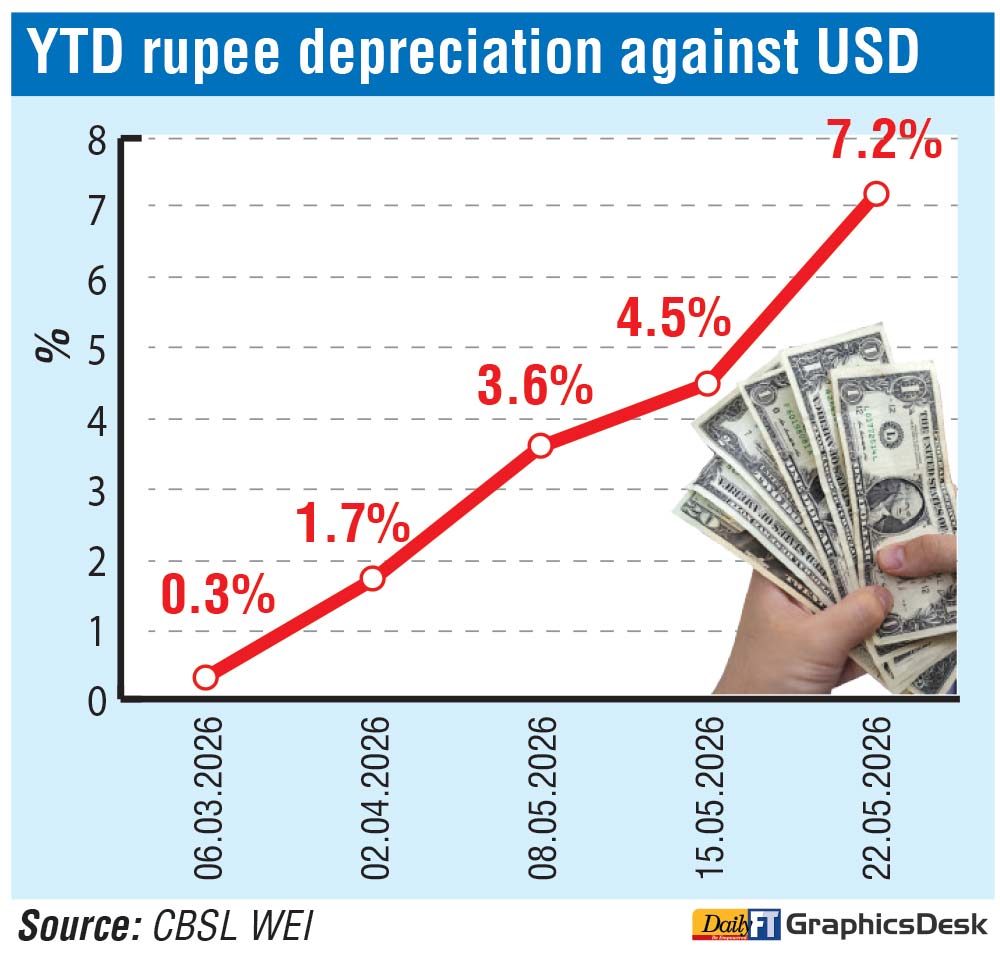
Data from the Central Bank of Sri Lanka (CBSL) show the extent of the panic that gripped Sri Lanka’s foreign exchange market last week, with the rupee’s year-to-date (YTD) depreciation against the US dollar accelerating sharply within days as importers rushed to secure dollars while exporters delayed conversions.
According to CBSL Weekly Economic Indicators data, the rupee’s YTD depreciation stood at 4.5% by 15 May before surging to 7.2% by 22 May, marking the sharpest deterioration in the currency so far this year.
The movement came amid heightened market anxiety over the economic fallout from the Middle East conflict and fears of rising global energy prices.
The rupee appreciated on Friday after the CBSL moved to calm a nervous foreign exchange market following sharp depreciation earlier in the week.
The interbank US dollar spot market buy/sell rate eased to Rs. 329/Rs. 335 on Friday, with the rupee strengthening from Thursday’s Rs. 331/Rs. 348, which marked the currency’s weakest level against the dollar last week.
Market participants said the CBSL met banking CEOs and foreign exchange dealers and is expected to introduce regulatory measures aimed at reducing volatility in the currency market.
Dealers said the CBSL informally capped the interbank US dollar spot rate at Rs. 330, while market speculation also emerged that the CBSL could shorten the mandatory conversion period for export proceeds from 90 days to 30 days.
Dealers said the rupee had come under pressure after importers began front-loading Letters of Credit (LCs) and booking foreign currency requirements as much as three months in advance amid expectations of further depreciation. At the same time, exporters delayed converting export proceeds into rupees in anticipation of higher exchange rates, tightening dollar liquidity in the domestic market.
According to dealers, the developments later triggered increased dollar conversions by exporters, helping restore liquidity to the market, while importers who had aggressively purchased foreign exchange earlier in the week moved to the sidelines expecting the exchange rate to ease further.
Market participants said the sharp exchange rate movement reflected a combination of positioning and external pressures linked to the Middle East conflict. There will continue to be pressure on the currency if global shocks persist, but what remains to be seen is how the market reacts and how the regulator responds.
International Monetary Fund (IMF) Mission Chief for Sri Lanka Evan Papageorgiou on Thursday also expressed confidence in Sri Lanka’s ability to manage economic pressures arising from the Middle East conflict, saying the country’s stronger policy framework, improved reserves, and ongoing reform program had placed the economy in a better position to absorb external shocks than in the past.
“Recent global developments have brought renewed pressures, as is the case for many economies in a challenging external environment. Navigating these shocks is never straightforward, but Sri Lanka’s policy framework today is considerably stronger than in the past,” he said.
Papageorgiou also stressed the importance of maintaining policy consistency and allowing the economy to adjust to evolving market conditions to sustain the gains achieved under the reform program.



