Saturday Oct 17, 2026
Saturday Oct 17, 2026
Saturday, 17 October 2026 00:00 - - {{hitsCtrl.values.hits}}
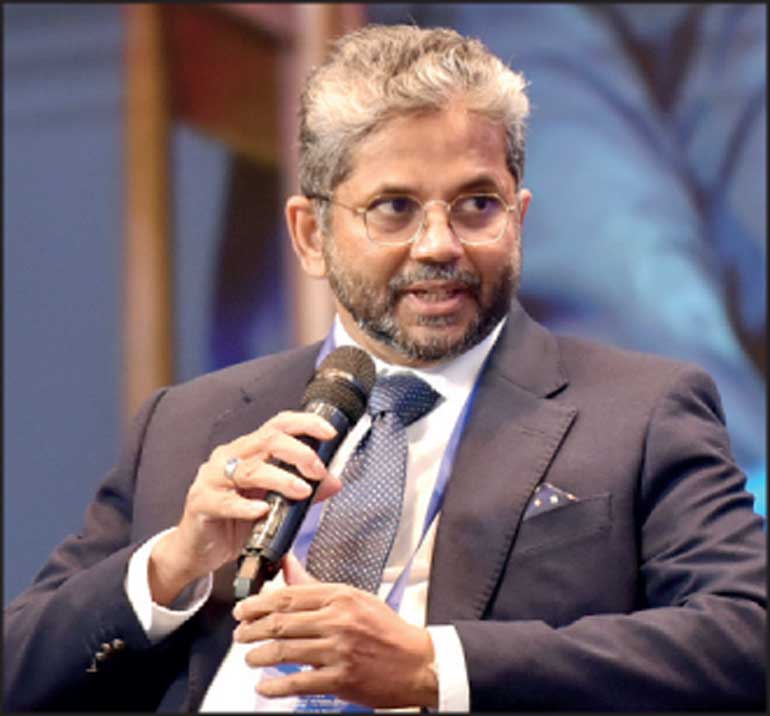
WindForce PLC Managing Director Manjula Perera
—Pic by Ruwan Walpola
Sri Lanka’s plan to attract around Rs. 400 billion in renewable energy and battery storage investment over the next three years could fall short, unless the Government addresses weak power purchase agreements, rupee tariffs, lengthy approval processes and delays in project execution, WindForce PLC Managing Director Manjula Perera warned.
Speaking during a panel discussion at the Sri Lanka Economic and Investment Summit 2026, he said the National System Operator’s (NSO) interim plan for 2027–2029 envisaged adding around 1,400 MW of solar power and 1,000 MW of battery energy storage, creating a substantial pipeline of investment opportunities.
However, he cautioned that the scale of the investment required would exceed the capacity of local investors alone, making foreign capital essential at a time when the sector remained constrained by regulatory and contractual shortcomings.
“Even though the opportunity is there, for the local investors, this is too much on the plate. Then the direct funding investment should come into the country,” he said.
Perera identified three major obstacles to attracting foreign investment, which include; power purchase agreements (PPA) that are not sufficiently bankable, the use of rupee-denominated tariffs for large-scale projects, and a cumbersome approval process requiring over 17 approvals for renewable energy developments.
“A Sri Lankan developer might be able to absorb the time and costs involved, but the same delays could discourage international investors comparing opportunities across markets,” he stressed.
Perera also questioned whether a shift towards competitive tendering, as proposed by President Anura Kumara Dissanayake, would deliver the intended benefits without parallel reforms to land allocation, approvals and contracting.
He said Sri Lanka’s renewable energy industry had largely developed under a feed-in tariff system, while the country had undertaken only three major large-scale tender exercises to date.
Citing WindForce’s 100 MW solar project at Siyambalanduwa, awarded in 2022, Perera said the Government took around 1.5 years to hand over the required land. “The project was expected to be commissioned by July 2027, but the process from award to commissioning spanned five years,” he added.
He said two 50 MW wind projects at Mullikulam, awarded to WindForce and Vidulanka in February 2026, also illustrated the problem. At the moment, the draft PPA is still with the Attorney General’s Department, while land-related issues remain unresolved.
“On paper, tenders are very good. We will get lower prices, but we have to decide what we want to achieve,” he said, noting that the priority should be to accelerate renewable capacity while reducing dependence on costly thermal power.
Perera said Sri Lanka’s electricity cost structure demonstrated why replacing expensive thermal generation should be a priority.
Noting that renewables accounted for around 54% of electricity generation, he said the remaining share from thermal sources, including diesel-fired plants, accounted for a disproportionately high share of generation costs.
He said thermal generation represented around 46% of electricity supply, but over 71% of the generation costs. Within that mix, diesel-fired generation accounted for around 14% of supply, while contributing around 40% of costs.
He put the average cost of diesel-generated electricity at Rs. 94 per kilowatt-hour, pointing out that reducing reliance on such generation was essential to bringing down the cost burden on consumers.
Perera insisted that these figures reinforce the need to focus on the speed at which cheaper renewable power could be added to the grid, rather than concentrating solely on the tariff secured at the tender stage.
He also said advances in battery storage had created new opportunities to integrate more solar and wind power, while improving grid stability.
“Previously, the high cost of storage meant large thermal power plants had to remain operational to provide system stability and spinning reserve capacity. Battery technology, including grid-forming capabilities, was increasingly able to meet those requirements,” he said.
He welcomed the Government’s battery storage tender program, referring to projects of 160 MW, 250 MW and a further 150 MW. The first 160 MW tranche was at the commissioning stage, while the 250 MW tranche was expected to follow, with the remaining 150 MW to be awarded soon.
Perera called for a stronger national electricity policy and more commercially capable institutions following the unbundling of the Ceylon Electricity Board (CEB).
Despite describing the Electricity Act as a positive development, he opined that the country’s electricity policy needed to be strengthened, noting it appeared to have been formulated in haste.
He also warned that restructuring the CEB into separate entities would not deliver the desired results unless those institutions had adequate human resources and the commercial capabilities required to operate effectively.
“If they are to run like private companies, we see a huge lack of human resources,” he said, calling for the recruitment and development of personnel with private-sector experience and commercial thinking.
Otherwise, he cautioned, the restructuring could simply reproduce existing institutional weaknesses across several successor organisations.




