Tuesday Sep 15, 2026
Tuesday Sep 15, 2026
Tuesday, 24 February 2026 03:10 - - {{hitsCtrl.values.hits}}
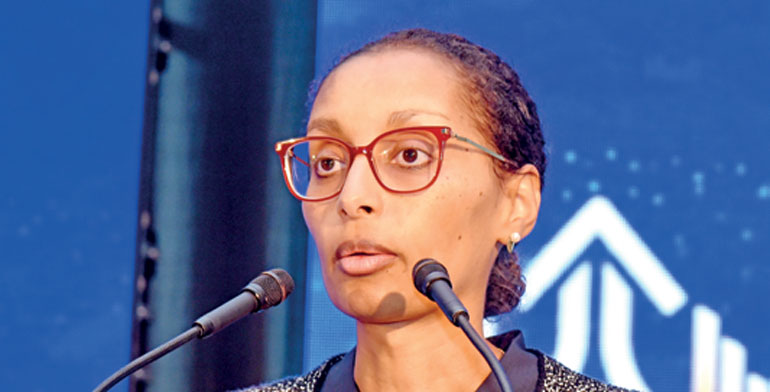
Dr. Martha Woldemichael
Pic by Ruwan Walpola
 Speaking at Softlogic Stockbrokers Investor Forum, urges shift from stabilisation to transformation through trade liberalisation, digitalisation and labour market reform
Emphasises fiscal credibility, rebuilding buffers, Central Bank independence and stronger governance
Says sustaining EFF track record vital for investor confidence and protecting vulnerable groups
The International Monetary Fund (IMF) yesterday said sustaining reform momentum is critical for Sri Lanka to move from crisis stabilisation to economic transformation, warning that recovery remains fragile despite tangible gains under the Extended Fund Facility (EFF).
Delivering the keynote address at the Softlogic Stockbrokers Investor Forum 2026, IMF Sri Lanka Resident Representative Dr. Martha Woldemichael said: “The task ahead is really to move from stabilisation to transformation.”
While IMF Managing Director Dr. Kristalina Georgieva in an exclusive interview last week with the Daily FT described Sri Lanka’s performance under the program as a success story, Dr. Woldemichael cautioned that a success story is not a finished story. She said the path ahead requires continued discipline, continued reform, and continued engagement between the Government, the private sector, and international partners to translate macroeconomic stability into lasting improvements in living standards across the country.
She said transformation means pressing ahead on trade liberalisation, reducing tariff barriers, streamlining Customs procedures, and integrating more deeply into regional and global supply chains through trade agreements so that Sri Lankan firms can access markets and inputs needed to compete.
Transformation, she said, also requires accelerating digitalisation in tax administration, public services, and the financial sector to improve efficiency, reduce corruption vulnerabilities, and open new avenues for innovation. Labour market reforms that increase flexibility and productivity and expand female labour force participation, which remains far below potential, represent one of the most significant untapped drivers of growth.
She added that investing in infrastructure connectivity across the island, strengthening tourism through quality and sustainability, and creating conditions to attract foreign direct investment through a stable regulatory environment and predictable framework for doing business are central to this next phase.
“Staying the course on this agenda matters significantly for investor confidence,” Dr. Woldemichael said, noting that when a Government meets program targets and completes reviews, it builds a track record. “A track record is the foundation on which investors make decisions.”
Referring to progress under the Extended Fund Facility (EFF), she noted that four out of eight reviews have been completed and close to $ 1.74 billion has been disbursed. Inflation fell to 2.3% year-on-year (YoY) in January 2025, reserves stood at $ 6.8 billion at the end of last year, and real GDP grew by 5% in 2024 following an average contraction of 4.8% in 2022-2023. Tax revenue increased from 7.3% of GDP in 2022 to 12.4% in 2024, while debt restructuring is almost complete and expected to place public debt on a path towards sustainability.
Dr. Woldemichael said Sri Lanka has taken major steps to strengthen governance and advance its anti-corruption agenda, including legislation safeguarding Central Bank independence, improving public financial management and public debt management, and strengthening the legal framework for anti-corruption.
In 2023, Sri Lanka became the first country in Asia to undergo an IMF governance diagnostic assessment, a comprehensive evaluation of governance weaknesses and corruption vulnerabilities across public institutions.
She emphasised that durable growth requires fiscal credibility and rebuilding fiscal and external buffers to ensure the country has policy space to respond to future shocks. “Buffers buy the ability to absorb shocks swiftly without abandoning the reform path,” she said, noting that strong reserves, sufficient fiscal space, and credible policy frameworks enable faster and more inclusive recovery.
At the same time, she stressed that macroeconomic stability alone is not sufficient. Social acceptance of reforms depends on protecting those least able to bear adjustment costs. Safeguarding reforms requires raising domestic revenue in a fair, transparent, and efficient manner, preserving cost recovery energy pricing to minimise fiscal risks, promoting sound debt management practises, refraining from monetary financing, and upholding Central Bank independence. Tax incentives, she said, should be granted only in limited, well-defined cases based on transparent and rule-based frameworks.
Protecting vulnerable households remains a prerequisite for reforms to be politically and socially sustainable. She underscored the need to sustain and adequately fund social protection programs to shield vulnerable groups from the impact of shocks and policy adjustments, particularly in the aftermath of the recent cyclone, which has put an estimated 10% of the population at risk of falling below the poverty line.




