Sunday Jul 12, 2026
Sunday Jul 12, 2026
Monday, 16 March 2026 05:26 - - {{hitsCtrl.values.hits}}
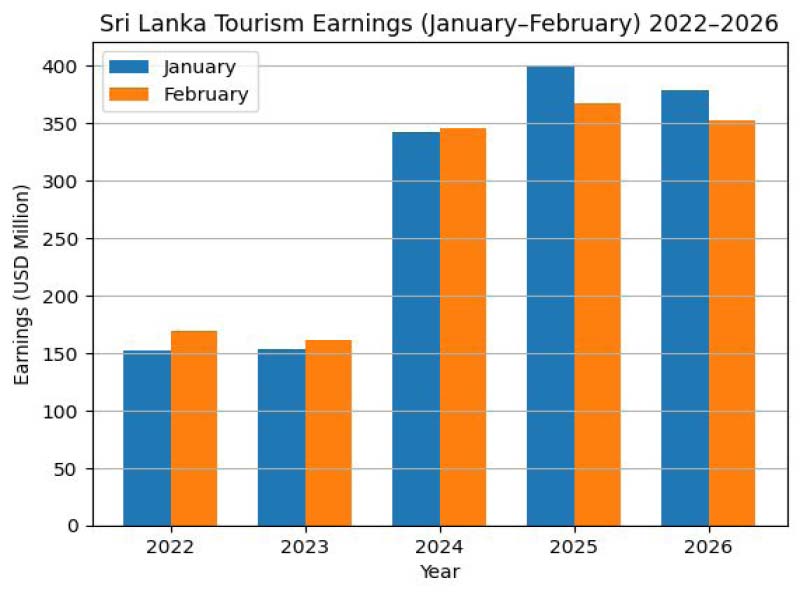 Sri Lanka’s tourism sector recorded its highest-ever February arrivals this year, but foreign exchange earnings from the industry declined, underscoring mounting concerns about falling per-capita tourist spending even as the country pursues an aggressive recovery strategy.
According to the Central Bank of Sri Lanka (CBSL), tourism earnings fell 4.4% year-on-year (YoY) to $ 352 million in February despite a sharp increase in arrivals during the same period. On a month-on-month basis, February revenue also declined by 7.5% compared with January.
The weaker earnings came even as Sri Lanka welcomed 279,328 tourists in February, marking a 16.3% YoY rise and the highest monthly arrival figure recorded in the country’s tourism history.
For the first two months of the year, tourism generated $ 730.3 million in foreign exchange, reflecting a 4.9% YoY decline.
The divergence between rising arrivals and falling earnings has raised concerns among analysts that the sector’s recovery is increasingly volume-driven rather than value-driven.
Industry observers note that increasing the number of visitors may not translate into stronger foreign exchange inflows unless spending per visitor also improves.
The trend highlights a widening gap between headline visitor numbers and actual foreign exchange generation, raising questions about the composition of tourist inflows and the spending patterns of travellers.
They also opined that the earnings situation could worsen in March with arrivals declining amidst the ongoing tensions in the Middle East.
During the first 11 days of March, Sri Lanka welcomed 66,996 visitors, pushing the year-to-date (YTD) figure to 623,651 travellers, amidst flight cancellations, restricted airspace, and higher travel costs affecting inbound tourism. The decline in early-March arrivals reflects the importance of Middle Eastern aviation hubs for Sri Lanka’s tourism connectivity.
Already, airlines, including the national carrier SriLankan Airlines, are being forced to avoid conflict zones and operate on longer, more expensive routes, significantly increasing fuel consumption and operational costs. Industry analysts estimate transatlantic fares could increase by 6% to 10%, while long-haul Asia-Pacific routes may rise by 8% to 15% due to higher fuel burn and longer flight paths.
Industry data indicate that around 30% of all tourist arrivals to Sri Lanka pass through transit points in the Middle East.
They also opined that the economic impact could extend beyond aviation. Higher airfares and broader inflation pressures may reduce discretionary travel spending globally, potentially slowing tourism growth later in 2026.
One key factor behind the softer revenue performance has been a downward revision in estimated tourist spending. The Sri Lanka Tourism Development Authority (SLTDA) recently revised its estimate of average daily expenditure per tourist from $ 172 to $ 148 following a new survey conducted last year.
Tourism remains a critical pillar of Sri Lanka’s economy, accounting for nearly 3% of national output and serving as one of the country’s key sources of foreign currency. In 2025, Sri Lanka earned $ 3.22 billion from tourism, representing only a marginal 1.6% increase from the $ 3.17 billion recorded in 2024. This modest revenue growth came despite a much stronger rise in visitor numbers.
Tourist arrivals climbed 15.1% YoY last year to 2.36 million, recording the highest-ever volume, reflecting improved air connectivity and a gradual restoration of traveller confidence following several years of severe disruptions.
For 2026, the Government has set an ambitious target of attracting at least 3 million tourists, betting that higher visitor volumes will eventually translate into stronger earnings of $ 4 billion.
However, analysts caution that without a meaningful rebound in per-visitor spending, higher arrival numbers alone may not be sufficient to significantly strengthen Sri Lanka’s external accounts.



