Tuesday Aug 18, 2026
Tuesday Aug 18, 2026
Saturday, 20 June 2026 05:37 - - {{hitsCtrl.values.hits}}
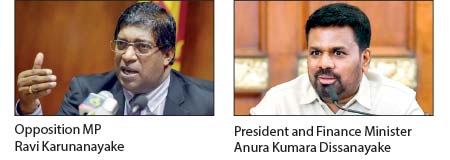 Opposition MP Ravi Karunanayake has called for lowering the medium-term inflation target to 2-3% from the current 5%, arguing that the forthcoming statutory review of the country’s monetary policy framework offers a critical opportunity to strengthen currency stability, protect household savings and reduce the risk of future balance-of-payments crises.
In a letter to President and Finance Minister Anura Kumara Dissanayake, Karunanayake urged the Government to begin preparations ahead of the October 2026 review of the Monetary Policy Framework Agreement (MPFA), under which the Central Bank of Sri Lanka (CBSL) currently targets medium-term quarterly headline inflation of 5%.
The existing framework was established under the Central Bank of Sri Lanka Act No. 16 of 2023 and formalised through an agreement signed on 5 October 2023 between then Finance Minister Ranil Wickremesinghe and CBSL Governor Dr. P. Nandalal Weerasinghe. Under the law, the inflation target and associated parameters must be reviewed every three years, placing the next review due in October 2026.
Karunanayake argued that while a 5% inflation target may have been appropriate during the immediate post-crisis adjustment period, Sri Lanka’s experience of sovereign default, currency instability, balance-of-payments pressures and the erosion of household purchasing power warranted a reassessment of the framework.
“The preservation of purchasing power and the protection of the value of the Rupee must therefore be regarded not merely as technical monetary objectives but as fundamental pillars of economic and social policy,” he said.
A central theme of the letter is the contention that Sri Lanka could be drifting towards a stagflationary environment in which economic growth remains weak while inflationary pressures persist.
Karunanayake noted that although macroeconomic stability had improved since the depths of the crisis, private sector investment remained subdued, industrial activity was operating below potential, credit growth remained constrained and household purchasing power continued to face pressure. At the same time, inflationary pressures continued to emerge despite the absence of strong aggregate demand.
He warned that a policy framework which tolerated relatively high inflation while growth remained weak risked producing “the worst of both worlds” through stagnant economic activity and a continued erosion of living standards.
Karunanayake also questioned whether Sri Lanka’s inflation problem was primarily demand-driven, arguing instead that much of the country’s inflation over the past decade had originated from imported and supply-side factors.
He identified exchange rate depreciation, imported fuel and energy costs, food supply disruptions, utility tariff revisions, tax increases, global commodity price movements and external financing constraints as among the principal drivers of inflation.
Accordingly, he argued that excessive reliance on interest rate adjustments alone could not adequately address the underlying causes of inflation.
“Higher interest rates cannot generate foreign exchange reserves. Higher interest rates cannot increase export earnings. Higher interest rates cannot reduce international oil prices. Higher interest rates cannot improve productivity,” Karunanayake said, while stressing that inflation control remained important within a broader economic strategy.
The former Finance Minister argued that Sri Lanka’s recurring economic crises had historically been balance-of-payments crises rather than conventional inflation crises.
He contended that reserve depletion, persistent currency depreciation, weak domestic savings, inadequate capital formation and dependence on external financing had repeatedly exposed the country to instability.
As a result, he proposed that future monetary policy should place greater emphasis on building foreign exchange reserves, encouraging domestic savings, promoting capital formation, supporting productive investment, improving export competitiveness and preserving the long-term value of the rupee.
“The true foundation of monetary stability lies not merely in the management of consumer prices but in the strengthening of the nation’s financial stock and productive capacity,” the letter stated.
Karunanayake supported his case by citing inflation targets maintained by several regional and advanced economies.
According to the letter, India operates with a 4% inflation target and a tolerance band of plus or minus 2%, Indonesia targets 2.5% with a similar tolerance range, while Thailand maintains a target range of 1-3%. Malaysia has historically maintained inflation around 2-3%, while Vietnam generally seeks to keep inflation below 4-4.5%. China’s inflation rate was cited at negative 0.4%.
He also pointed to the inflation objectives of major central banks, including the European Central Bank, Bank of Canada, Bank of England and US Federal Reserve, all of which target inflation around 2%, while the Swiss National Bank seeks to keep inflation below 2%.
“The common principle underlying these frameworks is clear: long-term economic prosperity is best supported by low, stable and predictable inflation, accompanied by strong monetary credibility and confidence in the domestic currency,” he said.
Karunanayake urged the Government to use the October 2026 review to undertake a comprehensive reassessment of the monetary policy framework. His proposals include: Reducing Sri Lanka’s medium-term inflation target from 5% to a 2-3% range; narrowing the existing tolerance band to strengthen policy credibility and accountability; expanding the framework to include reserve accumulation, domestic savings mobilisation, capital formation, productive investment and export competitiveness as explicit policy considerations; requiring enhanced Central Bank reporting to Parliament on inflation, reserve accumulation, exchange rate stability and growth outcomes; and embedding greater recognition of Sri Lanka’s historical vulnerability to balance-of-payments crises within the monetary policy framework.
Karunanayake said the review presented an opportunity to align Sri Lanka’s monetary architecture more closely with long-term development objectives.
“A revised inflation target of 2-3% combined with a broader policy focus on reserve accumulation, savings mobilisation, capital formation and productive growth would send a powerful signal that Sri Lanka is committed to preserving the value of its currency, protecting its citizens’ savings and preventing a recurrence of the crises that have repeatedly hindered our nation’s progress,” he said.



