Friday Oct 16, 2026
Friday Oct 16, 2026
Thursday, 30 April 2026 00:23 - - {{hitsCtrl.values.hits}}
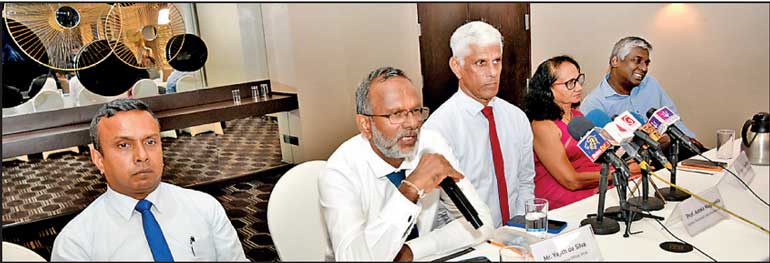
From left: Watawala Plantations Deputy General Manager – Operations Prasanna Premachandra, POIA COO Yajith de Silva, Lalan Rubbers Director Prof. Asoka Nugawela, SAARCFOODS Association Sri Lanka President Dr. Renuka Jayatissa, and University of Colombo Zoology Department Prof. Devaka Weerakoon
- Pic by Shehan Gunasekara
Regional Plantation Companies (RPCs) are preparing to invest in palm oil cultivation, expecting the Government to lift the seven-year ban.
The shift was outlined at an industry roundtable organised by the Palm Oil Industry Association (POIA) and Watawala Plantations PLC, where companies set out plans to expand cultivation if policy changes.
POIA Chief Operating Officer Yajith de Silva said the Plantations Ministry-appointed 13-member expert committee had found no basis for the environmental and health concerns cited in the 2019 ban. “They also concluded that there was a strong socio-economic case for lifting the ban on palm oil cultivation,” he said.
He said the committee’s report has been shared with the Cabinet and Parliament. “The scientific research into palm oil cultivation and its impact on the environment, health, and economy was compelling, but policymakers have told us that the industry had to deal with public misconceptions first, so our Association, in collaboration with the Planters’ Association and university academics, will conduct awareness campaigns and present the latest research to dispel popular myths about the crop,” he said.
Before the ban, oil palm cultivation covered about 10,400 hectares, with the private sector investing around Rs. 500 million to expand a further 8,000 hectares before the policy change halted projects.
Lalan Rubbers Ltd., Director Prof. Asoka Nugawela said the foregone expansion has had a measurable cost. “Today, the additional 8,000 ha of palm oil would have generated about $ 35 million per annum,” he said.
He said returns from palm oil remain higher than competing crops.
“A hectare of palm oil yielded 16,000 kg, which generated a net profit of over Rs. 800,000 per hectare per annum, whereas rubber, under the same conditions, would yield a net profit of under Rs. 300,000 per hectare per annum. Palm oil’s return on investment in terms of plant-to-crop yield is about three and a half years; rubber takes six to seven years, which makes it a compelling investment,” Prof. Nugawela said.
Wage levels also differ across crops, with palm oil workers earning about Rs. 185,000 per month, higher than earnings in rubber (over Rs. 40,000) and tea (over Rs. 75,000).
At yesterday’s roundtable, presentations were also made by Watawala Plantations PLC Deputy General Manager – Operations Prasanna Premachandra, South Asian Association for Regional Cooperation Food Data System (SAARCFOODS) Association Sri Lanka President Dr. Renuka Jayatissa, and University of Colombo Department of Zoology Professor Devaka Weerakoon, who said the latest environmental research suggested that replacing existing unyielding rubber plantations with oil palms had no material impact on the soil, water, or wildlife.
Globally, oil palm remains the most productive vegetable oil crop, yielding up to five times more oil than alternative vegetable oil sources like coconut. In Sri Lanka, the crop is concentrated in high rainfall regions such as Galle, Matara, Kalutara, Kegalle, and Ratnapura, where annual rainfall exceeds 4,000 mm and temperatures range between 24-32°C.
Industry data show oil palm can produce between four and eight metric tons of oil per hectare annually, compared with around 0.8 metric tons from coconut. The crop’s higher biomass output and efficient photosynthesis contribute to stronger yields per unit of land, while its active root system remains within the top metre of soil, relying primarily on rainwater rather than groundwater.
Carbon sequestration levels also compare favourably against tea and coconut, with oil palm estimated to absorb between 11 and 16.3 metric tons per hectare annually, though below rubber on a per hectare basis.
Industry estimates suggest that around 20,000 hectares of oil palm cultivation would significantly contribute to Sri Lanka’s domestic edible oil requirement, reducing import dependence and associated foreign exchange outflows.




