Tuesday Jul 14, 2026
Tuesday Jul 14, 2026
Saturday, 14 February 2026 00:12 - - {{hitsCtrl.values.hits}}
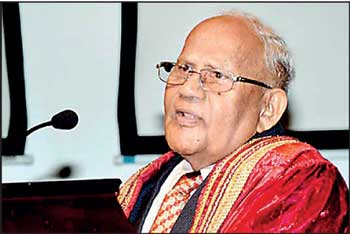 |
| Prof. A.D.V. de S. Indraratna |
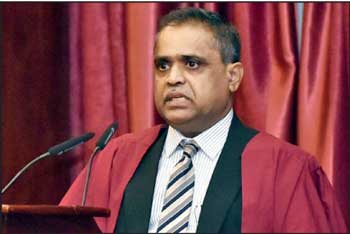 |
| Prof. O.G. Dayaratna-Banda – Pic by Ruwan Walpola |
By Devan Daniel
Delivering the Prof. A.D.V. de S. Indraratna Memorial Oration at the Annual Sessions of the Sri Lanka Economic Association (SLEA), University of Peradeniya Senior Professor of Economics and SLEA Vice President Prof. O.G. Dayaratna-Banda offered a blunt assessment of Sri Lanka’s economic predicament, arguing that the country remains trapped by ideology, institutional inertia, and an unwillingness to change, despite repeated crises.
“We are very good at advising and telling others what to do,” he said. “Sri Lankans are not very good at doing what they say. Everybody wants everyone else to change, except themselves.”
Prof. Dayaratna-Banda described Indraratna as a rare figure in Sri Lanka’s policy landscape, an economist who refused to dilute evidence to suit political convenience.
“He never wanted to say what others wanted to hear. He believed only in evidence-based arguments, not ideological positions.”
Recounting Prof. Indraratna’s academic journey from Andhra Pradesh to the University of Ceylon and later the University of Birmingham, he said the economist’s most enduring contribution lay in challenging denial within the political economy.
Referring to Indraratna’s 2007 research, Prof. Dayaratna-Banda noted that public sector corruption was estimated to absorb about 8.5% of GDP, reducing annual growth by roughly two percentage points. “Subsequent developments proved he was right,” he said, adding that the economist faced political hostility for stating uncomfortable truths.
Turning to the present, Prof. Dayaratna-Banda acknowledged Sri Lanka’s relatively rapid recovery from the post-2019 collapse. “No developing country that collapsed like this has recovered so soon,” he said, pointing to stabilised inflation, an improving external sector, and rebounding growth.
But he cautioned against mistaking stabilisation for structural change. “Recovery is not transformation,” he said.
At the centre of his argument was the services sector, which he said Sri Lanka continues to misunderstand. “Services are not a derived activity anymore,” he said. “They are not add-ons to agriculture and industry. They are the glue that binds them.”
With services accounting for around 57% of GDP and about half of employment, he argued that Sri Lanka already holds a structural advantage. “The problem is not the size of the services sector. The problem is that we remain stuck in low-complexity, low-value services.”
Modern services, including logistics, telecommunications, financial technology, and artificial intelligence (AI)-driven analytics, now determine productivity across the economy, he said. “Efficient services drive innovation-led growth.”
He added that global tradability has fundamentally altered the opportunity set. “You can work in a US laboratory while living in Sri Lanka. Research and development is now a globally tradable business.”
However, Prof. Dayaratna-Banda was unsparing in his assessment of the State’s capacity to support this shift. Weak broadband infrastructure, outdated curricula, and a deep skills mismatch were identified as binding constraints. “We like to pretend everything is fine,” he said. “But employers tell us otherwise.”
His sharpest criticism was directed at regulatory fragmentation and bureaucratic culture. “If you want to start a business in Sri Lanka, you deal with at least 14 Government agencies,” he said. “Unless you are an idiot, you will not start a business.”
Decades of discussion around one-stop investment facilitation had produced little progress, he added. “If I have capital, why should I chase the State to give me permission to invest?” He argued that institutional silos were a systemic failure rather than a personal one. “No person is inherently bad. Systems make people dysfunctional.”
Digitalisation, he said, had been reduced to rhetoric rather than reform. “They talk about a digital Government, but still ask for emails and printed copies. As long as regulations demand paper, behaviour will not change.”
Prof. Dayaratna-Banda concluded by challenging economists to rethink growth ambitions themselves.
“Are Sri Lankans really pursuing a $ 50,000 per capita income agenda?” he asked, urging greater realism about economic limits and social preferences. “There is an optimum income level an economy can bear. Unless we understand that, we will keep pursuing numbers we can never reach.”
The Oration closed with a call to honour Prof. Indraratna’s legacy through intellectual honesty rather than ceremony. He urged economists and policymakers to confront uncomfortable evidence, as Indraratna consistently did, if Sri Lanka is to move from repeated recovery to lasting transformation.



