Thursday Oct 15, 2026
Thursday Oct 15, 2026
Monday, 11 May 2026 00:23 - - {{hitsCtrl.values.hits}}
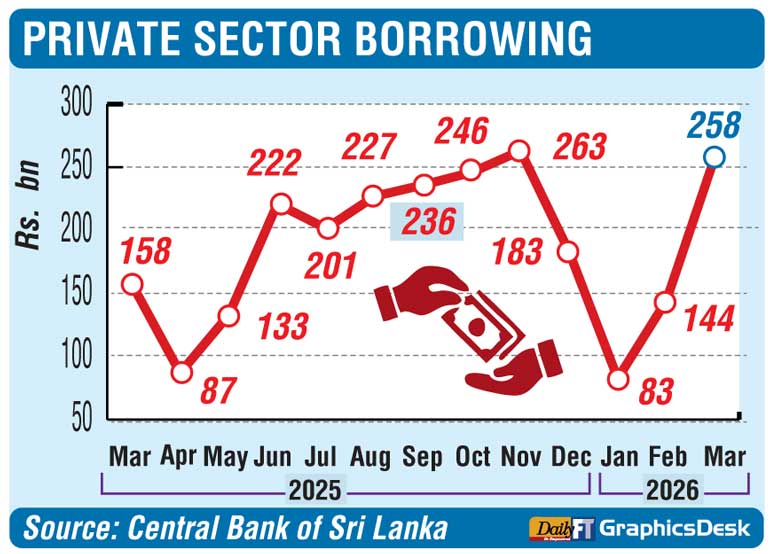
Private sector borrowings from the banking system accelerated sharply in March, with total outstanding credit increasing by Rs. 258.4 billion month-on-month (M-o-M) to Rs. 10.7 trillion ahead of the festive season.
This is the second highest monthly increase in outstanding private sector credit over the past 12 months after the Rs. 263 billion increase recorded in November 2025.
The lowest monthly increase in private sector credit during the period was recorded in January 2026 at Rs. 83 billion in the aftermath of Cyclone Ditwah, before recovering to Rs. 144 billion in February.
According to latest Central Bank of Sri Lanka (CBSL) data, total outstanding banking sector credit to the private sector increased to Rs. 10.7 trillion in March from Rs. 10.4 trillion in February, reflecting a 2.5% M-o-M increase.
On a year-on-year (YoY) basis, private sector credit expanded by 27.1% in March, up from the 26.4% growth recorded in February.
Lending from domestic banking units (DBUs) accounted for the bulk of the increase, rising by Rs. 259.9 billion or 2.6% M-o-M to Rs. 10.14 trillion in March from Rs. 9.88 trillion in February. On a YoY basis, DBU lending to the private sector grew 29.3% in March, compared to 28.9% in February.
In contrast, credit from offshore banking units (OBUs) edged down by Rs. 1.5 billion or 0.3% M-o-M to Rs. 556.2 billion in March from Rs. 557.7 billion in February. Outstanding OBU credit to the private sector declined 2.7% YoY in March, narrowing from the 5.5% contraction recorded in February.
Net credit to the Government fell by Rs. 11.9 billion or 0.1% M-o-M to Rs. 8.13 trillion in March from Rs. 8.14 trillion in February. On a YoY basis, net Government credit contracted 2.7% in March, compared to a 1.5% decline in February.
Credit to public corporations and State-owned enterprises (SOEs) also declined further, falling by Rs. 26 billion or 5.9% M-o-M to Rs. 411.2 billion in March from Rs. 437.2 billion in February. On a YoY basis, lending to public corporations contracted 31.2% in March, deepening from the 26.6% decline recorded in February.
In April, the CBSL in its flagship report Annual Economic Review 2025 said that with improved economic activity, firming demand conditions, and reconstruction and restoration efforts following Cyclone Ditwah, the growth momentum of credit to the private sector is likely to continue in 2026, although spillovers from the Middle East war could weigh on this outlook.
It said:
“Some slowdown in credit demand is possible, as recent adverse geopolitical events are likely to reduce global demand for domestic goods and services, along with other possible negative developments in the domestic economy stemming from the Middle East war.
“Accordingly, overall credit growth is expected to be relatively moderate in 2026, with a likely slowdown towards the latter part of the year. Credit to the public sector by the banking system is expected to moderate, supported by the continuation of fiscal consolidation, accompanied by major structural reforms, including the restructuring of State-Owned Business Enterprises (SOBEs).
“In the absence of direct CBSL financing to the Government, the Government is likely to rely more on alternative domestic financing options amid limited access to external financing, necessitating the maintenance of adequate financial buffers to withstand both global and domestic shocks and thereby ensuring the smooth functioning of Government operations.
“Further expansion in Net Foreign Assets (NFA) of the banking system is expected in the period ahead, supported by the expected increase in foreign exchange inflows, and the CBSL’s foreign exchange purchases to enhance its official reserves. Accordingly, monetary expansion is expected to persist in the period ahead, albeit at a slower pace.
“The CBSL remains ready to adjust its monetary policy stance in a data-driven and forward-looking manner. Within the conduct of monetary policy, effective monetary policy communication will remain vital for managing public expectations of inflation and supporting the achievement of low and stable inflation, thereby ensuring price stability. In this regard, the CBSL will not only continue to communicate its policy decisions promptly to the public through various channels, but will also assess the effectiveness and the public understanding of its messages. This would enhance transparency and accountability in monetary policy actions and reinforce public confidence.”




