Tuesday Sep 15, 2026
Tuesday Sep 15, 2026
Monday, 9 March 2026 06:44 - - {{hitsCtrl.values.hits}}
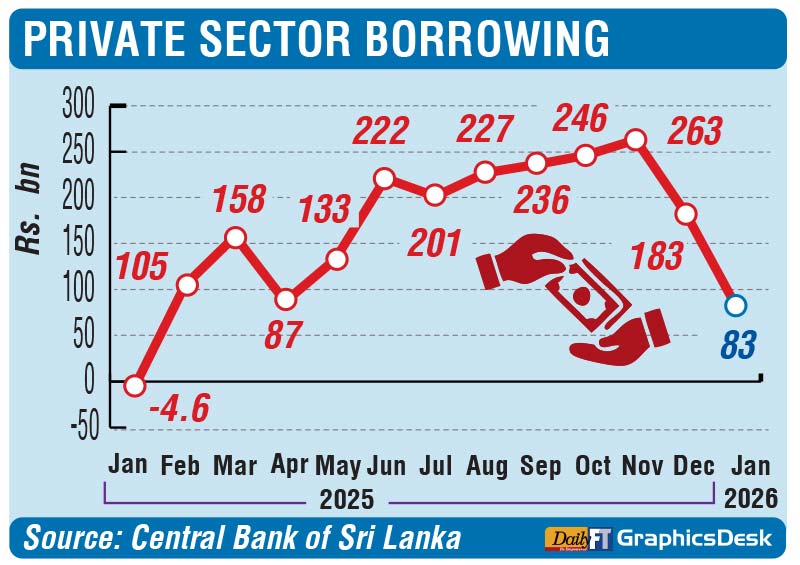 New private sector borrowing from Sri Lanka’s banking sector slowed sharply to Rs. 82.6 billion in January 2026, the lowest level in 11 months, extending the credit slowdown that has emerged in the aftermath of Cyclone Ditwah even as the overall stock of private sector debt continued to expand.
According to Central Bank of Sri Lanka (CBSL) data released last Friday, new borrowings from domestic commercial banks fell to Rs. 108 billion in January, a nine-month low, reflecting weaker demand for credit, or more cautious banks, following a strong expansion late last year.
Private sector borrowing from domestic commercial banks had peaked at Rs. 263 billion in November 2025, before declining to Rs. 183 billion in December 2025 and Rs. 108 billion in January, marking the third lowest monthly level in the past year. Only April 2025 (Rs. 87 billion) and February 2025 (Rs. 105 billion) recorded lower levels of new lending during the period.
Despite the slowdown in fresh borrowing, the total outstanding private sector debt stock rose 26.3% year-on-year (YoY) to Rs. 10.3 trillion by January.
Borrowings from domestic banks increased 29% YoY to Rs. 9.74 trillion, underscoring the continued dependence of Sri Lankan businesses on local banking sector funding. In contrast, outstanding debt from overseas banking units declined 6.6% YoY to Rs. 556 billion, reflecting the limited availability of foreign credit lines.
Meanwhile, net credit to the Government declined marginally by 0.6% YoY to Rs. 8.3 trillion, with CBSL exposure rising 5.3% to Rs. 1.8 trillion, while borrowings from domestic banks fell 2.6% to Rs. 6.4 trillion.
Bank lending to public corporations also contracted sharply, with total outstanding debt from domestic banks falling 29% YoY to Rs. 422.7 billion, signalling continued adjustment in credit exposure to State-owned enterprises (SOEs).
The latest credit data partly contradict the CBSL’s most recent Credit Supply Survey, which reported an improvement in banks’ willingness to lend during the fourth quarter of 2025 (https://www.ft.lk/front-page/CBSL-credit-survey-signals-easing-conditions-but-SME-bank-loan-rejections-up/44-788154).
While the Survey suggested expanding credit appetite across the retail, corporate, and small and medium enterprise (SME) segments, realised lending slowed markedly at the start of 2026.
New private sector borrowing from domestic commercial banks declined from Rs. 263 billion in November 2025 to Rs. 183 billion in December 205 and further to Rs. 108 billion in January, while total new borrowing from the banking sector fell to Rs. 82.6 billion, the lowest level in 11 months.
However, the broader credit trend remains expansionary. Total outstanding private sector debt rose 26.3% YoY to Rs. 10.3 trillion by end-January, reflecting the strong growth in lending recorded during 2025.
The Survey’s finding of declining lending appetite toward SOEs is consistent with the latest data. Outstanding bank credit to public corporations fell 29% YoY to Rs. 422.7 billion.
The gap between the Survey results and realised credit flows reflects the difference between lending intentions and actual disbursements. While the Survey captures banks’ reported willingness to lend, the January data indicate that credit demand or loan disbursements weakened at the start of 2026 despite improving system-level lending conditions.




