Saturday Nov 21, 2026
Saturday, 21 November 2026 00:16 - - {{hitsCtrl.values.hits}}
The Central Bank of Sri Lanka’s (CBSL) May tightening is showing up in market interest rates. Private sector credit growth is slowing but remains high, which is part of the reason for this week’s second rate hike.
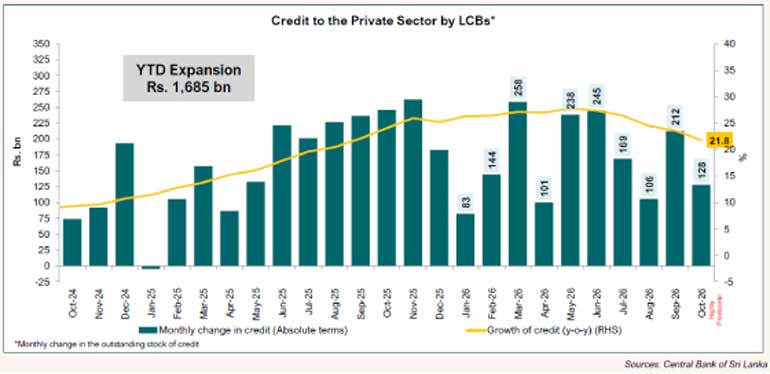
Economic Research Department Director Dr. Lasitha Pathberiya said that since the 100-basis-point hike in May, the interbank call money rate has risen by 108 basis points and the one-year Treasury Bill rate by 146 basis points. The weekly prime lending rate, which banks charge their best corporate customers, rose by 166 basis points. Private sector credit growth slowed but was still around 21.8% year-on-year, with large monthly expansions in some months such as September.
Governor Dr. Nandalal Weerasinghe said rates are meant to cool lending across the economy, not to target particular sectors. “I don’t think we are looking at the interest rate to curtail credit in one sector against others,” he said. He named personal loans, pawning and financial services as among the faster-growing areas.
Defending pawning, he said many people, including farmers, use gold-backed loans to finance cultivation and repay them after the harvest. “It’s the easiest way to have some credit for people who don’t have normal, easy access to credit. It’s a reasonable interest rate compared to the informal market rate,” he said.
He said rising gold prices had increased the value of the assets people borrow against, and so the size of the loans. That raised the risk that borrowers would not settle if prices fell. “It’s good that we imposed a loan-to-value ratio of 70%. That minimises the risk, not only for the customer but also for the bank,” Dr. Weerasinghe said. A loan-to-value ratio caps a loan as a share of the value of the asset pledged.
He said the CBSL does not decide how banks allocate credit. It sets interest rates and provides liquidity, and banks and borrowers make the lending decisions.
The CBSL will keep its deposit rate cap on non-bank financial institutions (NBFIs). The cap follows a formula linked to Treasury Bill and Bond rates and is adjusted quarterly. Asked whether weaker NBFIs would lose out to stronger players as liquidity tightens, the Governor said many companies already pay below the ceiling. “The cap is there to prevent even registered finance companies offering unnecessarily high rates to attract deposits. That’s a risk,” he said.