Friday Sep 25, 2026
Friday Sep 25, 2026
Monday, 15 December 2025 00:23 - - {{hitsCtrl.values.hits}}
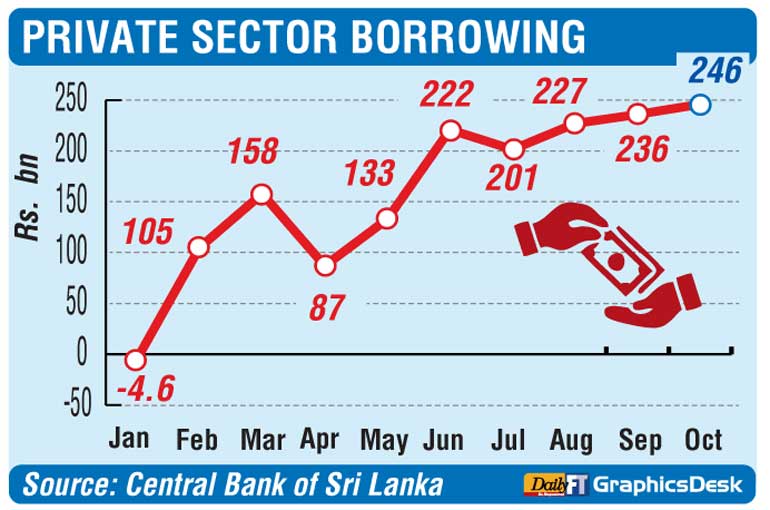
Total private sector borrowings in October 2025 spiked to a record Rs. 246.10 billion, resulting in the total outstanding amount reaching Rs. 9.76 trillion, up 24.1% from a year ago.
This is the highest monthly private sector borrowing this year after Rs. 236 billion in September, followed by Rs. 227 billion in August.
According to the latest Central Bank of Sri Lanka (CBSL) data, domestic banking sector credit to the private sector in October amounted to Rs. 247.7 billion.
The outstanding private sector debt stock from domestic banks during the first 10 months of 2025 was Rs. 9.76 trillion, up 25.8% from a year ago, and Rs. 583 billion from overseas banks, unchanged from a year ago.
Outstanding credit stock to the Government grew 2.8% year-on-year (YoY) to Rs. 8.2 trillion as of end-October, with credit from domestic banks up 2.8% YoY to Rs. 6.3 trillion. Total credit to public corporations was down 12% YoY to Rs. 587 billion, with the domestic banking sector debt stock at Rs. 534 billion, down 13.35% from a year ago.
Private sector credit growth data will likely be as encouraging for November 2025. However, the impact of Ditwah on private sector credit will only be known over the next few months.
In end-November, the CBSL, delivering the sixth and final Monetary Policy Review for 2025 announced that rates would remain unchanged at 7.75%. CBSL Governor Dr. Nandalal Weerasinghe said then that further easing of rates is still possible as the country had built sufficient buffers – monetary, reserves, and fiscal – if there are any global headwinds. However, the comments came before Cyclone Ditwah hit the island.
Post-Ditwah, Dr. Weerasinghe said the CBSL expects supply chain disruptions from the cyclone to cause only a brief increase in inflation to about 3%.
He said inflation should revert once bottlenecks clear. “Over a period of time, once supply chain issues are addressed, I would say we will come back to the normal inflation trajectory,” he said. “We will maintain stability going forward, as we have been doing so far under the framework.”
The CBSL has also announced several measures to help businesses affected by the Ditwah disaster to access bank credit at concessionary rates and terms.
At the regulatory level, the CBSL has directed licenced banks to roll out targeted debt relief and concessional credit for borrowers affected by the recent cyclonic disaster.
The measures include suspending capital and interest repayments on existing facilities for three to six months on a case-by-case basis, extending new loans with capped interest rates, waiving penal charges and fees until end-January 2026, and easing access to credit without automatic rejection based on adverse Credit Information Bureau (CRIB) records. The relief is to be granted on request by affected borrowers by 15 January 2026 and is intended to support households and businesses while preserving financial system stability.




