Friday Sep 18, 2026
Friday Sep 18, 2026
Tuesday, 7 April 2026 01:56 - - {{hitsCtrl.values.hits}}
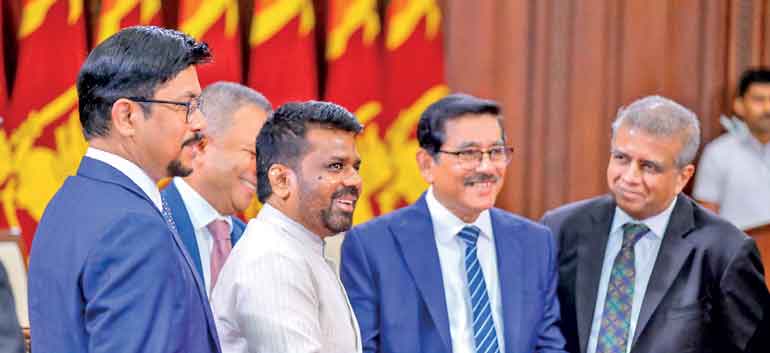
From left: Digital Economy Deputy Minister Eng. Eranga Weeraratne, President Anura Kumara Dissanayake, CBSL Governor Dr. Nandalal Weerasinghe, and Chief Adviser to the President on Digital Economy Dr. Hans Wijayasuriya
President Anura Kumara Dissanayake yesterday launched a national drive to accelerate QR-based payments, positioning digital transactions as a cornerstone of efforts to formalise the economy, improve subsidy targeting, and build a more transparent, data-driven system.
He made these remarks at the Presidential Secretariat during the official launch of the ‘National QR Payment Adoption Program,’ a key initiative aimed at accelerating the country’s transition towards a cash-lite economy.
Marking a significant milestone in Sri Lanka’s digital transformation journey, the program seeks to reduce reliance on physical currency, while promoting secure, reliable, and efficient digital payment systems. As part of the rollout, financial institutions have removed the Merchant Discount Rate (MDR) on all LankaQR transactions up to Rs. 5,000, effective immediately.
The initiative is being implemented with the support of the Central Bank of Sri Lanka (CBSL), the Digital Economy Ministry, GovTech institution, LankaPay, and licenced financial institutions. It is built on four key pillars: removing transaction barriers, incentivising adoption, introducing new technologies, and conducting countrywide awareness campaigns.
The President stressed that banks and financial institutions occupy a central role in ensuring the program’s success, urging them to actively promote QR-based transactions.
“We need new tools and models to bring culturally embedded transactions into this system. If banks extend their full support, QR-based transactions can be rapidly popularised,” he said.
Citing the upcoming Sinhala and Tamil New Year season as a strategic opportunity, Dissanayake proposed converting traditional cash-based gifting and seasonal transactions into QR-based payments, describing it as a potential “turning point” in shifting consumer behaviour.
He noted that while Sri Lankan society is open to innovation, adoption hinges on convenience and attractiveness. “If these innovations are not user-friendly, people will not embrace them. The initial push must come from the Government and financial institutions,” he added.
The President also linked digital payments to a broader structural issue of a lack of reliable transaction data for policymaking.
He pointed out that inefficiencies in subsidy targeting stem from the inability to systematically track economic activity. Using fuel subsidies as an example, Dissanayake noted disparities in benefit distribution depending on consumption levels.
“In a scenario where a rural user buys five litres of diesel, they receive Rs. 500 in subsidy, whereas a large vehicle filling 100 litres receives Rs. 10,000. This highlights the urgent need for better data to ensure subsidies reach intended beneficiaries,” he explained.
He reiterated that digitised transactions can serve as a proxy for assessing income levels and economic status, enabling more targeted and equitable welfare distribution.
The Government has already decided to provide a subsidy of up to Rs. 100 per litre of diesel following recent global price pressures, but effective targeting remains a key challenge.
A major challenge, the President observed, lies in transitioning Sri Lanka’s deeply entrenched cash-based transactional culture into a digital framework.
Despite strong engagement with banking systems through deposits and transactions, the country has yet to fully move from traditional passbook-based systems to modern digital platforms.
He stressed that for QR payments to succeed, they must extend beyond formal retail environments and embed themselves in everyday social and cultural practices.
“From giving money to children for school to New Year customs such as offering betel, our society is built around transactions. If QR payments are to become the norm, they must align with these cultural practices,” he said.
The digitalisation drive forms part of a broader ambition to build a $ 15 billion digital economy, not only through the ICT sector, but by enhancing productivity across agriculture, small and medium enterprises (SMEs), and other key industries.
However, the President acknowledged that progress to date has lacked scale and coordination, emphasising the need for structured implementation and sustained public engagement.
Dissanayake added that extensive media campaigns and awareness programs are expected to play a crucial role in driving adoption, with the Digital Economy Ministry already prioritising outreach efforts.
Digital Economy Deputy Minister Eng. Eranga Weeraratne noted that Sri Lanka still has Rs. 1.48 trillion in currency in circulation, underscoring the scale of the shift towards a digital economy.
He said despite strong banking penetration with 89% of adults holding bank accounts and existing infrastructure such as ATMs and the LankaQR system, adoption of digital payments remains limited. “Cash continues to dominate 99% of retail transactions, with only around 400,000 users recorded for QR payments in the final quarter of last year,” he added.
The Deputy Minister said the National QR Adoption Program aims to bridge this gap by changing both consumer behaviour and transaction patterns, enabling even small, everyday payments such as roadside purchases to be made digitally.
“To drive adoption, financial institutions have agreed to waive service fees on transactions below Rs. 5,000, alongside plans to introduce incentive schemes, including a lottery-based reward system and a nationwide awareness campaign targeting both merchants and consumers,” Eng. Weeraratne added.
CBSL Governor Dr. Nandalal Weerasinghe said two key reforms are expected to significantly boost uptake. The first is zero-cost QR transactions for low-value payments, supported by banks and LankaPay. The second is the introduction of person-to-person (P2P) QR payments, allowing individuals to transact directly without needing a merchant interface.
“This is a critical shift. By simply carrying a QR code, individuals can make and receive payments anytime, anywhere, without cash,” he said, noting that similar models have driven widespread adoption in countries such as India.
Chief Adviser to the President on Digital Economy Dr. Hans Wijayasuriya also expressed his views at the event.
The event was attended by the Secretary to the President Dr. Nandika Sanath Kumanayake, Ministry Secretaries and Government officials, as well as Chairpersons and CEOs of banks and financial institutions, among others.



