Sunday Aug 30, 2026
Sunday Aug 30, 2026
Saturday, 23 May 2026 05:46 - - {{hitsCtrl.values.hits}}
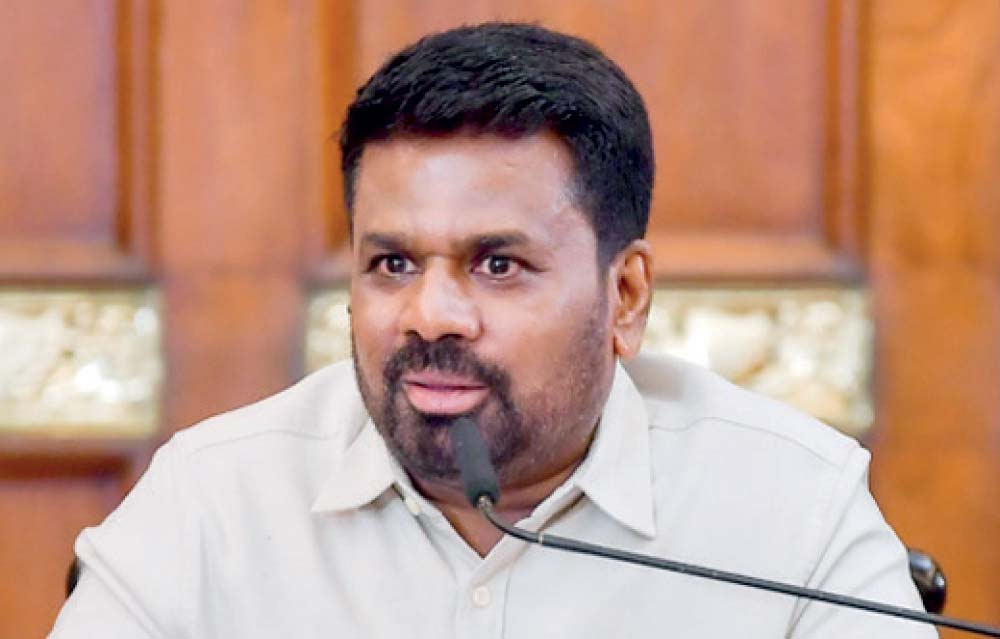
President Anura Kumara Dissanayake
President Anura Kumara Dissanayake yesterday publicly acknowledged mounting economic pressures from the escalating Middle East conflict while insisting Sri Lanka is not facing a repeat of the 2022 economic collapse, in remarks aimed at containing growing market anxiety over the country’s external position.
Speaking at a ceremony to recommence construction work on the Nintavur Cultural Centre, the President said rising oil prices, higher import costs, weaker tourism inflows and pressure on export earnings were increasing demand for dollars and contributing to the depreciation of the rupee.
“The dollar is appreciating to some extent against the rupee,” he said, adding that the escalating Middle East conflict was increasing the country’s import bill and placing pressure on foreign exchange flows.
However, the President strongly rejected comparisons with 2022, when Sri Lanka’s reserves collapsed, imports became unavailable and shortages of fuel, cooking gas, milk powder and fertiliser paralysed the economy.
“Some people claim that this situation is similar to 2022. It is not,” he said.
“In 2022, we did not even have rupees. In 2022, the Central Bank had no dollars either. That is not the case today.”
President Dissanayake said the Central Bank currently holds close to $ 7 b in reserves, compared with about $ 50 m during the depths of the crisis in 2022, while Sri Lanka is also expecting a further $ 700 m inflow in the coming days.
“There is a shortage of dollars in the market, but the Central Bank currently holds close to 7,000 million US dollars,” he said.
The remarks come as investors increasingly monitor whether Sri Lanka’s post-crisis stabilisation framework can withstand a major external shock, with the renewed Middle East conflict raising concerns over oil prices, shipping costs, tourism flows, export earnings and pressure on the rupee.
The President’s intervention was significant less because it removed the underlying risks, and more because it signalled that the Government recognises the pressures openly and is attempting to prevent market fears from escalating into a broader confidence crisis.
“We will under no circumstances allow shortages of imported fuel, gas, milk powder or fertiliser,” he said. “Such a situation will not arise again.”
While acknowledging that the country remained under strain, he argued that Sri Lanka still retained operational capacity, access to foreign exchange reserves and the ability to manage imports systematically.
“We are under a certain degree of pressure and we must manage it carefully,” he said. “But we are capable of facing it.”
President Dissanayake described the current situation as an externally driven crisis linked to geopolitical tensions rather than a domestically generated economic breakdown.
The President also used the address to defend the Government’s broader reform agenda, saying the administration had already taken steps to strengthen the economy, reduce political privileges and enforce the law equally regardless of status or influence.
He said the Government had acted on its mandate to curb corruption, prevent racism and ensure equal application of the law, while also moving to abolish excessive political privileges including pensions.




