Thursday Oct 15, 2026
Thursday Oct 15, 2026
Thursday, 15 October 2026 06:15 - - {{hitsCtrl.values.hits}}
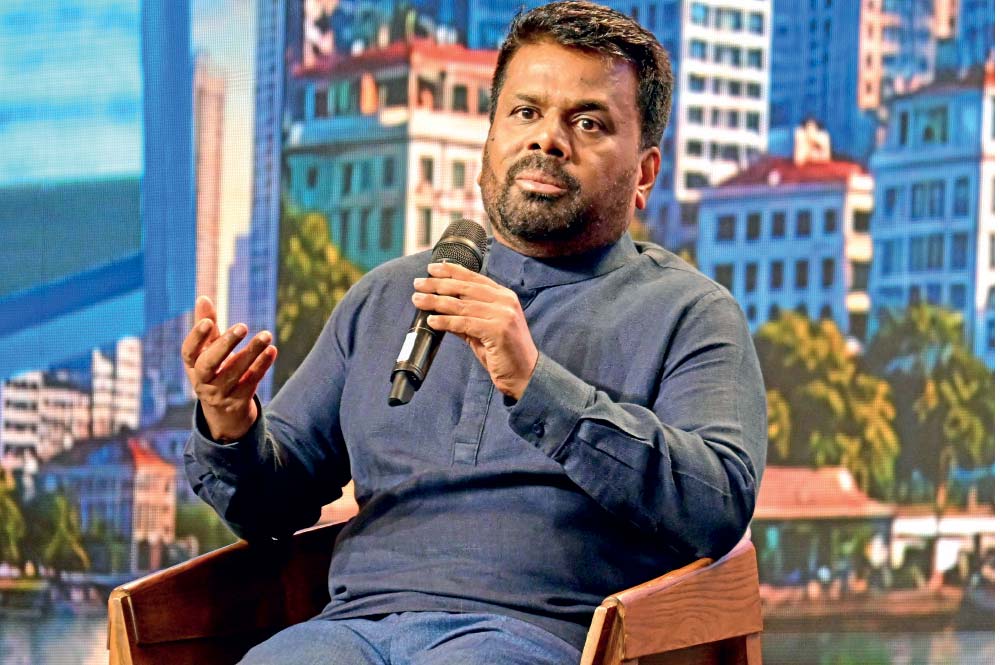
President Anura Kumara Dissanayake - Pic by Lasantha Kumara
President Anura Kumara Dissanayake has outlined a February 2027 deadline for presenting key legislation covering State-Owned Enterprises (SOEs), public-private partnerships (PPPs), labour reforms and Customs modernisation to Parliament, as the Government seeks to address structural barriers to investment and fiscal sustainability.
Speaking at the inauguration of the Sri Lanka Economic and Investment Summit 2026 on Monday (12), Dissanayake said work on the proposed laws was at different stages of completion, with the SOE legislation expected to reach Cabinet within two weeks.
“Regarding the SOE law, I expect it will be presented to the Cabinet in about two weeks,” he said.
The President said the PPP legislation had already been drafted and submitted to the Legal Draftsman’s Department, with recommendations received. The Government is also consolidating existing labour legislation into a unified framework, while proposed amendments to the Customs Ordinance are being finalised following discussions between the Treasury and the Sri Lanka Customs Department.
“Most likely, all of these bills will be presented to Parliament for approval by February,” he said.
The legislative program forms part of Sri Lanka’s broader structural reform agenda under the International Monetary Fund’s (IMF) Extended Fund Facility (EFF), which places emphasis on strengthening public financial management, improving governance and creating a more predictable environment for private investment.
Delays in enacting these reforms have been identified as constraints on the country’s long-term economic competitiveness. Outdated governance arrangements for SOEs can sustain fiscal risks and inefficiencies, while gaps in the legal framework for PPPs can complicate private sector participation in infrastructure and other public projects.
On labour reforms, Dissanayake said around 12 separate labour statutes were currently in force and that the Government was working to consolidate them into a single law.
“A draft bill has already been formulated, though reviewing and finalising it will take some time,” he said, indicating that the process would require further scrutiny before the legislation was ready.
The proposed Customs reforms seek to replace or modernise provisions rooted in the Customs Ordinance of 1869, which the Government considers in need of updating to meet contemporary trade and administrative requirements.
Dissanayake said an agreement had been reached on the proposed amendments after extensive discussions between the Treasury and Customs Department.
“The proposed amendments to the Customs Ordinance are the most appropriate way forward,” he said, adding that the proposals had been submitted to the Legal Draftsman’s Department and that the Government expected the Bill to be finalised promptly.
The reforms are significant for Sri Lanka’s efforts to strengthen revenue mobilisation, improve trade facilitation and attract investment as it continues its post-default economic recovery.
A modernised SOE framework is intended to strengthen accountability and governance across State enterprises, while clearer PPP rules could provide greater certainty for investors considering projects alongside the Government. Labour law consolidation and Customs modernisation are also expected to address regulatory complexity and improve the business environment.




