Friday Aug 07, 2026
Friday Aug 07, 2026
Thursday, 5 March 2026 05:33 - - {{hitsCtrl.values.hits}}
|
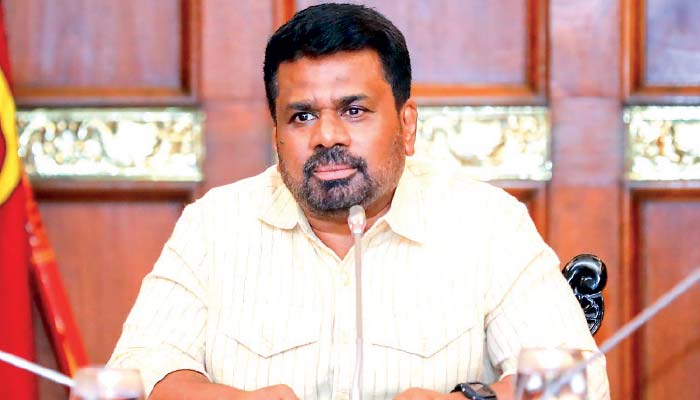
President Anura Kumara Dissanayake |
President Anura Kumara Dissanayake yesterday convened a series of high-level discussions at the Presidential Secretariat to review the potential economic impact of the ongoing conflict in the Middle East and to assess measures required to safeguard Sri Lankan migrant workers and tourists.
The meetings focused on the possible implications of the conflict for fuel and gas supplies, tourism flows, exports, investment activity, and food security, as well as the safety of Sri Lankans residing in or travelling to the affected region.
Officials examined the potential impact of disruptions to energy supplies and maritime routes on domestic fuel prices and inflation. While noting that current fuel stocks remain adequate, the President directed authorities to closely monitor reserves and ensure that contingency measures are in place to maintain supply stability.
Attention was also drawn to the country’s limited storage capacity for liquefied petroleum gas, with officials exploring potential short-term options, including the use of Hambantota Port, to manage additional reserves if required.
The discussions further considered possible congestion at Colombo Port arising from disruptions to maritime traffic through key routes such as the Suez Canal and the Strait of Hormuz.
Officials were asked to explore arrangements that would facilitate the movement of vessels operating regularly with Sri Lanka.
Tourism officials noted that a large share of visitors from Europe travel through Middle Eastern transit hubs. Authorities are therefore exploring alternative aviation routes and operational adjustments to minimise potential disruptions to tourist arrivals.
Officials from the Trade, Commerce, Food Security and Cooperative Development Ministry informed the meeting that existing food reserves are currently adequate but that contingency plans are in place to address potential risks.
The President emphasised that while the course of the conflict remains uncertain, the Government must maintain close vigilance across all sectors and act in a coordinated manner to protect economic stability and the livelihoods of citizens.
“Although the future cannot be predicted, we must work collectively to overcome this challenge by remaining continuously vigilant to developments in every sector,” President Dissanayake said.
The President also instructed the Finance Ministry to explore the preparation of a relief package aimed at encouraging investment in the technology sector, including opportunities linked to data centres and digital infrastructure. These proposals are to be examined in consultation with Senior Adviser to the President on Digital Economy Dr. Hans Wijayasuriya.
A separate discussion reviewed measures taken to support Sri Lankan migrant workers abroad and tourists currently in the country.
Officials reported that 24-hour emergency services have been activated through Sri Lankan diplomatic missions to assist nationals overseas, as well as tourists within the country.
According to the Foreign Affairs Ministry, no serious injuries have so far been reported among Sri Lankans residing in countries affected by the conflict. Relevant embassies have been instructed to provide assistance where required.
Hotlines established by the Sri Lanka Tourism Development Authority (SLTDA) and the Sri Lanka Bureau of Foreign Employment (SLBFE) are receiving and updating information on issues faced by tourists and migrant workers.
Authorities said 19 inquiries related to visa expirations, 42 immigration-related issues, and one financial matter have been reported so far. No requests have been received for special aircraft services.
Officials are also exploring arrangements with foreign governments to grant grace periods for Sri Lankan workers who have returned temporarily to the country so they may resume employment overseas once conditions stabilise.
The President further instructed officials to gather information on Sri Lankans currently in Middle Eastern countries for tourism or business purposes who may face difficulties returning and to make the necessary arrangements to facilitate their travel.
SriLankan Airlines officials informed the meeting that aviation services are gradually returning to normal and that necessary operational support can be provided if required.
The discussions were attended by Foreign Affairs, Foreign Employment and Tourism Minister Vijitha Herath, Ports and Civil Aviation Minister Anura Karunathilake, Tourism Deputy Minister Prof. Ruwan Ranasinghe, Foreign Employment Deputy Minister Arun Hemachandra, and several senior Government officials, including Secretary to the President Dr. Nandika Sanath Kumanayake, Finance Ministry Secretary Dr. Harshana Suriyapperuma, and representatives from the Central Bank of Sri Lanka, Sri Lanka Ports Authority, Board of Investment, and other institutions.