Sunday Oct 25, 2026
Sunday Oct 25, 2026
Tuesday, 8 September 2026 03:27 - - {{hitsCtrl.values.hits}}
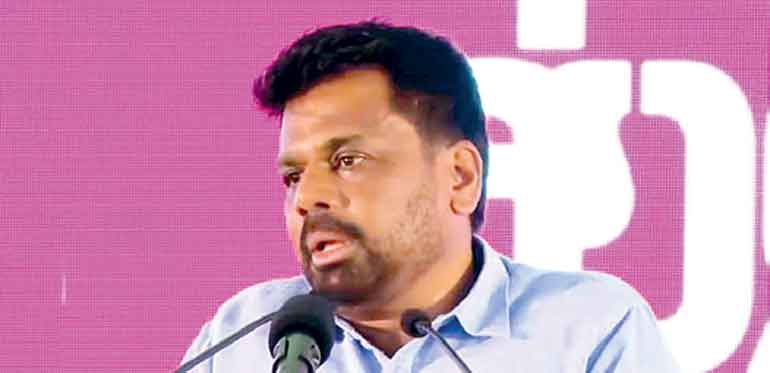
President Anura Kumara Dissanayake
President Anura Kumara Dissanayake said Sri Lanka will next year begin construction on three major expressways using only Treasury funds, without any foreign borrowing, describing it as the first time this has happened in the country’s history.
Speaking at a public event in Bulathsinhala, President Dissanayake said work will start on expressways linking Galagedara to Rambukkana, Ingiriya to Padukka, and Kurunegala to Galewela. “For the first time in Sri Lanka’s history, all three of these expressways will be constructed entirely using money from our Treasury, without taking a single cent in foreign loans,” he said.
President Dissanayake also outlined a Rs. 60 billion railway electrification program. Tenders for the first phase, covering the Panadura-Maradana, Negombo-Maradana and Ragama-Maradana lines, are due to be awarded in November, with Rs. 100 billion allocated in next year’s Budget to fund the project.
Construction of the Rs. 47 billion Malwathu Oya reservoir project will also begin, with funding to be provided through next year’s Budget as required.
On digital infrastructure, President Dissanayake said 1,000 4G towers are planned over three years to complete nationwide 4G coverage, with 250 to be completed next year. Rs. 30 billion has been allocated in next year’s Budget for digitalisation, which he said would allow citizens to access around 80% of government services from home, including birth and death certificates, land deeds and revenue licences.
The Government also plans to establish 50 vocational universities across the country, including two in the Kalutara District, as an alternative track to the traditional university system for students after their Advanced Level examinations.
On energy, President Dissanayake said a 160-megawatt battery storage system has been installed to store solar power generated during the day for release during peak demand between 6 p.m. and 10 p.m., reducing the need to burn diesel. A further 200-megawatt battery system is planned. He said the Government is also reviewing existing agreements at the Ceylon Petroleum Corporation with the aim of creating a more competitive fuel market.
On rural infrastructure, President Dissanayake said Rs. 25 billion had been allocated for rural roads, but bitumen imports were disrupted by the conflict in the Middle East. The Cabinet subsequently authorised the Petroleum Corporation to import bitumen from any source, at whatever price necessary, to keep road construction on schedule. Funds have also been provided to renovate small reservoirs ahead of expected heavy rainfall between October and January, following a drought linked to El Niño conditions expected to continue until the end of September.
President Dissanayake said Rs. 100 million and Rs. 200 million had been allocated in the Budget for feasibility studies, saying projects would only be funded once assessed to produce results for the public.
President Dissanayake also pointed to a number of other outcomes he described as firsts for the country under his administration. He said Government revenue reached 16.7% of GDP in 2025, the highest in 30 years, which he attributed to closing routes through which tax and land-lease revenue had previously been diverted before reaching the Treasury. He said the 2025 budget deficit was the lowest recorded since 1957, and that Rs. 2 trillion has been allocated for capital expenditure in next year’s Budget, an amount he said no previous governments had allocated for capital development.
President Dissanayake said that over the past two years, no tear gas, baton charges or water cannon had been used against a public protest, and no police complaint relating to a racially motivated conflict had been recorded. He said the National People’s Power had been formed without using financial power, media influence or state power to influence the outcome, which he described as unprecedented in the country’s political history.
On social welfare, President Dissanayake said Rs. 6,000 was provided to 1.7 million schoolchildren to purchase educational equipment, which he said had not been done before. He said children in state care homes now receive a monthly allowance of Rs. 5,000, having previously received none, along with Rs. 2 million on leaving care at age 18 to build a house.




