Sunday Oct 11, 2026
Sunday Oct 11, 2026
Wednesday, 18 March 2026 00:40 - - {{hitsCtrl.values.hits}}
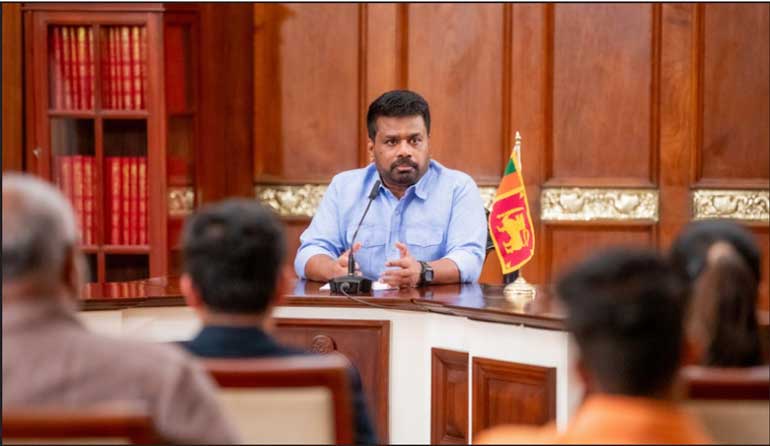
President Anura Kumara Dissanayake yesterday underscored that ensuring the uninterrupted functioning of the country remains the Government’s primary objective, calling for the collective support of the public and private sectors, media and citizens to navigate the current challenges.
Addressing a special media briefing, he expressed confidence that a robust mechanism is already in place to monitor developments and respond effectively to evolving circumstances.
He announced that temporary permits have been issued to US dollar-denominated businesses to import fuel and sell it directly to the tourism and export sectors, as the Government moves to cushion the impact of shipment delays triggered by the escalating conflict in the Middle East.
The President said the decision was taken following requests from business associations representing exporters and tourism operators. “Those business associations requested us to permit them to import the fuel they require. We have given that opportunity temporarily,” he said in a live telecast.
He noted that around 30 private sector businesses have already registered to import fuel using their own foreign currency and sell it in dollars.
“They import fuel using their own dollars and sell fuel in dollars. Starting Wednesday morning (today), the export sector can begin supplying its own fuel. That fuel is already in their storages. Those private sector businesses can supply fuel for exporters and tourism businesses,” he said.
Trading in foreign currency is generally prohibited in Sri Lanka, making the temporary relaxation a significant and targeted intervention aimed at safeguarding dollar-earning sectors amid the fuel crunch.
The President attributed the current pressure on supplies to disruptions in global shipping and energy markets due to the Middle East crisis.
He said two shipments of 90,000 tons of crude oil, despite being secured under long-term tenders, have been delayed. A separate shipment by a private sector fuel distributor has also been delayed. “Our primary energy sources are fuel, gas and coal. We have secured long-term tenders for fuel supply. The fuel supply disruption from the Middle East conflict has delayed some fuel shipments,” he said.
Warning of the volatility in global energy markets, the President said that during crises vessels are often diverted for private sales, with multiple agents claiming authority over a single shipment.
“At times like this, we are aware that a black market tends to emerge globally. Vessels at sea are diverted for private sale, often with multiple agents presenting themselves for a single ship. This is the nature of the situation during such a crisis. Unlike the private sector, the state cannot engage in such instantaneous procurement,” he explained.
To fast-track decisions, a special committee of senior officials has been appointed with the approval of the National Procurement Commission. Its decisions are subsequently ratified by the Cabinet, forming a streamlined mechanism to ensure uninterrupted fuel supply.
The President said that while fuel shipments have faced delays, the Government is confident of averting an energy crisis.
On coal supplies, he said 23 vessels had been dispatched to suppliers, of which 13 have already arrived. Issues remain with the remaining shipments, but the Cabinet has approved an urgent tender to secure five additional vessels from a supplier deemed reliable.
“Once this delivery is secured, we will be able to prevent a crisis in the coal sector,” he said, adding that there is no immediate need for power cuts.
On LP gas, he said 38,000 tons had already arrived this month, exceeding the monthly requirement of 33,000 tons. Another 33,000 tons are expected to arrive Wednesday or Thursday.
“Around 80% of the LP gas supply is supplied by State-run Litro Gas and the balance by the private company. Since there was no supply from the private company, the hotel industry who had contracts with them had to request gas from Litro. This caused the shortage,” he said.
He said part of the gas stock is already in local storage, while some is held in floating storage facilities in the Maldives. “The next scheduled supply is expected between 21 and 23 April. Accordingly, there is no risk of a crisis in the gas market,” he assured.
Responding to questions about reducing fuel taxes, the President said the Ceylon Petroleum Corporation (CPC) had an Rs. 884 billion debt burden when the Government took office. This was transferred to the Treasury, which now bears an annual interest cost of around Rs. 100 billion.
He said CPC made a profit in March, and the Government would review fuel pricing in light of global oil prices and domestic economic activity.
“If fuel prices increase, economic activities will decrease, so we will consider all factors and come to a middle ground decision,” he said.
Addressing food security concerns, the President said there are sufficient fertiliser stocks for the upcoming Yala season. A bag of urea is currently priced at Rs. 9,200 through the Government and Rs. 9,500 in the private sector, with 500 Farmer Service Centres distributing supplies.
Dissanayake also confirmed that wheat stocks are sufficient for three months, along with green gram and other grains used in food supplements. The Government has held discussions with the Essential Food Importers Association and assured them of adequate fuel for distribution ahead of the festive season.
The President defended the introduction of the QR code system for fuel distribution, noting that nearly five million QR codes have already been registered.
“This is the first time the QR system is being used at the point of fuel distribution. Two expert companies in Sri Lanka voluntarily assisted with this initiative,” he said.
He acknowledged that the system could initially disrupt some essential sectors, but said measures are in place to prevent such impacts. The health sector, for instance, has secure reserves sufficient for six weeks beyond the current allocation, with additional buffers for hospitals, ports and airports.
Fuel allocations for agriculture, fisheries and industry are being increased where necessary. The Ministry of Agriculture has prepared specific plans for the paddy harvesting season, while the fisheries sector, including 30,000 small boats will receive managed allocations based on operational needs.
Goods are being distributed through channels such as Sathosa and cooperative networks to ensure essential food supplies remain uninterrupted.
The President said challenges facing the country fall into three categories: internal issues, natural disasters and external shocks such as the Middle East conflict.
“We are definitely not a nation that can make an influence in such a scenario. However, I can assure you that as a Government, we are taking proactive measures to mitigate any serious threat to our ongoing economic recovery efforts,” he said.
A special committee chaired by the Social Security Minister, Upali Pannilage has been appointed to assess the broader economic impact, including potential issues related to insurance, loan repayments and livelihoods.
He said the Central Bank is providing updated reports, sometimes every two days, to the Economic Monitoring Committee to enable timely and data-driven decisions.
“We are confident that we can overcome this challenge. A robust mechanism is already in place and we are continuously monitoring the situation. Accordingly, we believe we will be able to respond to these circumstances effectively.”




