Friday Oct 16, 2026
Friday Oct 16, 2026
Monday, 16 March 2026 05:28 - - {{hitsCtrl.values.hits}}
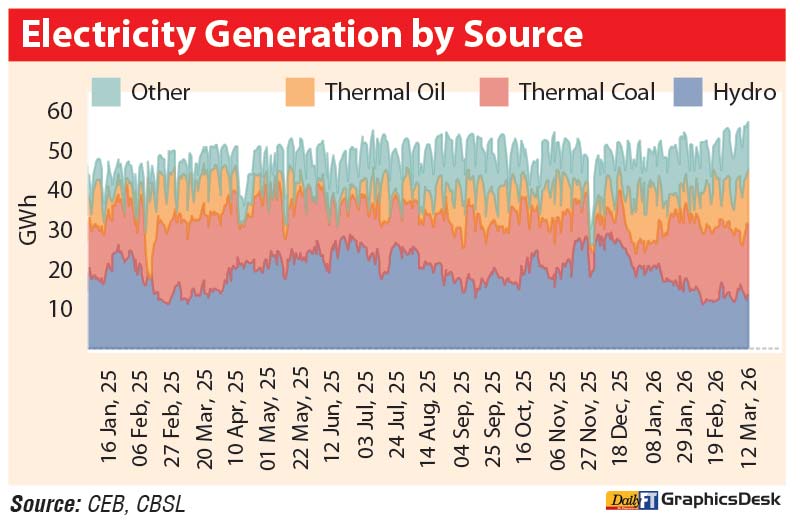 Sri Lanka’s electricity generation mix showed a modest shift towards oil-based power in the week ending 12 March compared with the final week of February.
This broadly follows a cyclical pattern for this time of year but is more concerning now as global energy markets remain volatile amid the ongoing Middle East conflict and rising oil prices.
According to data released by the Central Bank of Sri Lanka (CBSL) on Friday, thermal fuel-based generation accounted for 23.1% of total output in the week ending 12 March, up from 19.9% in the final week of February, while the share of hydropower declined to 23.2% from 25.1%. Coal remained broadly stable at around 30.4% of generation compared with 32% earlier, while solar contributed roughly 20.8%, largely unchanged from 21.7% previously. Wind and biomass continued to play a marginal role, accounting for 1.9% and 0.6%, respectively.
Data from the power system show that peak electricity demand rose during the week ending 12 March, reaching 3,040 MW on 12 March, compared with a peak of 2,944 MW recorded on 26 February. Total daily energy generation also increased slightly, reaching 58.16 GWh on 12 March compared with 56.20 GWh at the end of February.
Thermal oil generation showed a notable increase over the period. Oil-fired power production rose to 14.02 GWh on 12 March, up from 11.69 GWh recorded on 26 February. Across the week ending 12 March, oil-based generation ranged between 12.08 GWh and 14.02 GWh per day, higher overall than the 8.19 GWh to 12.42 GWh range recorded during the reference week in February.
Coal-fired generation remained broadly stable over the period. Output from coal plants ranged between 15.09 GWh and 18.22 GWh during the week ending 12 March, broadly comparable to the 17.14 GWh to 18.42 GWh range recorded during the last week of February.
Hydropower generation showed a slight decline. Daily hydro output ranged between 12.29 GWh and 13.72 GWh during the week ending 12 March, compared with higher levels earlier, including 15.34 GWh recorded on 23 February. The reduction in hydro contribution increased the relative share of thermal generation in the system.
Renewable contributions from wind and solar remained relatively stable. Wind generation ranged between 0.87 GWh and 1.24 GWh in the week ending 12 March, while solar output fluctuated between 11.33 GWh and 12.71 GWh. Biomass generation remained marginal, contributing around 0.28 GWh to 0.39 GWh per day.
The shift towards greater oil-based generation comes at a time when global crude prices have surged above $ 100 per barrel amid escalating tensions in the Middle East, raising concerns over energy costs for import-dependent economies such as Sri Lanka.
While Sri Lanka’s coal and renewable capacity provides some buffer, the power system continues to rely on oil-fired generation during periods of higher demand or lower hydro availability. With global oil prices remaining elevated, this shift in the generation mix could increase pressure on energy import costs and the overall electricity sector if geopolitical tensions persist.




