Saturday Oct 10, 2026
Saturday Oct 10, 2026
Monday, 6 July 2026 05:18 - - {{hitsCtrl.values.hits}}
|
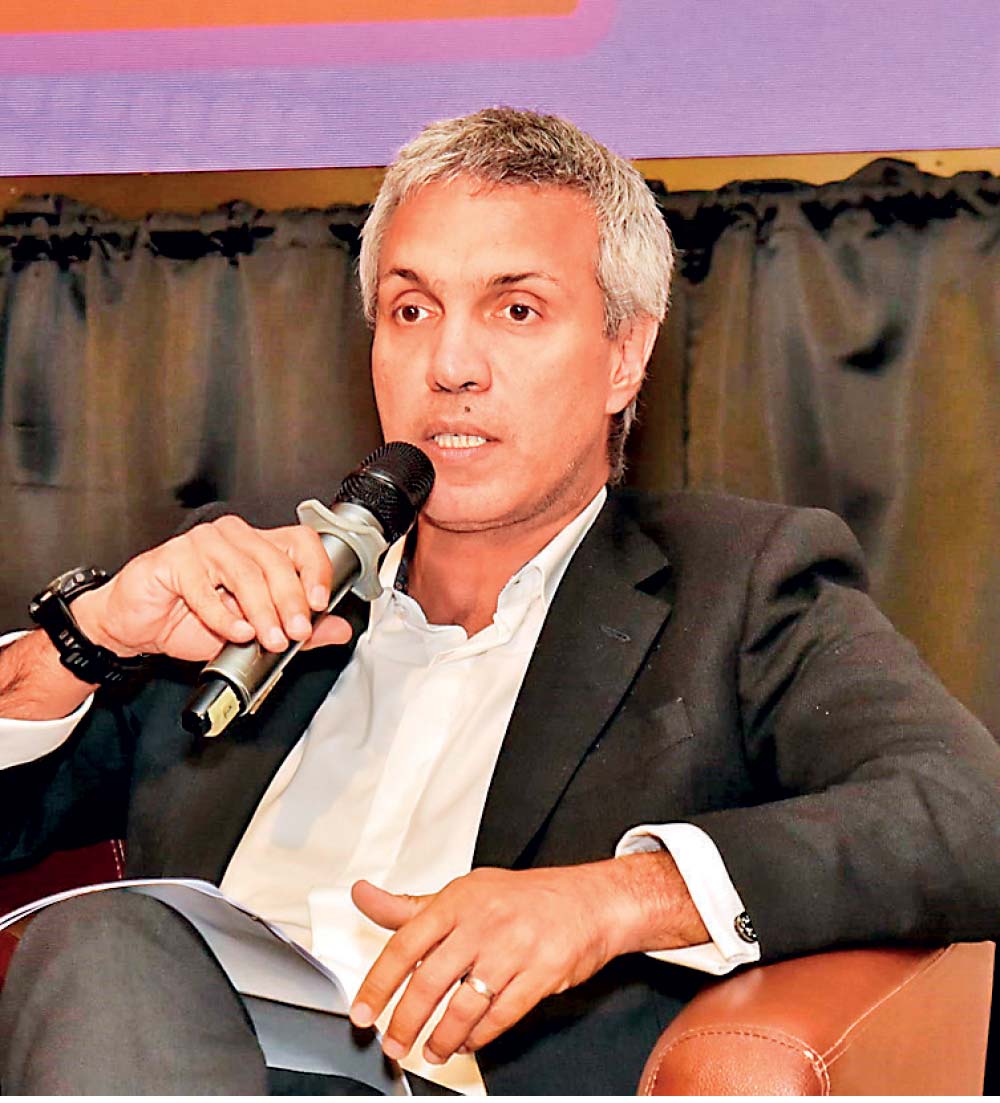
Colombo Port City Economic Commission Director General Revan Wickramasuriya – Pic by Upul Abayasekara
|
The Colombo Port City Economic Commission is considering using Port City Colombo as a regulatory sandbox to trial labour market reforms, arguing that rigid employment laws rather than tax rates remain one of the biggest obstacles to entrepreneurship, investment, and long-term economic growth.
Speaking at the CA Sri Lanka 5th Annual Economic and Tax Symposium, Colombo Port City Economic Commission Director General Revan Wickramasuriya said Sri Lanka had placed excessive emphasis on tax concessions to attract investment while neglecting structural reforms that ultimately determine investor confidence.
“We keep always going back to tax as an incentive to drive investments. That’s not a key driver,” Wickramasuriya said.
Pointing to Port City’s own experience, he noted that a tax incentive framework introduced in 2023 offering property developers tax holidays of up to 25 years failed to trigger construction activity before it expired in August 2025. Under a revised framework introduced in September 2025, which reduced the maximum concession to 15 years, developers have begun construction despite operating under shorter tax holidays of 10 to 12 years.
“Clearly, it is not tax holidays that drive investments,” he said, adding that investor confidence, policy stability, and certainty over future tax policy were far more important.
“The biggest tax incentive that can be given is assurance where the next tax rate is going to be,” he said.
Wickramasuriya reserved his strongest comments for labour market reforms, arguing that Sri Lanka’s employment laws discourage entrepreneurs from taking risks by making it difficult to restructure businesses or exit unsuccessful ventures.
“What holds back businesses, risk takers, and entrepreneurs in this country is taking risk,” he said, noting that while entrepreneurs can readily establish businesses, winding them up and terminating employment when ventures fail remains a significant challenge.
“We’re trying to work through maybe Port City, create a sandbox environment and try something out,” he said, suggesting the Special Economic Zone (SEZ) could be used to pilot politically difficult labour reforms before wider implementation.
Drawing on his own experience working overseas, Wickramasuriya said flexible labour markets had not prevented employees from thriving and questioned why Sri Lankan companies continue to establish operations abroad despite paying taxes in those jurisdictions.
He also pointed to workers’ remittances, expected to reach around $ 9 billion this year, as evidence that Sri Lankans readily work under more flexible labour regimes overseas.
“We need to look at not tax incentives, but reforms in labour laws,” he said, adding that freer movement of capital was another critical reform needed to improve the country’s competitiveness.
Wickramasuriya said improving investor confidence had already translated into stronger investment momentum within Port City Colombo following last year’s political transition.
While six land parcels had been leased between 2021 and 2024, none had commenced construction. Since January 2025, however, the Commission has executed leases for a further four land parcels, bringing the total to 10, with construction now underway on six developments and the remaining four expected to commence within the next six months.
The six ongoing developments represent investments of around $ 500 million in land and buildings, while the remaining four are expected to be of similar or greater value. The Commission has also licenced around 185 businesses under the Port City framework, employing approximately 15,000 people, including about 8,000 foreign professionals, while occupying around 150,000 square metres of office space.
Rejecting persistent claims over the ownership of Port City land, Wickramasuriya said all land administered by the Commission remains owned by the Government and is leased, rather than sold, to investors.
“This misunderstanding that this land belongs to China or part of the land has been given on a freehold basis to China is absolutely incorrect and not factual,” he said.