Tuesday Oct 13, 2026
Tuesday Oct 13, 2026
Monday, 30 March 2026 05:41 - - {{hitsCtrl.values.hits}}
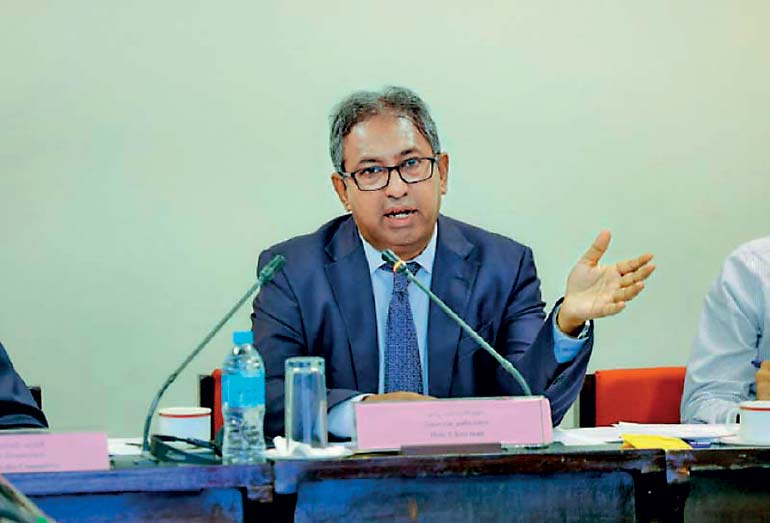
CoPF Chairman SJB MP Dr. Harsha de Silva
The Colombo Port City Economic Commission and the Board of Investment (BOI) told the Committee on Public Finance (CoPF) that the current Middle East crisis presents an opportunity to attract investment flows to Sri Lanka, particularly from businesses seeking alternative locations in the region.
Commission officials, who appeared before the CoPF earlier this month, said the initial outreach is being prepared, including engagement through the Foreign Affairs Minstry and Sri Lanka’s diplomatic missions in Gulf countries. They identified business process outsourcing (BPO) operations and disaster recovery offices of firms based in the United Arab Emirates (UAE) as among the segments that could relocate more quickly.
Officials also said the approach would involve positioning both Port City and the wider country to prospective investors, while noting that further discussions are required to develop a coordinated strategy.
CoPF members, however, raised concerns over delays in approvals and institutional coordination, noting that the window to attract such investment could be limited.
The hearing highlighted the absence of a formal coordination mechanism between the Port City Commission and the BOI. Officials said interactions currently take place on a case-by-case basis, although proposals have been made to introduce regular meetings between the two agencies.
Regulatory dependencies were also identified as a constraint. Approvals for offshore banking operations require clearance from the Central Bank of Sri Lanka (CBSL), while certain imports depend on separate regulatory authorities, resulting in delays outside the control of the Commission and the BOI.
Committee members also pointed to administrative delays arising from manual processes and repeated information requests. Officials said steps are being taken to introduce digitised workflows and single-window systems to streamline approvals.
Questions were also raised regarding the broader institutional framework, including the future role of the BOI under proposed reforms, as well as the need for clearer alignment between agencies involved in investment promotion.
The interim provision allowing Port City-authorised businesses to operate outside its designated area is due to expire on 27 May. Officials said Cabinet approval has been obtained to extend the period by two years, with the necessary legislative amendment to follow.
Differences in incentive structures between Port City projects and those operating under the BOI were also discussed, with members noting the potential for market distortions arising from varying tax concessions and investment thresholds.
On compliance, the Commission confirmed that it had issued instructions to certain developers to cease advertising Port City projects until they obtain the required approvals as authorised persons. Officials said further action would be taken if such activity continues.
Officials also said that 70 investment applications that had been pending were approved following amendments to the Colombo Port City Economic Commission Act in January 2026.
From a public finance perspective, it was disclosed that Government spending on utility infrastructure up to the Port City boundary is expected to reach approximately Rs. 10.5 billion. Returns to the Government are structured through land-related revenues as provided for in the Act.
CoPF members stressed the need to address approval timelines, institutional coordination, and policy consistency to enable the country to respond more effectively to emerging investment opportunities.



